-
E-mail
hebeishengyi@163.com
- Phone
-
Address
Botou Industrial Development Zone, Hebei Province
Product Categories
- Bucket elevator series
- Dust collector skeleton series
- Dust collector bag series
- Spiral Conveyor Series
- Dust collector accessories series
- Cyclone Dust Collector Series
- Single machine dust collector series
- Star shaped unloader series
- Electromagnetic pulse valve series
- Dust collector series for various industries
- Filter cartridge dust collector series
- Welding smoke purifier series
- Catalytic combustion equipment series
- Low temperature plasma purification equipment
- Bag filter series
- Spray washing tower equipment series
- Light Oxygen Purifier Series
- Plug in valve series
Hebei Shengyi Metallurgical Machinery Co., Ltd
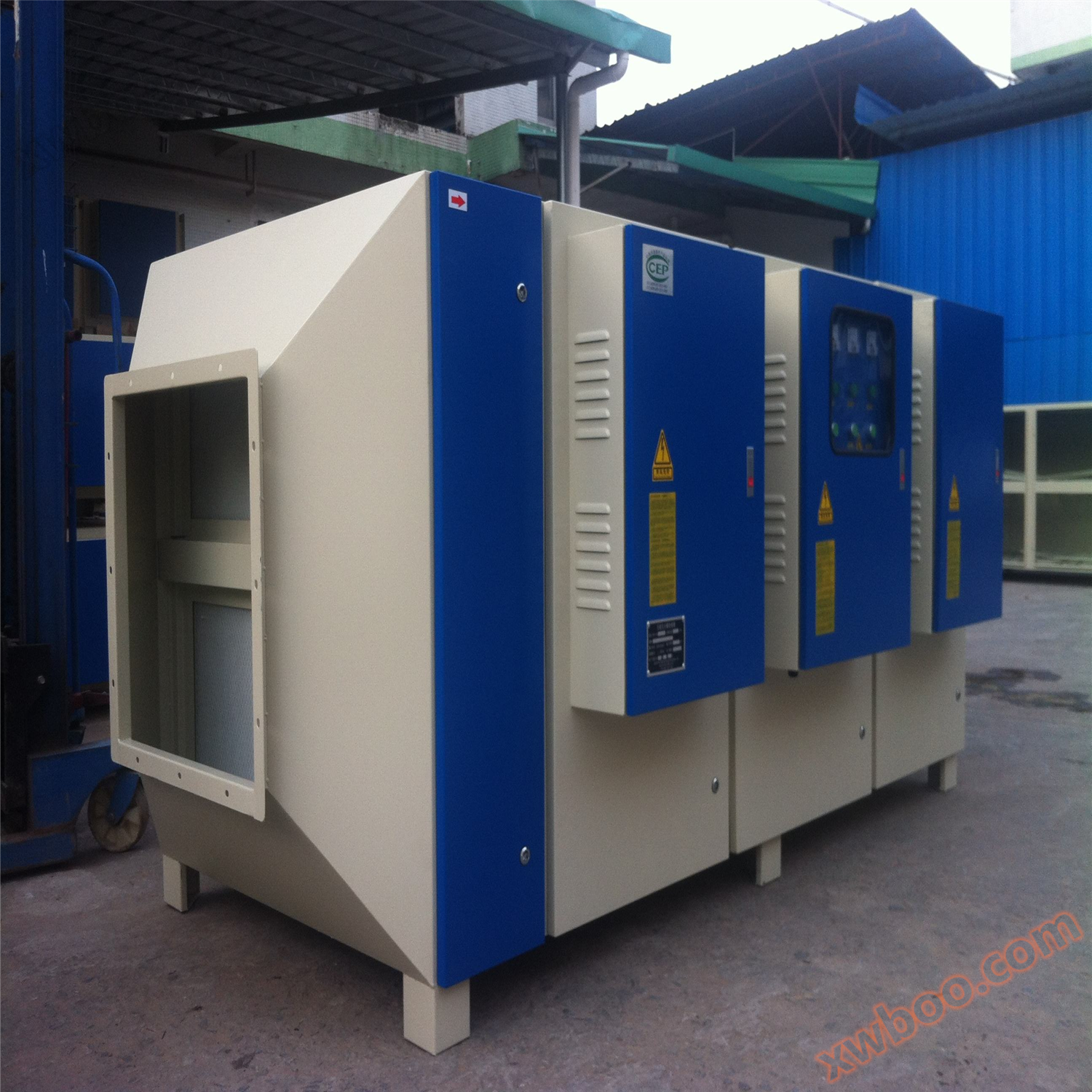
Plasma exhaust gas purification equipment
NegotiableUpdate on 11/03
- Model
- Nature of the Manufacturer
- Producers
- Product Category
- Place of Origin
Overview
Firstly, when the exhaust gas enters the equipment through the uniform flow plate filter cotton, it is discharged at high voltage and high frequency by the equipment, instantly generating a high voltage of 15000 volts to 20000 volts, which breaks down the exhaust gas.
Product Details
Equipment Introduction
Low temperature plasma technology is a new technology for exhaust gas treatment developed in recent years. The principle of low-temperature plasma treatment for exhaust gas is that when the applied voltage reaches the discharge voltage of the gas, the gas is broken down, producing a mixture including electrons, various ions, atoms, and free radicals. Low temperature plasma degradation of pollutants is the process of utilizing high-energy electrons, free radicals, and other active particles to interact with pollutants in exhaust gas, causing pollutant molecules to decompose in a very short period of time, in order to achieve the goal of degrading pollutants.
working principle
Firstly, when the exhaust gas enters the equipment through the uniform flow plate filter cotton, it is discharged at high voltage and high frequency by the equipment, instantly generating a high voltage of 15000 volts to 20000 volts, which breaks down the exhaust gas. During this stage, long-chain and multi chain waste gas molecules have weaker bond energies and weaker binding forces. It is easy to break through chemical bonds and transform into small molecule compounds, which is known as stage purification.

Secondly, water molecules and oxygen molecules entering the equipment with exhaust gas are broken down by high pressure, generating strong oxidizing groups such as hydroxyl groups and ozone molecules. These strong oxidizing groups come into full contact with waste gas molecules for oxidation, accelerating the reaction process. The entire reaction is clean and thorough, with high energy utilization and very high purification efficiency.
The plasma functional segment can stimulate the energy of pollutants, promote the breaking and recombination of molecular bonds of long-chain and multi chain pollutant molecules, and degrade difficult to treat pollutants into easier to treat low-carbon pollutants.
The plasma chemical reaction process is roughly as follows:

From the above reaction process, it can be seen that electrons first obtain energy from the electric field, and transfer the energy to pollutant molecules through excitation or ionization. Those pollutant molecules that obtain energy are excited, and at the same time, some molecules are ionized, thus becoming active groups. Then these active groups collide with oxygen and between active groups to generate stable products and heat.
In addition, high-energy electrons can also be captured by substances with strong electron affinity such as halogens and oxygen, becoming negative ions. These negative ions have excellent chemical activity and play an important role in chemical reactions.
Advantages of plasma technology:
In the low-temperature plasma generated by dielectric barrier discharge, the electron energy is high and can interact with almost all odorous gas molecules.
Quick response, not limited by gas velocity.
By using anti-corrosion materials, the electrode does not come into direct contact with the exhaust gas, fundamentally solving the problem of equipment corrosion.
Only electricity is needed, the operation is extremely simple, there is no need to send dedicated personnel to guard, and it basically does not occupy labor costs.
The device starts and stops very quickly, can be used and turned on as needed, and is not affected by temperature.
Small air resistance and mature technology.


