-
E-mail
market@czbkgz.com
-
Phone
13776809887
-
Address
Zhenglu Town Industrial Development Zone
Changzhou Baokang Drying Machinery Co., Ltd
In a few minutes, you can learn about the working principle and main structural components of the hollow blade dryer
Date: 2025-09-30Read: 88
Hollow blade dryer is a device that relies on indirect conduction heating to achieve material drying. Its design focuses on improving heat transfer efficiency and ensuring continuous operation. The following will provide a detailed introduction to the working principle and core structural composition of the device, providing reference for understanding the operating mechanism and component functions of the device.
1、 Working principle
The device uses indirect conduction heating as its core, and completes drying by fully contacting the material through dual heat transfer surfaces. The specific process is as follows:
•Thermal medium conductionThe heat medium (such as water vapor, hot water, or thermal oil, with a temperature of -40 ℃ to 320 ℃) is passed through a rotary joint into the shell jacket and hollow blade shaft, causing the shell wall and blade surface to heat up. This design increases the heat transfer area per unit volume, and the heat is mainly transferred to the material through solid contact, reducing air heat loss and only a small amount of heat is dissipated through the insulation layer.
•Material mixing and heat exchangeAfter the material enters the W-shaped shell from the feeding port, it moves under the push of the rotating hollow blade. The wedge-shaped structure of the blade allows for alternating compression and relaxation of the material, while flipping and mixing to update the contact interface with the heating surface, ensuring uniform heating; The relative motion between the material and the blade can also wash the blade and keep the heat transfer surface clean.
•Continuous drying and dischargingThe axial tilt angle of the blade causes the material to move along a spiral trajectory towards the discharge port, forming a continuous conveying. The discharge port baffle controls the material level inside the shell to ensure that the heat transfer surface is covered by the material; The residence time of the material can be adjusted by the feeding speed and blade speed (several minutes to several hours). After drying, the material is discharged from the discharge port, and the evaporated moisture is carried away by a small amount of gas and processed centrally.
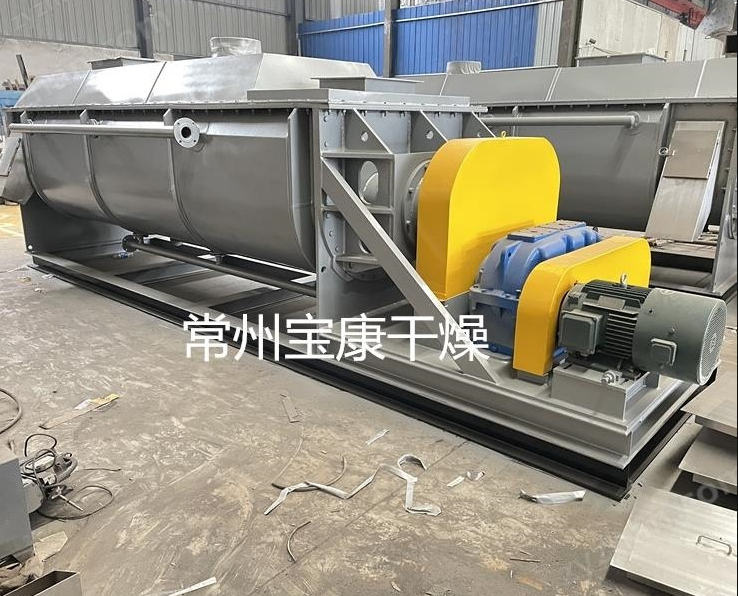
2、 Main structural components
The equipment structure is designed around heat transfer efficiency and material handling requirements, and the core components are classified as follows:
1. Main heat transfer structure
•W-shaped jacket shellThe end face is W-shaped, with the inner wall in contact with the material and the outer jacket forming a heat transfer surface through the heat medium. This structure expands the heat transfer area, guides material flow, and reduces dead corners; The top of the shell is equipped with a sealed cover, and end caps are provided at both ends to prevent dust leakage, collect volatile gases, and facilitate exhaust gas treatment.
•Hollow blade shaftUsually there are 2-4 hollow shafts with wedge-shaped hollow blades welded on the surface, both of which are heat transfer cores. The heat medium enters the shaft and blade through the rotary joint at the shaft end, and transfers heat through the surface of the blade; Some blades have scrapers at the bottom, which can scrape the material at the bottom of the shell and improve the uniformity of heat exchange; The number of shafts and blade arrangement are designed according to the processing capacity and material characteristics, with multiple shafts enhancing mixing and self-cleaning effects.
2. Drive and connection structure
•Transmission systemComposed of an electric motor, reducer, gear or sprocket, it drives the hollow blade shaft to rotate at low speed (10-40 revolutions per minute). Low speed operation ensures thorough mixing of materials while reducing equipment wear and energy consumption.
•rotary jointInstalled at both ends of the hollow blade shaft, it is a key component for the entry and exit of the heat medium. It can achieve a sealed connection between the fixed pipeline and the rotating shaft, ensuring stable transportation of the heat medium and avoiding leakage.
3. Material conveying and control structure
•Feeding and discharging deviceThe feeding port is connected to a spiral feeder to achieve quantitative continuous feeding; An adjustable baffle is installed at the discharge port to ensure heat transfer efficiency by controlling the material level; Some equipment is equipped with auxiliary mechanisms in the feeding, drying, and discharging areas to optimize the conveying rhythm.
•Auxiliary control componentsEquipped with temperature sensors, level gauges, and other monitoring components, it provides real-time feedback on parameters such as the temperature of the heat medium and the level of the material inside the shell. In conjunction with the control system, it adjusts the feeding speed, rotation speed, and heat medium flow rate to ensure stable drying; The outer shell is wrapped with insulation layer to reduce heat loss and energy consumption.