-
E-mail
gongyiyuhua@126.com
-
Phone
18623711598
-
Address
Yingyu Industrial Zone, Gongyi City
Gongyi Yuhua Instrument Co., Ltd. (Headquarters)
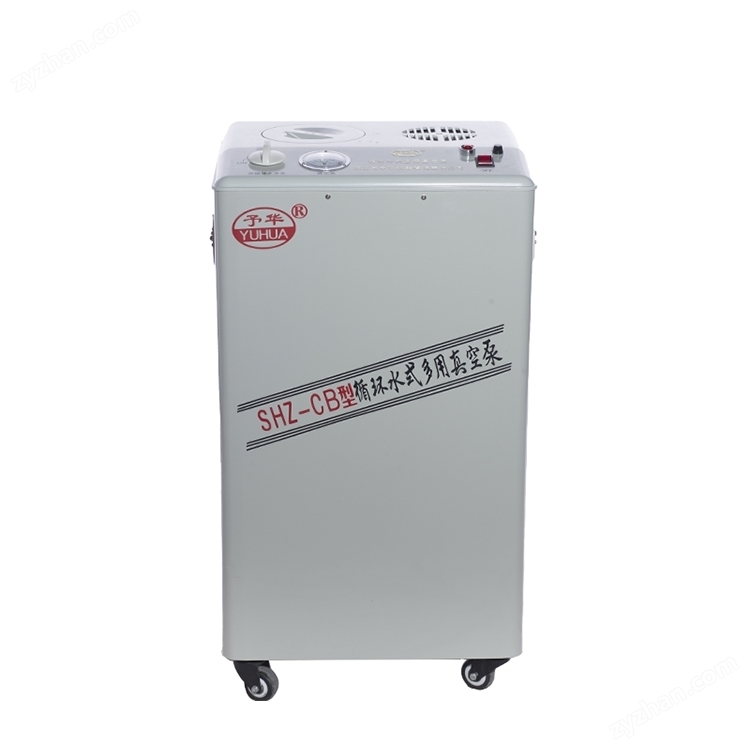
What is the process principle of laboratory circulating water vacuum pump?
Date: 2025-11-05Read: 8
The process principle of the circulating water vacuum pump is mainly based on the working mechanism of the water ring vacuum pump, which forms a water ring through the rotation of the impeller to achieve gas suction, compression, and discharge. The core process is as follows:
1. Rotation of impeller and formation of water ring
The motor drives the impeller to rotate eccentrically inside the pump casing, and the working water forms a closed water ring that rotates along the inner wall of the pump casing under the action of centrifugal force. Due to the eccentric installation of the impeller, the spatial volume between the water ring and the blades will periodically change.
2. Inhalation and compression
When the impeller blades rotate from the upper right to the lower right, the water ring moves outward, and the space volume between the two blades gradually increases, forming a low-pressure zone where gas is drawn in from the suction port. Subsequently, the blades rotate to the upper left, causing the water ring to move towards the axis, reducing the spatial volume and compressing the gas.
3. Exhaust and circulation
The compressed gas is discharged through the exhaust port, while the water ring continues to circulate and flow, playing a role in heat dissipation, sealing, and cooling. The working water needs to be regularly replenished to maintain the thickness and temperature stability of the water ring.
4. Key features:
Using water as the working medium is environmentally friendly and has low noise.
Continuous pumping is achieved through the "liquid piston" action of the water ring.
It is necessary to control the water temperature and speed to maintain the vacuum degree.