-
E-mail
zhoujun0588@163.com
-
Phone
15821628189
-
Address
No. 3869 Huaxia East Road, Pudong New Area, Shanghai: (By car: Central Huaxia Elevated Road: Turn around 50 meters from the exit of Chuannan Feng Road towards Pudong Airport)
Jiayi (Shanghai) Machinery Equipment Co., Ltd
Detailed explanation of the process flow and structural composition of plant pigment centrifuge
Date: 2025-12-27Read: 4
As the core equipment for natural pigment extraction, the high-efficiency separation performance of plant pigment centrifuge directly affects the purity and yield of the product. Shanghai Jiayi Machinery Equipment Co., Ltd. (hereinafter referred to as "Jiayi") has formed a unique advantage in the field of plant pigment centrifuges with years of technological accumulation. This article is based on industry common technology and the characteristics of Jiayi equipment, systematically analyzing its process flow and structural composition.
1、 Process flow: precise separation from raw materials to finished products
1. Raw material pretreatment stage
Crushing and cell wall breaking: Plant materials (such as marigold, chili, etc.) are crushed by a grinder to 80-100 mesh, and the cell wall structure is destroyed by mechanical shear force, releasing pigment components. For example, in the extraction of chili red pigment, the crushed raw materials need to undergo alkalization treatment to promote pigment dissolution.
Solid liquid separation: The crushed slurry enters the centrifuge pretreatment module and achieves rapid separation within 10 seconds at a speed of 3000-5000 rpm, with a solid residue rate of less than 0.5%, significantly improving subsequent extraction efficiency.
2. Solvent extraction and mixed mass transfer
Solvent selection: Select the extractant based on the polarity of the pigment. Fat soluble pigments (such as carotenoids) use ethyl acetate or tributyl phosphate, while water-soluble pigments (such as anthocyanins) use a water organic solvent two-phase system.
Mixing reinforcement: The solvent and raw material liquid are injected into the centrifuge drum in proportion, and the two phases are sheared into 50-200 μ m droplets by high-speed rotation at 8000-12000 rpm. The mass transfer interface area is increased by 5 times compared to traditional equipment, and the extraction efficiency is improved by more than 30%.
3. Separation and purification of supergravity field
Density gradient separation: Under centrifugal force field (separation factor exceeding 1000G), the denser heavy phase (containing impurities) settles towards the drum wall, while the lighter phase (containing pigments) gathers towards the center and is discharged through different outlets. For example, the GQ105 centrifuge can complete two-phase separation within 30 seconds with an emulsion entrainment rate of less than 0.1%.
Online monitoring and adjustment: Integrate pH and density sensors to adjust the extraction agent ratio in real time. In lutein extraction, by adjusting the pH to a weakly acidic environment, the solvent partition coefficient is increased to over 200, and the impurity removal rate reaches 99%.
4. Concentration and drying
Membrane concentration technology: The separated pigment solution is filtered through a membrane filtration system to remove large molecular impurities (such as proteins and cellulose), and then concentrated to the target concentration through a reverse osmosis membrane, with a solvent recovery rate of over 98%.
Low temperature drying: spray drying or vacuum drying is adopted, and the control temperature is ≤ 40 ℃ to prevent pigment denaturation, and the purity of the final product is more than 95%.
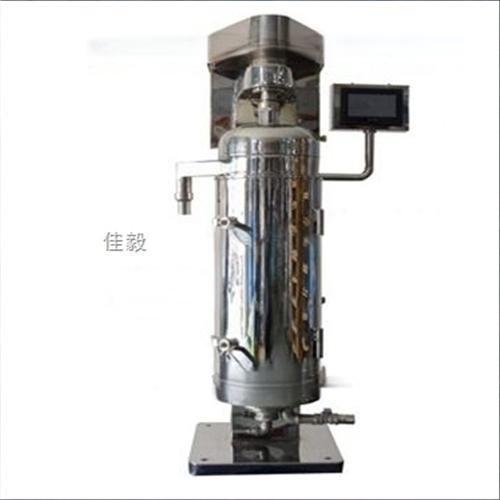
2、 Structural composition: Modular design supports efficient operation
1. Core separation unit
Drum system: made of 316L stainless steel material, with an inner diameter of 105-145mm, an effective length of 730mm, a maximum speed of 16000 rpm, a separation factor of 15000-15900 R.C.F, and the ability to process particles larger than 0.1 μ m.
Damping lubrication system: Oil free design to avoid pollution, lower damping structure to reduce vibration noise, suitable for GMP standard production environment.
2. Auxiliary function module
Feeding and discharging system: The feeding port has a diameter of 12 mm and the discharging port has a diameter of 38 mm. It is equipped with a peristaltic pump for continuous feeding and a liquid level sensor for automatic flow control.
Cooling device: Optional cooling coil, controlled at a separation temperature of -20 ℃ to 40 ℃ through an external cold source (such as liquid nitrogen), suitable for thermosensitive pigments.
3. Intelligent control system
PLC control panel: integrated frequency converter and braking unit, supporting one click setting of speed, time, and temperature parameters, with an error rate of less than 0.1%.
Safety protection device: equipped with overload protection, door lock interlock, and pneumatic brake system to ensure equipment stability during high-speed operation.