-
E-mail
sumcso@sumspring.com
-
Phone
15665715386
-
Address
16th Floor, Greenland Quanjing Yayuan Business Building, Yangguang New Road, Shizhong District, Jinan City
Jinan Sanquan Zhongshi Experimental Instrument Co., Ltd
Packaging tape initial adhesion tester: an important tool for adhesive quality
Date: 2025-12-23Read: 4
Packaging tape initial adhesion tester: an important tool for adhesive quality
In various fields such as modern logistics, product packaging, and medical health, packaging tape plays a crucial role as an auxiliary material. It not only ensures the stability and safety of the items during transportation, but also enhances the sealing and aesthetics of the packaging through its good adhesive properties. Whether used for food packaging preservation or industrial product damage and leakage prevention, the performance of packaging tape directly affects the protective effect of the product and the end user experience. Therefore, the quality control of packaging tape, especially its initial adhesion performance, has become an important indicator for measuring the qualification of products.
Why conduct initial adhesion testing on packaging tape?
Initial adhesion, as the name suggests, refers to the ability of adhesive tape to adhere to the adhesive surface upon initial contact. This performance is directly related to whether the tape can quickly and effectively adhere to the target surface, and is the most fundamental and critical part of evaluating the adhesive properties of the tape. For adhesive products such as stickers, labels, pressure-sensitive tapes, protective films, patches, and Babu pastes, insufficient initial adhesion may lead to problems such as weak adhesion and easy detachment, seriously affecting the product's effectiveness and consumer satisfaction. Therefore, conducting initial adhesion testing on packaging tape is an important means to ensure product quality and enhance market competitiveness.
Design of Three Station Rolling Ball Method
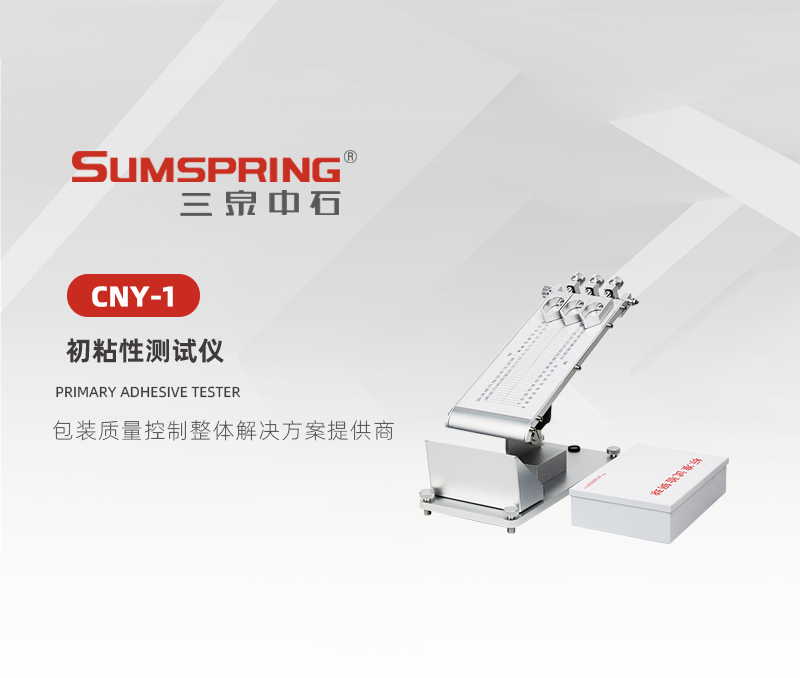
In order to meet the market's demand for efficient and accurate testing, the initial adhesion tester CNY-1 for packaging tape adopts a three station rolling ball method design. This design significantly improves testing efficiency, allowing users to test multiple samples simultaneously or continuously on the same instrument, greatly shortening the testing cycle. In addition, the three station independent control ensures the independence and accuracy of each test result, avoiding mutual interference.
Adjustable experimental angle: meets different testing needs
The packaging tape initial adhesion tester of Sanquan Zhongshi also has the function of adjustable test angle from 0-60 °, which greatly expands the testing range and enables suitable testing conditions to be found for packaging tapes with different adhesive strengths and application scenarios. By adjusting the test angle, different usage environments can be simulated, such as the adhesive effect under vertical, inclined, or specific inclined angles, in order to more comprehensively evaluate the initial adhesive performance of the tape.
Widely used in multiple fields
With its testing performance and wide applicability, the initial adhesion tester for packaging tape has become a testing equipment for pharmaceutical companies, adhesive manufacturers, quality inspection centers, drug testing centers, and other units. In the pharmaceutical industry, it helps ensure that the initial adhesion of medical materials such as plaster and Babu paste meets standards, ensuring patient safety during use; In the field of self-adhesive and packaging materials, it is an important part of the quality control system, ensuring the effectiveness and reliability of adhesive tape products in all aspects.
Detailed explanation of testing principle
The testing principle is based on the inclined rolling ball method, which precisely controls the angle of the inclined surface to allow a certain weight of steel balls to roll freely from the top of the inclined surface and briefly contact the adhesive surface of the test sample placed at the bottom of the inclined surface. Determine the initial adhesion strength of the sample based on the location where the steel ball stops rolling or is stuck to the sample, as well as the type of steel ball used (usually distinguished by diameter or weight). This method is simple, intuitive, easy to operate, and can accurately reflect the initial adhesion performance of the tape in practical applications.