-
E-mail
sumcso@sumspring.com
-
Phone
15665715386
-
Address
16th Floor, Greenland Quanjing Yayuan Business Building, Yangguang New Road, Shizhong District, Jinan City
Jinan Sanquan Zhongshi Experimental Instrument Co., Ltd
Working principle of medical adhesive tape peeling strength tester
Date: 2025-12-23Read: 3
Working principle of medical adhesive tape peeling strength tester
In the field of medical packaging, medical adhesive tape, as an auxiliary material, is widely used in wound dressing, fixing medical devices, fixing intravenous catheters, protecting surgical incisions, and other aspects. It not only requires good breathability and biocompatibility, but also needs to ensure that the adhesion on the patient's skin is stable and easy to control, in order to avoid discomfort or even injury to the patient due to too strong or too weak adhesion. Therefore, the peel strength test of medical adhesive tape has become an important part of evaluating its performance and ensuring medical safety.
Application of medical tape
The main function of medical patch tape is to provide stable fixation, help doctors accurately control the position of medical equipment during surgery or treatment, and protect patients' skin from external pollution or friction damage. Its materials are diverse, including non-woven fabric, polyurethane, silicone, etc., each with its specific application scenarios and advantages. For example, silicone tape is particularly suitable for sensitive skin or patients who require long-term fixation due to its low allergenicity and good breathability; Polyurethane tape is commonly used for fixing in humid environments due to its high strength and water resistance.
The importance of peel strength testing
Peel strength, which refers to the maximum force required for the adhesive tape to peel off from the surface of the adhered object, is one of the key indicators for measuring the adhesive performance of medical tape. Low peel strength may cause the tape to accidentally peel off during use, affecting the treatment effect; Excessive peel strength may cause pain or skin damage to patients during removal. Therefore, conducting peel strength testing on medical tape is not only to ensure its effectiveness in specific application scenarios, but also to ensure patient comfort and safety.
Working principle of medical adhesive tape peeling strength tester
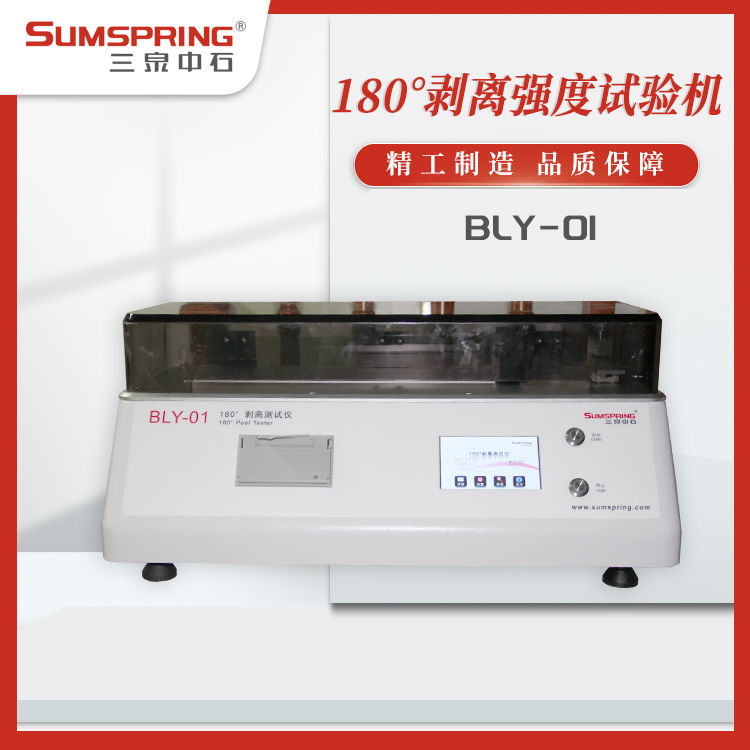
The BLY-01 medical adhesive tape peeling strength tester for Sanquan Zhongshi is a precision equipment specifically designed to evaluate the peeling performance of adhesive tape. During the testing process, first align the adhesive surface of the test sample with the standard experimental plate to ensure that the contact surface is flat and free of bubbles. Subsequently, use a standard roller to uniformly roll the sample three times, simulating the pressing process in actual use, to fully bond the tape with the experimental board. Afterwards, clamp the sample onto the peeling tester and perform the peeling operation at a 180 ° angle. During the peeling process, the force sensor will record and transmit real-time peeling force data. These data will be processed and divided by the peeling width of the sample to obtain the peeling strength value of the sample.
Advantages and Applications of Testers
The BLY-01 medical adhesive tape peel strength tester plays an important role in the medical field due to its high precision, high reliability, and wide applicability. It can not only accurately measure the initial viscosity force value of medical tape, but also ensure the accuracy and reliability of test data through the equipped excellent sensor technology. In addition, the device complies with international standards such as FINAT and ASTM, providing strong support for international certification of product quality. Therefore, it is widely used in various research centers, adhesive product enterprises, quality inspection centers, and medical institutions, becoming an important tool for ensuring medical safety and improving product quality.
In short, the medical adhesive tape peeling strength tester of Jinan Sanquan Zhongshi Experimental Instrument is a key equipment for evaluating the performance of medical adhesive tape, and its importance is self-evident. Through scientific and accurate testing, we can better understand the adhesion performance of medical tape, providing strong guarantees for the safety and effectiveness of medical processes.