-
E-mail
info@labcan.cn
-
Phone
18016316889
-
Address
No. 988 Jingtang Road, Jiading District, Shanghai
Kerun Experimental Equipment (Shanghai) Co., Ltd
Application of Omegawave Laser Doppler Blood Flow Meter in Blood Flow Monitoring Experiment of Type 2 diabetes Rats
Date: 2025-12-22Read: 5
Toshiya SatoteamPublished in《Am J Physiol Regul Integr Comp Physiol》JournalThe articleThe research content is:passUratananesthesia(Ethyl carbamate)And sympathetic nerve resection 2 Study on type 2 diabetes rats and non diabetes rats2 The relationship between impaired parotid parasympathetic vasodilation and reduced salivary secretion related to type 2 diabetes was analyzed.
summary
By using laser speckle imaging and saliva collection methodsUratanAnesthesia and sympathetic nerve resection 2 The relationship between the hemodynamics of three main salivary glands and salivary secretion was studied in type diabetes rats and non diabetes rats. In diabetes rats and non diabetes rats, lingual nerve stimulation can rapidly increase gland blood flow, and induce three glands to secrete saliva. Compared with non diabetes rats, diabetes rats have increased parotid blood flow and salivary secretionobviousReduce; But this phenomenon was not observed in other glands such as submandibular gland and sublingual gland. Although intravenous acetylcholine can increase parotid blood flow in a dose-dependent manner, this response in diabetes rats is lower than that in non diabetes rats. Similarly, in parotid gland of diabetes ratsM1andM3Muscarinic acetylcholine receptor(mAChRofmRNAThe expression level was also relatively lower than that of non diabetes rats. Our research results indicate that,2 Type 3 diabetes can damage the parasympathetic vasodilation function and salivary secretion function of parotid gland, which suggests that the disorder of cholinergic vasodilation pathway may be one of the potential mechanisms leading to the impairment of parasympathetic mediated vasodilation function of gland.
experimentMaterials and Instruments
(1) Experimental materials
laboratory animal
◦2 Type diabetes model rats:8-10Weeks of age (pre diabetes) and45-50Weeks old (chronic diabetes stage) maleOLETFRat, this rat is affected by cholecystokinin(CCK)-1 Lack of receptors leads to overeating and is induced by multiple recessive genes and testosterone regulation2 Type diabetes;
◦Non diabetes control rats: male of the same ageLETORats;
Experimental drugs
◦Anesthesia related: IsofluraneUratan
◦Muscle relaxant: Pancuronium bromide;
◦Neurotransmitters and solvents: Acetylcholine, sterile physiological saline;
◦Molecular biology reagents:TRIzol/mRNAReagentsFastStart Essential DNA Green MasterRegardingM1-M5 mAChRandβ -Actin actin(β-actin)Specific primers.
(2) Experimental instruments
1. Blood flow measuring instrument
Omegawave OZ-2Laser speckle flow imaging device:adopt780nmSemiconductor laser diffuse irradiation of glands to obtain two-dimensional blood flow mapsandThrough matchingpalletSoftware analysis area of interestofBlood flow signal;
Omegawave FLO-C1Laser Doppler flowmeter:Used to monitor changes in blood flow on the left side of the lower lip, all records undergo zero flow electrical calibration, and blood flow changes are measured in arbitrary units(a.u.)Expressed.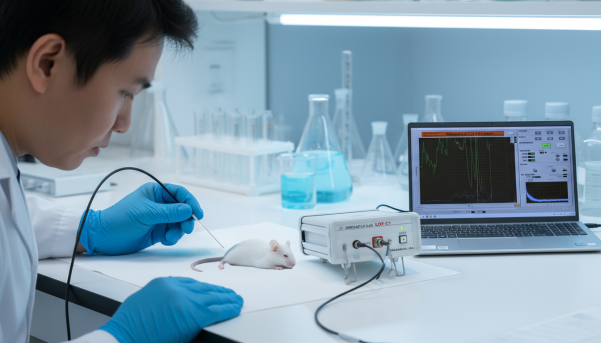
Omegawave FLO-C1Laser Doppler flowmeter

Omegawave OZ-2Laser speckle flow imaging instrument

Schematic diagram of electrical stimulation site, blood flow measurement site, and saliva collection method in rats
AThe stimulation site is the lingual nerve(LN)The central cut-off end.
B、CBlood flow measurement site:BThe image shows the measurement of parotid gland using laser speckle imaging technology(PG)Submandibular gland(SMG)And sublingual gland(SLG)Blood flow;CThe image uses a laser Doppler flowmeter(LDF)Measure the blood flow of the lower lip.
DSaliva secretion recording method: Collect saliva through a polyethylene catheter and a Walton tube; Place cotton balls in the mouth to collect saliva; Measure the mucosal humidity value using a humidity detection device.
Physiological parameter monitoring instrument
Small electrode blood glucose analyzer、ventilator、Infrared analyzer、Electronic stimulator.
Saliva and mucosal humidity detection instrument
Humidity detector、Polyethylene pipe, pre weighed cotton ball, precision balance.
Experimental Procedure
1. Animal preparation and anesthesia management
2. Weight and blood glucose measurement
Rats were fasted before the experiment 15 Weigh the patient after anesthesia with isoflurane at an hour; Tail vein blood collection approximately20μL, usingAntsense DuoBlood glucose analyzer detects fasting blood glucose, with each sample tested2 Take the average value.
3. Detection of glandular blood flow and vascular conductivity
Rat lying horizontally,Omegawave FLO-C1Laser Doppler flowmeterLaser irradiation on the three major salivary glands,Omegawave OZ-2Laser speckle flow imaging instrumentCollect scattered light to generate raw speckle images (reflecting the number of red blood cells)/Speed);LDFMonitor the blood flow on the left side of the lower lip.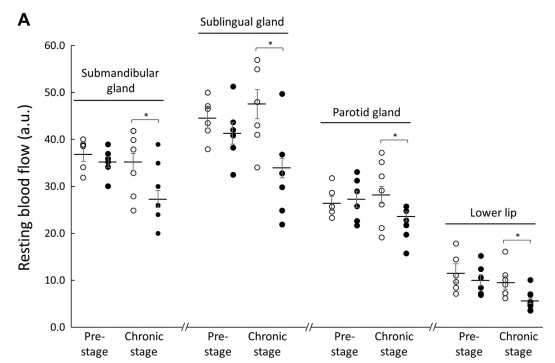
In diabetes rats (solid circle, sample size of each group n=6)And non diabetes rats (hollow circle, sample size of each groupn=6)Diabetes and diabetesOmegawave OZ-2Laser speckle flow imaging instrumentMeasure the resting blood flow of glands and lower lip [Any unit(a.u.)]
4. Tongue nerve stimulation and acetylcholine administration
5. Saliva secretion and measurement of oral mucosal humidity
6. real-timeRT-PCRdetectionmAChR mRNAexpression
7. statistical analysis
empirical conclusion
2 Type 3 diabetes mainly damages the parasympathetic vasodilation function and salivary secretion function of parotid gland, but has little effect on submandibular gland and sublingual gland; Dysregulation of cholinergic vasodilation pathway (especiallyM1TheM3 mAChRDecreased expression) is the potential mechanism of parotid parasympathetic nerve mediated blood flow increase and damage. Abnormal gland hemodynamics may be involved in diabetes related xerostomia(xerostomia)The occurrence.