-
E-mail
info@labcan.cn
-
Phone
18016316889
-
Address
No. 988 Jingtang Road, Jiading District, Shanghai
Kerun Experimental Equipment (Shanghai) Co., Ltd
Literature sharing | The effect of parasympathetic vasodilation mediated by trigeminal nerve input on facial temperature regulation
Date: 2025-12-30Read: 4

Department of Dentistry and Oral Biology, Department of Physiology, Hokkaido University of Health SciencesofHanako OhkeThe team is《The Journal of Physiological Sciences》A study was published in a journal. The aim of this study is to investigate the parasympathetic vasodilation mediated by trigeminal nerve input and its relationship with the cervical sympathetic trunk(CST)Induced sympathetic constriction of blood vessels in the face of the mouth (with a focus on the lower lip) blood flow(BF)And local temperature(Tm)Analyze its potential mechanism of action and the interaction between the two in depth.
summary
Skin temperature of the mouth and face(Tm)Will affect oral and facial function, and be related to blood flow(BF)Related. The increase in blood flow mediated by parasympathetic vasodilation may have significant implications for regulating facial temperature. Therefore, this study investigated the relationship between parasympathetic reflex vasodilation and oral and facial temperature in anesthetized rats. Electrical stimulation of the lingual nerve(LN)The central cut-off end can increase blood flow and temperature in the lower lip, while hexamethonium can weaken this increasing effect, while atropine has no such effect. Vasoactive intestinal peptide(VIP)Excitants can simultaneously increase blood flow and temperature in the lower lip. Activate the cervical sympathetic trunk(CST)It will lower the blood flow and temperature of the lower lip, but this lowering effect will be inhibited by stimulation of the lingual nerve. The research results indicate that parasympathetic vasodilation plays an important role in maintaining oral and facial hemodynamics and temperatureVIPPerhaps participated in this reaction process.
Keywords: parasympathetic reflex vasodilation; Tongue nerve; Cervical sympathetic trunk; Vasoactive intestinal peptide; skin temperature
experimentMaterials and Instruments
(1) Experimental materials
1. Experimental animals:42Only adult malesWistarrat
2. Medications: Isoflurane, Uratan, Pancuronium Bromide, Hexamethylammonium Bromide, Atropine SulfateVIPagonistAGP-8633Acetylcholine bromide, sterile physiological saline
(2) Experimental instruments
Omegawave OZ-1Laser speckle blood flowimagingceremony、Non-contact thermometer、Electrical stimulator、pressure sensor、Infrared analyzer、ventilator、data acquisition system、syringe pump、Binocular microscope
Omegawave OZ-EX1Laser speckle blood flowimagingceremony
Experimental Procedure
1. Animal preparationAfter induction of anesthesia with isoflurane, rats were subcutaneously injected with Uratan to maintain anesthesia. After animal tracheal intubation and intravenous injection of pancuronium bromide, use50%air and50%Artificially ventilate a mixture of oxygen gas to maintain the end expiratory carbon dioxide concentration at40 - 45 mmHgThe depth of anesthesia is achieved by pinching the toes2Second no flexion response, no nociceptive stimulation inducedSABPJudging by the increase in reflexivity, supplement with Uratan if necessary.
2. Cardiovascular parameters and local temperature measurement: ThroughOmegawave OZ-1Laser speckle blood flowimagingceremonyCollect blood flow images of the lower lip and left foot dorsal skin, and analyze the regions of interest using software(ROI)The average blood flow signal (in any unit)a.u.Representation); Non contact thermometer measures the local temperature of the lower lip.

Omegawave OZ-EX1Laser speckle blood flowimagingceremony
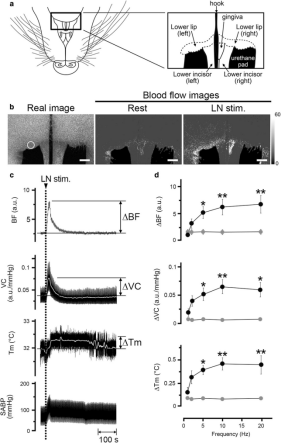
Left nerve(LN)After cutting off the central end, the lower lip, dorsum pedis skin, and mean arterial blood pressure were measured before and after electrical stimulation(SABP)The blood flow(BF)Vascular conductivity(VC)And skin temperature(Tm)Change situation
3. Neural electrical stimulationUnder binocular microscopy, unilaterally stimulate the central cutting end of the lingual nerve and the peripheral cutting end of the cervical sympathetic trunk, either alone or in combination. Bilateral transection of the cervical vagus nerve and superior cervical sympathetic trunk before stimulation to ensure detection of only non vagal parasympathetic effects.
4. pharmacological interventionMedication is administered intravenously through a syringe pump10minAfter administration, at least10minPerform electrical stimulation again to ensure blood flow andSABPReached a stable state. Calculate the percentage of reactions after intervention using the reactions before drug intervention as a control.
empirical conclusion
1. Frequency dependent electrical stimulation of the central cutting end of the lingual nerve(≥5Hz)Increase blood flow, vascular conductivity, and local temperature in the ipsilateral lower lipcontralateralThere is no effect on the skin of the lower lip and dorsum pedis, and this effect is related toSABPandHRThe change is unrelated and mainly mediated by parasympathetic reflex vasodilation.
2. Hexamethylammonium can inhibit the lower lip blood flow and temperature increase induced by tongue nerve stimulation, while atropine has no such effect, indicating that this parasympathetic vasodilation is a non cholinergic mediated response.
3. VIPExcitants can dose dependently increase lower lip blood flow, vascular conductivity, and local temperature, combined withVIPEvidence of expression in relevant ganglia and vascular innervated nerve fibers suggestsVIPPossible involvement in the non cholinergic parasympathetic vasodilation response in the oral and facial regions.
4. Frequency dependent electrical stimulation of the peripheral cut-off end of the cervical sympathetic trunk(≥1-2Hz)Reduce blood flow, vascular conductivity, and local temperature in the ipsilateral lower lip, which is caused by sympathetic vasoconstrictionSABPandHRChange is irrelevant.
5. Tongue nerve stimulation can inhibit the lower lip blood flow and temperature decrease induced by cervical sympathetic trunk stimulation, indicating that the parasympathetic reflex vasodilation mediated by trigeminal nerve input can compensate for the insufficient blood flow perfusion and temperature decrease caused by increased sympathetic nerve activity in the oral and facial regions, playing an important role in maintaining oral and facial hemodynamics and temperature stability.