-
E-mail
shouwang6368@126.com
-
Phone
18051034886
-
Address
No. 19, Tuanshan East Road, Lishui Economic Development Zone, Nanjing City
Nanjing Shouwang Machinery Equipment Co., Ltd
Automatic batching system: precise quantity control and efficient collaborative work
Date: 2025-09-29Read: 5
Automatic batching system: precise quantity control and efficient collaborative work
Automatic batching systemIt is a core production unit that achieves precise mixing of multiple materials in preset proportions through automated equipment, widely used in industries such as chemical, food, pharmaceutical, and building materials that require high precision, efficiency, and safety of ingredients. The quality of its work directly determines the final product quality, and it is necessary to focus on controlling the following 7 key points of work:
1、 Early stage: Matching material characteristics with system adaptability
Before adding ingredients, it is necessary to clarify the material properties to ensure that the system design is accurately adapted to the material characteristics, in order to avoid ingredient errors or equipment failures caused by improper adaptation
Material attribute analysis
Record key parameters of materials: particle size (powder/granules/small pieces), humidity (whether they are prone to moisture absorption and agglomeration), fluidity (whether they are prone to bridging and blockage), corrosiveness (whether anti-corrosion materials are required), flammability and explosiveness (whether explosion-proof design is required);
For example, flour in the food industry (prone to dust) needs to be equipped with negative pressure dust removal devices, corrosive liquids in the chemical industry need to be measured in stainless steel measuring tanks, and sand and gravel in the building materials industry (high wear) need to be transported by wear-resistant screw conveyors.
System selection and adaptation
Adaptation of measuring devices: For materials with good fluidity, choose "belt scale" or "spiral scale"; for viscous materials, choose "weighing module+mixing tank"; for liquid materials, choose "electromagnetic flowmeter" or "volumetric metering pump";
Adaptation of conveying equipment: Pipe chain conveyor/negative pressure suction machine is used for powder materials, and belt conveyor/bucket elevator is used for granular materials to avoid material residue or loss caused by incorrect selection of conveying equipment.
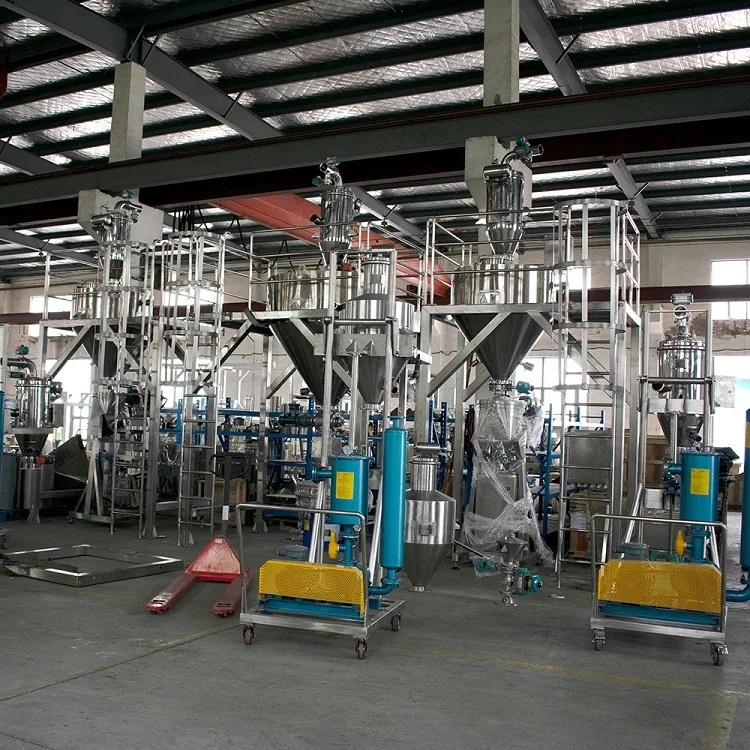
2、 Core: Full process control of ingredient accuracy
Accuracy is the core goal of automatic batching systems, and closed-loop management needs to be established from three aspects: measurement, control, and calibration
Accuracy guarantee of measuring devices
Select measuring equipment that meets production accuracy requirements: for example, the pharmaceutical industry requires weighing sensors with an accuracy of ± 0.1%, while the building materials industry can relax to ± 0.5%;
Installation specifications for measuring devices: The weighing module should be installed horizontally to avoid vibration interference (shock-absorbing pads can be added); Flow meters should be kept away from the pump body and valves to reduce errors caused by fluid disturbances.
PLC program precise control
Preset "segmented batching logic": For bulk materials (accounting for more than 50%), adopt the "fast feeding+slow replenishment" mode (such as adding 90% of the rated amount first, and then slowly replenishing to 100%) to avoid material overshoot;
Real time data feedback: The measurement data is transmitted in real-time to the PLC through sensors. If the deviation of a certain material's ingredient quantity exceeds the preset value (such as ± 0.3%), the system will automatically pause and alarm, and resume after manual confirmation.
Regular calibration and verification
Daily calibration: Before each shift, calibrate the measuring equipment with standard weights (for weighing devices) and standard flow meters (for flow meters), and record the calibration data;
Periodic verification: Conduct a monthly "comparison test between actual ingredient quantity and theoretical value". For example, if the theoretical ingredient is 100kg (A material 60kg+B material 40kg), the deviation after actual weighing should be ≤ the preset accuracy. Otherwise, troubleshoot equipment faults (such as sensor drift and belt slippage).
3、 Efficiency: Rhythm synergy in the ingredient process
To avoid "waiting style inefficiency", it is necessary to improve overall efficiency through "sequence optimization and device linkage":
Optimization of ingredient sequence
Following the principle of "large first, small second, dry first, wet second": first mix high proportion bulk materials (such as adding sand and gravel first, and then cement in building materials) to reduce uneven mixing caused by small materials being covered by bulk materials; Prepare dry materials first, then add liquid/viscous materials to avoid equipment sticking;
Parallel batching of multiple materials: If the system has multiple independent measuring units (such as multiple weighing tanks), different materials can be measured simultaneously (such as material A being measured in tank 1 and material B being measured in tank 2), and after measurement is completed, they can be synchronously discharged into the mixing equipment to shorten the total time.
Equipment linkage control
Establish a linkage logic of "loading metering unloading mixing": when the measuring tank completes the measurement of material A, the system automatically triggers the opening of the discharge valve and notifies the loading equipment to replenish the next batch of material A;
Avoid equipment idling: If the mixing equipment has not completed the previous batch of mixing, the system will automatically pause the subsequent material unloading to prevent material accumulation at the unloading port.
4、 Safety: Avoiding equipment and material risks
The automatic batching system involves electrical, mechanical, and material (some of which are flammable, explosive, or toxic), and requires the establishment of multiple layers of safety protection:
Equipment safety protection
Mechanical protection: Conveyor equipment (such as belts and chains) should be equipped with protective covers, limit switches for measuring tanks/mixing tanks (to prevent overpressure/over liquid level), and emergency stop buttons should be accessible within a range of 1.5m around the equipment;
Electrical safety: Explosion proof motors, PLCs, and cables should be selected for explosion-proof scenarios (such as chemical engineering), with equipment grounding resistance ≤ 4 Ω to avoid accidents caused by static electricity accumulation.
Material safety control
Toxic/corrosive materials: Sealed measuring tanks and pipelines are used for transportation, and operators need to wear gas masks/anti-corrosion gloves. Emergency eye wash stations and sprinkler systems are installed around the equipment;
Flammable and explosive materials: The system needs to be anti-static (such as pipeline grounding, conductive treatment of non-metallic components), and the use of components that are prone to sparks (such as iron scrapers) is prohibited. Combustible gas detectors should be installed on site.
Abnormal emergency handling
Preset fault handling logic: If the material is blocked (the sensor detects that the measuring tank is not discharging), the system will automatically start the vibrator (or reverse conveying) to clean it. If it is not resolved within 10 seconds, the machine will stop and give an alarm;
Manual emergency access: In case of system failure, operators can cut off hazardous equipment (such as closing the feed valve or stopping the motor) through "manual mode" to prevent the accident from escalating.
5、 Cleaning: prevent cross contamination of materials
Especially in the food and pharmaceutical industries, "no cross contamination" is a mandatory requirement, and equipment cleaning and residue control need to be done well:
Standardization of cleaning process
Batch cleaning: After completing each batch of ingredients, clean the measuring tank, discharge valve, and conveying pipeline (dry materials are blown with compressed air, and viscous/liquid materials are rinsed with clean water/special cleaning agents);
Material replacement and cleaning: Before changing the type of material, a "cleaning verification" must be carried out (such as wiping the inner wall of the pipeline with white gauze and no visible residue; or sampling and testing for residual content ≤ 10ppm). Only after the cleaning is qualified can the next batch be started.
Adaptation of cleaning equipment
Easy to clean design: The inner walls of measuring tanks and pipelines should be smooth (roughness Ra ≤ 0.8 μ m) to avoid dead corners; Choose quick installation pipeline connections (such as clamp connections) for easy disassembly and cleaning;
Special cleaning device: The food industry can install a "CIP online cleaning system" (in-situ cleaning), which automatically flushes the inside of the equipment with high-temperature and high-pressure cleaning solution, reducing manual operation.
6、 Monitoring: full process data visualization and traceability
Realize "traceability and analyzability" through data monitoring, facilitating problem troubleshooting and process optimization:
Real time monitoring and alarm
The central control room is equipped with a monitoring interface: real-time display of various material measurement values, equipment operating status (such as motor current, valve switch), abnormal information (such as accuracy exceeding the standard, equipment failure), alarm information needs to be prompted by sound and light and recorded;
Key parameter over limit control: If parameters such as measurement accuracy, mixing time, and equipment temperature exceed the time limit, the system will automatically pause and lock, requiring manual confirmation of the cause before unlocking.
Data tracing and analysis
Data storage: Record the "material name, batch number, measurement data, operator, equipment status, and time" of each batch of ingredients, and the data storage time must comply with industry standards (such as pharmaceutical industry storage for ≥ 3 years);
Data analysis: Regularly (such as weekly) calculate the accuracy qualification rate of ingredients and equipment failure rate, analyze the reasons for deviations (such as frequent accuracy exceeding the standard of a certain material, which may be due to sensor aging), and optimize accordingly (such as replacing sensors).