-
E-mail
shouwang6368@126.com
-
Phone
18051034886
-
Address
No. 19, Tuanshan East Road, Lishui Economic Development Zone, Nanjing City
Nanjing Shouwang Machinery Equipment Co., Ltd
Unpacking and feeding equipment: One click bag release, intelligent control feeding operation guide
Date: 2025-09-29Read: 5
Unpacking and feeding equipment: One click bag release, intelligent control feeding operation guide
Unpacking and feeding equipmentUsing the entire process
1、 Preparation before operation
Equipment inspection
Mechanical part: Check whether the disassembly machine blades, fixtures, conveyor belts and other components are intact, without looseness or wear.
Electrical system: Confirm that the motor, sensors, and control cabinet wiring are normal and there is no risk of leakage or short circuit.
Safety device: Test the emergency stop button, safety light barrier, and protective door interlock function to ensure immediate shutdown in case of malfunction.
Dust removal system: Check if the bag filter and dust collection pipeline are unobstructed to avoid dust leakage.
Material preparation
Ton bag/small bag inspection: Confirm that the packaging bag is not damaged, damp or clumped, and avoid getting stuck during feeding.
Preprocessing: Pre dry materials that are prone to moisture absorption, such as cement and fertilizers; Crushing large pieces of material (such as ore).
Batch record: Scan the QR code of the packaging bag or record the batch number for quality traceability.
Environmental confirmation
Ventilation conditions: Ensure good ventilation around the equipment and that the dust concentration meets occupational health standards (≤ 8mg/m ³).
Space cleaning: Remove debris around the feeding port to prevent interference with equipment operation.
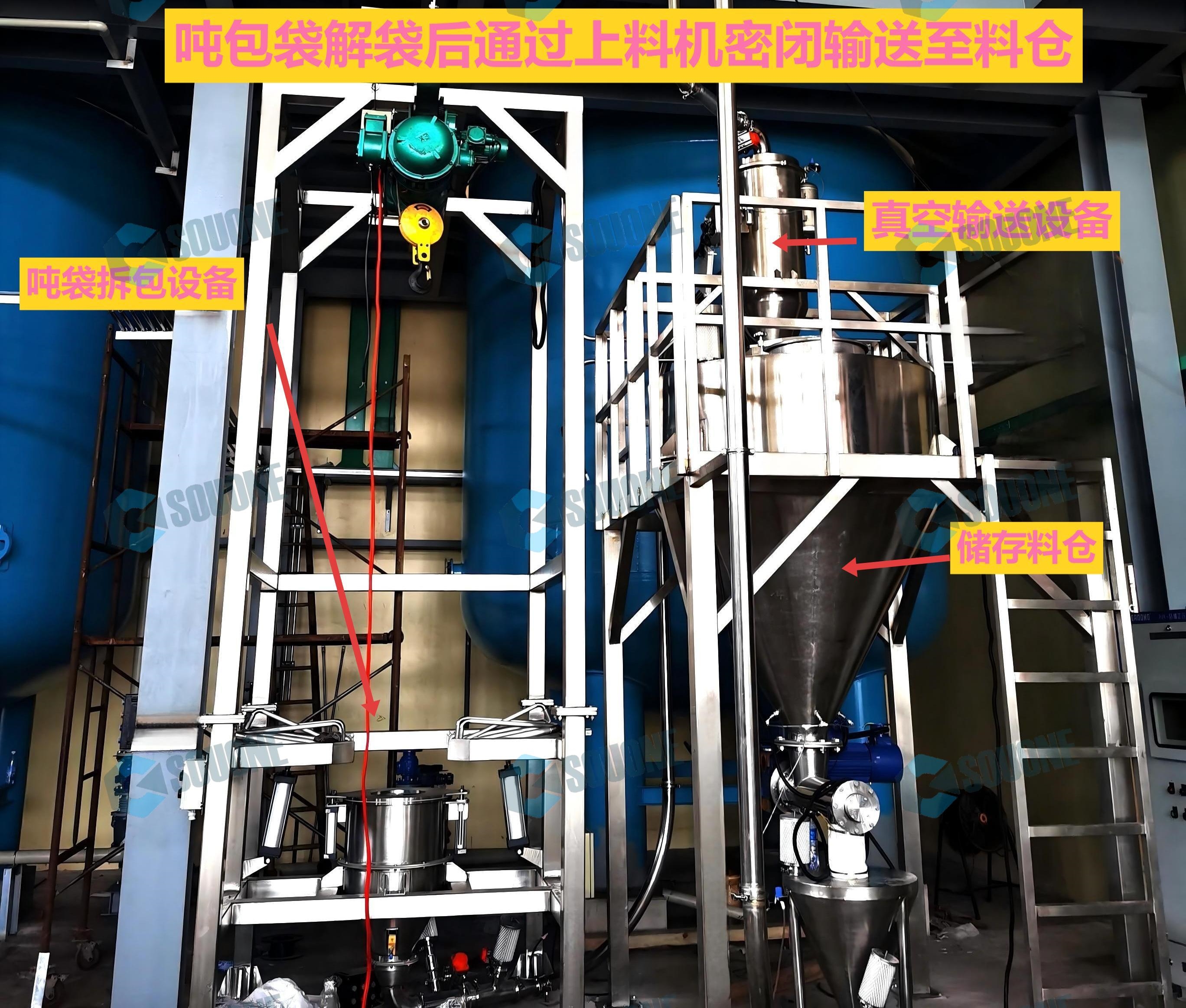
2、 Startup and commissioning of unpacking and feeding equipment
Power on preheating
Start the power supply of the control cabinet, preheat the motor, sensors and other components (the preheating time needs to be extended in winter).
Check the device status through HMI (Human Machine Interface) and confirm that there are no alarm messages.
Parameter Settings
Feeding speed: Adjust the conveyor belt/screw speed (usually 50-200r/min) according to the flowability of the material (such as powder or particle).
Cutting force: For thick or multi-layer bags, increase blade pressure; For thin bags, reduce pressure to prevent damage.
Dust removal parameters: Set the pulse dust collector injection interval (usually 10-30 seconds/time) and pressure (0.4-0.6MPa).
No load trial operation
Start the equipment and observe whether the chain and conveyor belt run smoothly without any abnormal noise or jamming.
Test the suction of the dust removal system to ensure that there is no dust overflow from the feeding port.
3、 Feeding operation steps
Ton bag feeding process
Lifting positioning: Use a crane or forklift to lift the ton bag above the unpacking machine, and fix the bag opening with hooks or fixtures.
Automatic opening: Start the cutting device, the blade cuts open the bottom or side of the bag, and the material falls into the hopper below by gravity.
Vibration assistance: For viscous materials, turn on the vibrator to promote feeding and prevent blockage.
Empty bag handling: After the feeding is completed, the empty bags are automatically folded or compressed and sent out through a conveyor belt.
Small bag feeding process
Manual bag removal: The operator wears a dust mask, cuts open the small bag with scissors, and pours it into the feeding hopper.
Automatic bag breaking (optional): Some equipment is equipped with a small bag breaking machine, which automatically cuts open the bag opening by rotating the blade.
Screening and impurity removal: The material is sieved through a vibrating screen to remove impurities such as paper scraps and thread ends.
Material transportation and mixing
Pneumatic conveying: Powdered materials are transported to storage tanks through Roots blowers or air compressors.
Screw conveying: Granular materials are transported to the mixer through a screw conveyor.
Online mixing: When feeding multiple materials, uniform mixing is achieved through pipeline mixers or static mixers.
4、 Operation monitoring and adjustment
Real time data monitoring
View parameters such as feeding amount, equipment speed, and dust removal efficiency through HMI or SCADA system.
When the deviation between the actual feeding amount and the set value exceeds 2%, an alarm will be triggered.
exception handling
Card: Immediately stop the machine and clean the blocked materials in the feeding port or conveying pipeline.
Blade wear: Replace the passivated blade and adjust the cutting pressure.
Dust removal failure: Check if the bag is clogged, clean or replace the filter bag.
dynamic adjustment
Adjust the vibration frequency or heating device temperature according to changes in material humidity.
Reduce the conveying speed and minimize frictional static electricity for highly active materials such as flammable dust.
5、 Shutdown and maintenance
Normal shutdown
After the feeding is completed, wait for the materials inside the equipment to be emptied, and then turn off the conveying, dust removal, and motor power in sequence.
Clean up residual materials at the feeding port to prevent clumping.
Emergency shutdown
Press the emergency stop button to immediately cut off the power and investigate the cause of the malfunction (such as personnel entering by mistake or equipment overheating).
routine maintenance
Cleaning: Clean the dust inside the equipment every week to avoid material accumulation affecting accuracy.
Lubrication: Apply lubricating grease to the chain and bearings every month to reduce wear.
Calibration: Calibrate the weighing sensors and flow meters quarterly to ensure accurate measurement.
Spare Parts Management
Reserve vulnerable parts such as blades, filter bags, and conveyor belts, and establish an inventory warning mechanism.
Record equipment failure history and optimize maintenance plans accordingly.