-
E-mail
GXM7788@126.COM
-
Phone
13958337766
-
Address
Xinqiao, Xiangshan County, Ningbo City, Zhejiang Province
Ningbo Xuming Pharmaceutical Equipment Co., Ltd
Structure and process flow of secondary reverse osmosis equipment
Date: 2025-07-21Read: 8
The secondary reverse osmosis equipment uses a two-stage series reverse osmosis (RO) membrane treatment process to deeply remove dissolved salts, organic matter, and particles from water, significantly improving the purity of the produced water. It is widely used in the fields of pharmaceuticals, electronic ultrapure water, and drinking pure water preparation. The core structure and process flow are as follows:
1、 Core structure composition
1. Preprocessing unit
Multi media filter: filled with quartz sand, anthracite and other filter materials, removes suspended solids and colloids (accuracy 5-10 μ m), reduces turbidity and SDI pollution index.
Activated carbon filter: adsorbs residual chlorine, odors, and organic matter (reducing residual chlorine to<0.1mg/L) to prevent oxidation of the RO membrane.
Softener (optional): Replace calcium and magnesium ions (hardness<1mg/L) with cation resin to prevent fouling on the membrane surface.
Security filter: 5 μ m precision filter element intercepts residual particles and protects the RO membrane.
2. Reverse osmosis host unit
First level RO system:
The high-pressure pump (pressure 1.0-1.5MPa) drives the raw water to pass through the primary membrane group (such as CPA3 low-pressure composite membrane).
Membrane module arrangement: often connected in series in a 2:1 ratio (e.g. 6 8-inch membranes), with a desalination rate of 90% -95% and a recovery rate of about 75%.
Secondary RO system:
The secondary high-pressure pump (pressure 0.8-1.2MPa) sends the first stage produced water into the secondary membrane group (such as ESPA2/3 ultra-low pressure membrane).
• Membrane module arrangement: Series in a 1:1 ratio (e.g. 3 8-inch membranes), with a desalination rate>98% and a recovery rate of approximately 85%.
3. Auxiliary system
Chemical dosing unit:
Scale inhibitors (such as FLOCON260) prevent membrane fouling (dosage 1-2.4mg/L).
NaOH adjusts the pH of the primary water to 7.8-8.5 to promote the removal of CO ₂.
UV sterilizer: 254nm wavelength kills bacteria (sterilization rate>99%).
Cleaning system: including cleaning box, pump, and 5 μ m filter, regularly cleaning membrane pollutants.
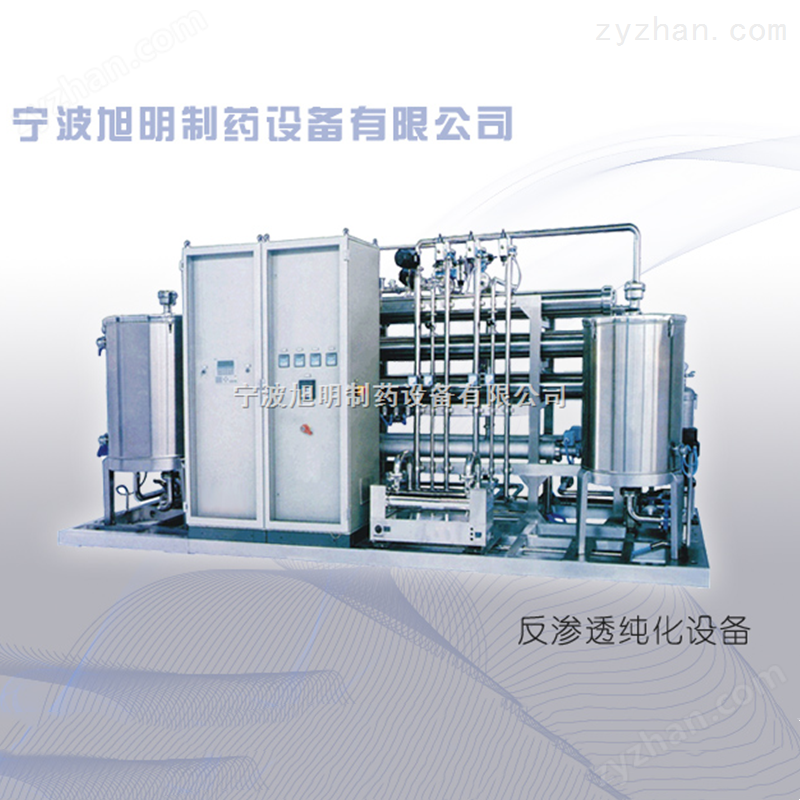
2、 Process flow
1. Preprocessing stage
The raw water undergoes physical filtration (sand filtration, carbon filtration) and chemical softening (if necessary) to reduce SDI to<5, meeting the RO membrane inlet requirements.
2. First level reverse osmosis
At a pressure of 1.0-1.5MPa, the conductivity of the first stage produced water decreases to 20-50 μ S/cm, removing most ions and organic matter. The discharge rate of concentrated water is about 25%.
3. Intermediate processing
The primary produced water enters the intermediate water tank, undergoes UV sterilization to inhibit microbial growth, and NaOH is added to adjust the pH.
4. Secondary reverse osmosis
The secondary RO further desalinates the water, with a conductivity of less than 10 μ S/cm (up to 1-5 μ S/cm) and a SiO ₂ content of less than 0.02mg/L, meeting the standards for high-purity water.
5. Post processing (optional)
EDI Electrodeionization: Deep desalination, with a water production resistivity of 15-18M Ω· cm.
Ozone/UV: Terminal disinfection to ensure sterile water quality.