-
E-mail
fengjunjie@noozle.com.cn
-
Phone
13918684639
-
Address
Building 4, 3255 Shengang Road, Songjiang District, Shanghai
Nuoze Fluid Technology (Shanghai) Co., Ltd
Don't just focus on pressure, what is the selection of micro jet homogenizer? These are crucial
Date: 2025-12-19Read: 3

What are the models of microjet homogenizers? How to choose?
Don't just focus on pressure,These are crucial
As a core process equipment in industries such as pharmaceuticals, chemicals, new energy, and new materials, micro jet homogenizers can quickly achieve high standard nanoscale dispersion homogenization with ultra-high pressure jet technology.
The selection of micro jet homogenizers can be based on four core principles: "process adaptation, compliance, cost control, and long-term stability", combined with material characteristics, production needs, industry standards, and other multidimensional comprehensive judgments. The following are detailed key factors for selection, taking into account both professionalism and practicality:
Core Process and Material Characteristics
1.1 Key attributes of materials
Accurate matching is required based on material characteristicsviscosity(低粘度水溶液、中高粘度凝胶 / 浆料)、hardness(Soft biological agents, hard mineral materials)solid content(Low and high solid content slurries) andchemical properties(Corrosive, heat sensitive), etc;
For example, when dealing with high viscosity or high solid content slurries, large channel feeding design and ultra-high pressure (above 200MPa) models can be selected; When handling heat sensitive materials such as vaccines, enzyme preparations, cell wall breaking, active proteins, and collagen, priority should be given to selecting models with jacket cooling systems to control the temperature rise during homogenization and avoid loss of material activity; When dealing with corrosive materials (such as acidic and alkaline solutions, organic solvents), it is necessary to use core components made of corrosion-resistant materials such as 316L stainless steel, PTFE lining, or diamond to prevent equipment corrosion and material pollution.
1.2 Process Objective Requirements
For the process objectives, precise selection should be made based on homogeneous particle size, uniformity requirements, and processing capacity
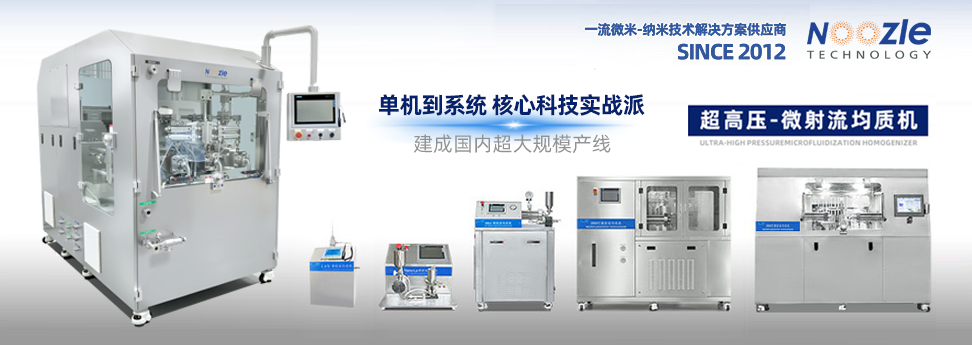
If preparation is requiredNano scale products (10-100nm, such as liposomes, nanoemulsions, etc.)It is necessary to choose ultra-high pressure and cooperate with multi-channel interactive cavity design to ensure uniform and extremely narrow particle size distribution;Scenarios with high requirements for batch stabilityIn the pharmaceutical industry, it is necessary to choose models with pressure fluctuations of ≤ ± 1% and support precise parameter control to ensure consistent particle size distribution of different batches of products; At the same time, according toproduction scaleSelect the corresponding processing capacity models (laboratory research and development type, pilot type, large-scale production type, ultra large scale production type), and reserve 10% -20% production capacity margin to cope with process optimization or order fluctuations.
Core Process and Material Characteristics
Industry compliance and cleanliness standards
Pharmaceutical/Medical Aesthetics Industry:To meet GMP certification requirements, production equipment must have CIP (online cleaning) and SIP (online sterilization) functions, with no hygiene blind spots; Contact material components must comply with food grade/pharmaceutical grade material standards such as 316L stainless steel and zirconia ceramics; Support the recording and traceability of process parameters (pressure, flow rate, temperature) to meet FDA and EMA compliance requirements.
Energy and Chemical/New Materials Industry:When dealing with flammable and explosive materials, explosion-proof models (Exd II BT4 level or above) should be selected; When dealing with volatile and corrosive gases, it is necessary to choose a model with excellent sealing performance to prevent leakage.
Biomedical industry:To meet the requirements of biosafety level, the equipment must have anti cross contamination design (such as disposable channels, sterile packaging) to avoid material contamination.
Cosmetics/Food and Beverage Industry:The material must be certified by FDA and NSF, non-toxic, harmless, and easy to clean; To avoid the risk of material residue in the equipment, a quick detachable structure is preferred for easy daily cleaning and disinfection.
Equipment performance, material and configuration
3.1 Pressure and flow stability
When the pressure is met, priority should be given to brand models with small pressure fluctuations (± 1%) and uniform flow to ensure product batch consistency; At the same time, pay attention to high-pressure sealing technology to avoid pressure leakage.
3.2 Core Component Types and Material Lifespan
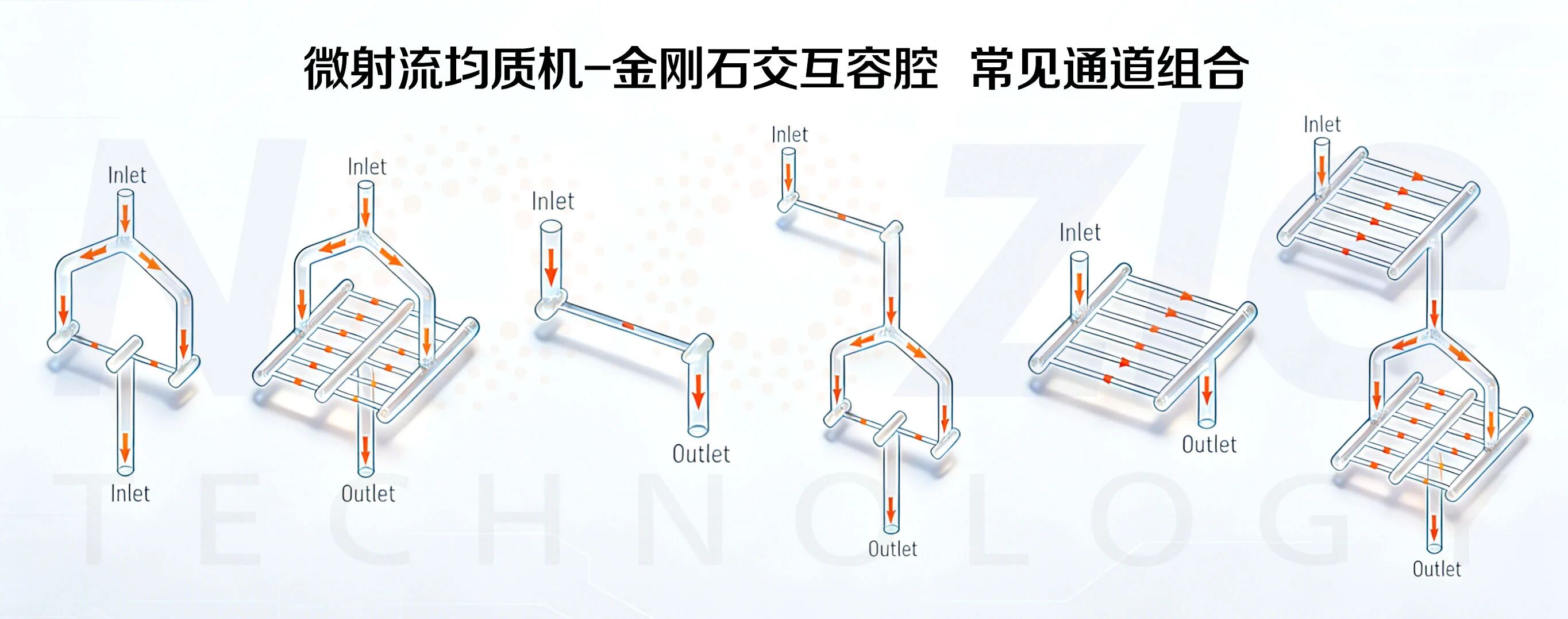
Diamond interactive cavity is the core component of microjet homogenizer, which can be divided into different diamond microchannel structures based on their internal characteristics”Y "cavity," Z "cavity," EC "cavityAccording to the different requirements of material processing technology and dispersion effect in the processing industry, make reasonable choices (the common combinations are shown in the figure below, consult equipment manufacturers for more information), while paying attention to the replacement cycle of vulnerable parts.
3.3 Temperature control
Clarify temperature management requirements and understand equipment cooling methods; When handling heat sensitive materials, check the cooling efficiency of the equipment and whether the outlet temperature can be controlled within the required range.
3.4 Control and Automation Level
Detailed understanding of internal software functions, such as precise setting of process parameters, real-time monitoring and alarm, and automated operation, as well as full process data recording and traceability to meet compliance requirements; At the same time, it has friendly human-computer interaction and multi system integration expansion functions, adapting to the production needs of industries such as medicine, materials, and food.


Manufacturer and after-sales service
4.1 Initial Procurement Cost
Select suitable models based on actual process requirements; Compare the cost-effectiveness of different manufacturers, rather than simply looking at prices (low-priced models may have hidden costs such as frequent replacement of vulnerable parts and high energy consumption).
4.2 Post maintenance costs
了Understand the prices and replacement frequency of core and vulnerable components; Pay attention to whether the equipment is easy to disassemble and maintain, reducing downtime.
4.3 Depreciation and Residual Value
Choose a brand with mature technology and good reputation, as equipment depreciation is slow and residual value is higher.
Cost investment and operational considerations
5.1 Manufacturer's Strength
Priority should be given to manufacturers who have been deeply involved in the industry for many years and possess core technologies such as homogeneous chamber design, pressure control technology, and temperature control technology, as their equipment has better stability; Check if the manufacturer has any relevant industry cases (such as nano drug preparation cases in the pharmaceutical industry, carbon nanotubes in the energy materials industry, dispersion cases of ceramic slurries, injection type collagen dispersion cases in the medical beauty and cosmetics industry, etc.)
5.2 After sales service
Confirm whether the manufacturer provides on-site installation, debugging, and operation training (especially compliance operation and maintenance training); Understand the warranty period and repair response time; Do you provide spare parts inventory guarantee to avoid long-term downtime due to missing parts.
5.3 Customization Capability
If there are special process requirements (such as multi material switching, special material homogenization), can the manufacturer provide customized solutions (such as replaceable non-standard homogenization chambers, special material customization, etc.).
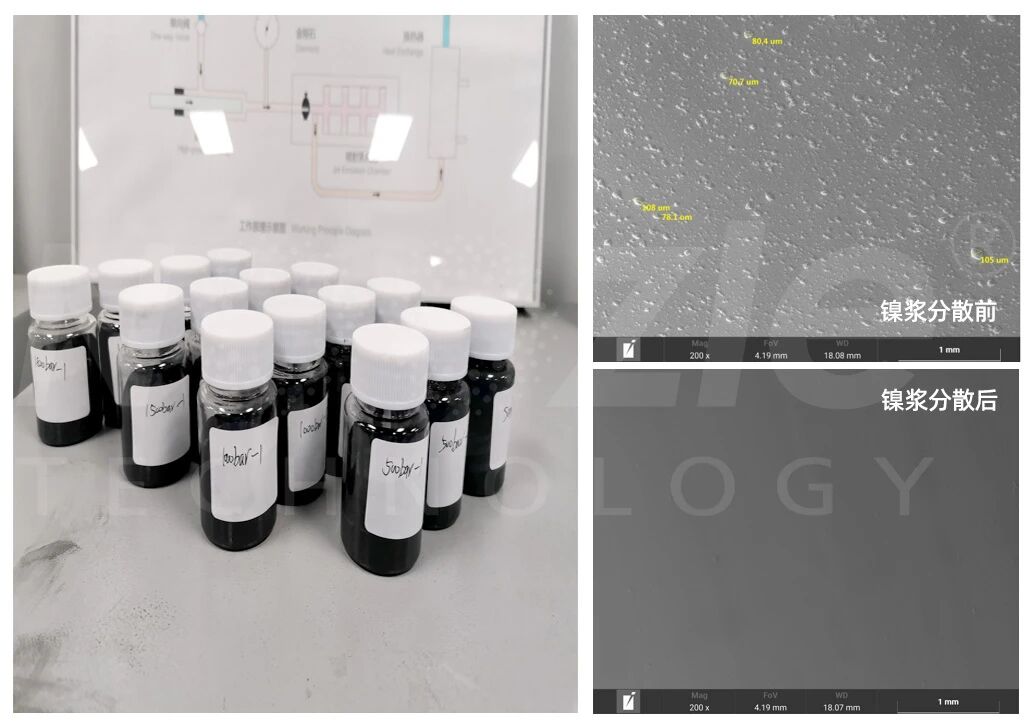
Experimental type only requires 1ml or more
Production type can reach 1000L/H
