-
E-mail
fengjunjie@noozle.com.cn
-
Phone
13918684639
-
Address
Building 4, 3255 Shengang Road, Songjiang District, Shanghai
Nuoze Fluid Technology (Shanghai) Co., Ltd
Study on the effect of homogenization technology on the physical stability of nutrient grade nano liposomes loaded with high oleic acid palm oil
Date: 2025-08-29Read: 5
Study on the effect of homogenization technology on the physical stability of nutrient grade nano liposomes loaded with high oleic acid palm oil
1、 Introduction
This article belongs to the special topic of micro jet homogenizer application, with a total of 3800 words. It will take about 20 minutes to read
summary
This study systematically compared the effects of three preparation techniques, namely microjet homogenization, ultrasound, and rotor stator, on the physical stability of high oleic palm oil (HOPO) nanoliposomes. The results showed that the nanoliposomes prepared by microjet homogenization technology had excellent physical stability, with the smallest average particle size (100.3 ± 1.7 nm) and low polydispersity index (0.13 ± 0.01); The samples prepared by ultrasonic technology showed the best colloidal stability (Zeta potential -55.9 ± 0.8 mV). The study also found that the addition of HOPO significantly improved the storage stability of nanoliposomes. After 35 days of storage at 4 ℃, the particle size growth of samples containing HOPO was reduced by 40% compared to the control group. This study provides important technical references for the efficient delivery of functional oils and fats in the food industry
Keywords
Nano liposomes; Microfluidic homogenization; High oleic palm oil; Physical stability; Zeta potential; Particle size distribution; Response surface optimization of food delivery system
2、 Overall framework
The overall framework of this article is as follows:

3、 Introduction
High oleic palm oil (HOPO) is a functional oil rich in bioactive components. Its high content of beta carotene (up to 500-700 mg/kg) and natural antioxidants such as vitamin E not only have important nutritional functions, but also enhance the stability of liposome membranes through synergistic effects with phospholipid molecules.
The main preparation techniques for current nanoliposomes includeMicro jet homogenizationUltrasonic treatment and rotor stator dispersion, etc. among which,Micro jet homogenization technology has demonstrated advantages in industrial production due to its efficient particle size control capability and good process repeatabilityUltrasonic technology is known for its simple equipment and low cost; The rotor stator technology has significant advantages in handling high viscosity systems. However, there is still insufficient comparative research on these three technologies in terms of energy efficiency, product stability, and active ingredient protection.
Based on this, this study used response surface methodology to systematically optimize the preparation process parameters, focusing on investigating the effects of three technologies: microjet homogenization, ultrasound, and rotor stator on the physical stability of HOPO nanoliposomes. By characterizing key indicators such as particle size distribution, Zeta potential, and polydispersity index, combined with storage stability experiments, a structure-activity relationship of process structure performance is established to provide theoretical basis and technical support for the industrial application of functional lipid nanocarriers.
4、 Basic process
Preparation of crude liposomes
Raw material mixing
Mix soybean lecithin (containing 16% phosphatidylcholine, 14% phosphatidylethanolamine, 10% phosphatidylinositol, 34% triglycerides) with high oleic palm oil (HOPO) according to the experimental design ratio.
Hydration Process
Temperature control: 35 ℃ constant temperature stirring (1000 rpm, 10 min)
Water phase addition: Slowly add Milli-Q pure water
Primary Homogenization: High Speed Homogenizer (Ultra Turrax T25, 20000 rpm, 12 min)
Product features: Formation of multi-layer vesicles (MLVs) with particle sizes ranging from 1-5 μ m
Micro jet homogenization treatment
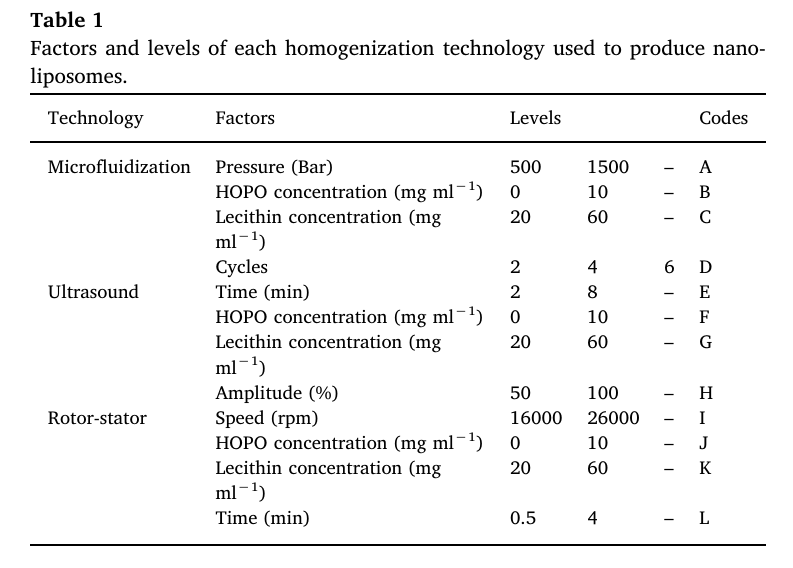
Process the crude liposome sample in a micro jet homogenizer using a 75 μ m Z-shaped interaction chamber; Adjust the particle size by changing the pressure (500-1500 bar) and the number of cycles (2-6 times). During the entire process, use an ice water bath to control the suspension temperature to<35 ° C.
ultrasonic treatment
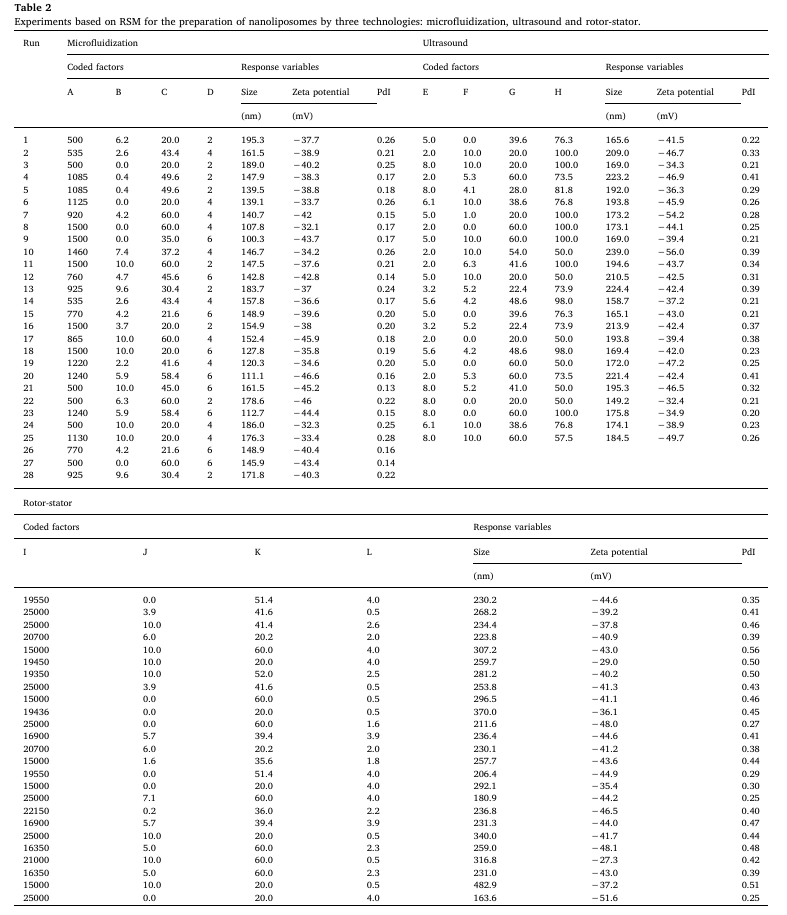
Take 80 mL of crude liposome suspension and place it in a 100 mL beaker. Use ultrasonic waves (1/2 "probe, 20 kHz) to treat it according to the" time (min) "and" amplitude (%) "designed in Table 2; Ice water bath temperature control<35 ° C.
Rotor stator processing
Continuously circulate the crude liposome suspension through the rotor stator system, and adjust the speed (15000-25000 rpm) and processing time (0.5-4 min) according to the design in Table 2; The temperature control of the 2 ° C water circulation system is less than 35 ° C.
5、 Results and Discussion
1. The influence of homogenization technology on the characteristics of nanoliposomes
All three techniques can prepare nano liposomes with a particle size of ≤ 200 nm.
The particle size obtained by microjet (MF) is the smallest and most concentrated (100.3 nm lower, PdI=0.13), which can be precisely controlled by adjusting pressure and cycle number.
Ultrasound (US) can reduce the particle size to 149.2 nm, but PdI is slightly higher (0.20), mainly affected by ultrasound time and amplitude.
The particle size obtained from the rotor stator (RS) is the largest and the smallest is 163.6 nm, and the PdI can reach 0.25, which is dominated by the speed and processing time.
Zeta potential stability: US (-55.9 mV)>RS (-51.6 mV)>MF (-46.6 mV).
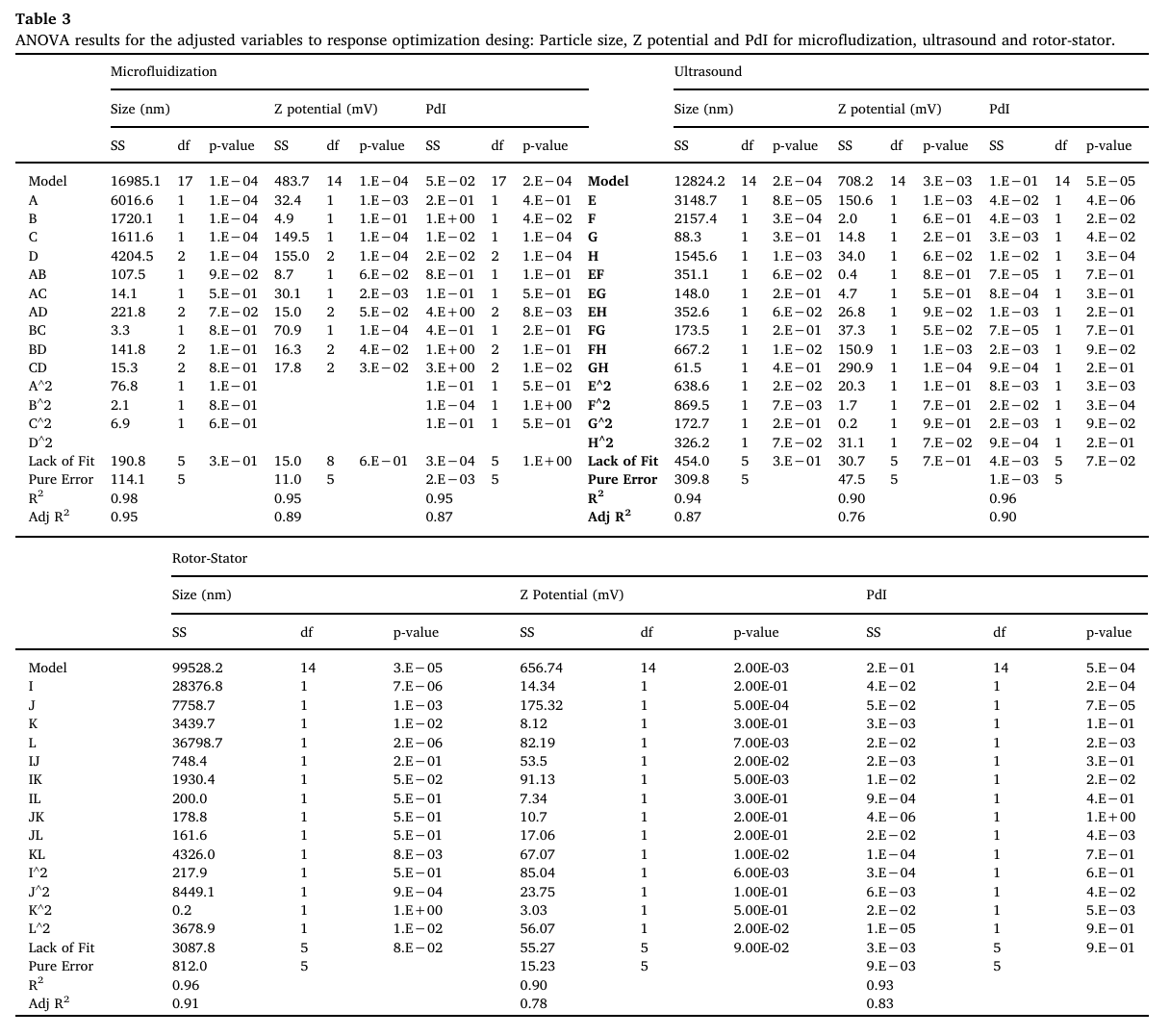
Establish RSM models for all technologies and conduct analysis of variance (ANOVA). Only retain significant models with p<0.05; The R ² of all models is>0.90, and the mismatch term p>0.05, indicating that the models fit well and can be used for prediction.
The influence of microjet homogenization on the stability of nanoliposomes
Particle size: significantly decreases with increasing pressure and number of cycles; The maximum pressure (1500 bar)+6 cycles can yield 100.3 nm. An increase in oil concentration leads to an increase in particle size (long-chain oleic acid inserts into the phospholipid bilayer), while an increase in phospholipid concentration leads to a decrease in particle size (forming more vesicles). Zeta potential: ranging from -32.1 to -46.6 mV, in the high stability range. An increase in pressure and cycle times can weaken the potential, possibly due to oxidation or air contamination. Increasing oil concentration can maintain a more negative potential, which is speculated to be related to its synergistic effect with antioxidant components such as phospholipids. PdI:0.13–0.28, All<0.3 indicate a highly uniform system; Increasing the number of cycles can significantly reduce PdI.
The effect of ultrasound on the stability of nanoliposomes
Particle size: decreases with prolonged ultrasound time and increased amplitude; 10 min、 149.2 nm can be obtained at 100% amplitude. Increasing oil concentration also increases particle size. Zeta potential: Overall between -32.4 and -55.9 mV, in the high stability region. Long term ultrasound reduces the absolute value of the potential, which may be related to the promotion of phospholipid hydrolysis/oxidation by free radicals generated by cavitation. PdI: decreases with increasing ultrasound time and amplitude; The stronger cavitation effect caused by longer processing time and higher amplitude helps to homogenize the particle size.
The influence of rotor stator factor on the stability of nanoliposomes
Particle size: decreases with increasing rotational speed and processing time; The maximum speed (25000 rpm)+4 minutes can reduce the particle size to 163.6 nm. The influence trend of oil concentration and lecithin concentration on particle size is consistent with the above two techniques. Zeta potential: ranging from -27.3 to -51.6 mV, overall still highly stable. PdI:0.25–0.56, Significantly higher than the previous two techniques, indicating a wider particle size distribution; Increasing the speed and time can improve uniformity to a certain extent.
Optimization and storage physical stability of nanoliposomes
Perform secondary optimization on three technologies using RSM:
The goal is to minimize particle size, absolute Zeta potential, and PdI; On this basis, further increase the HOPO loading to investigate its impact on stability.
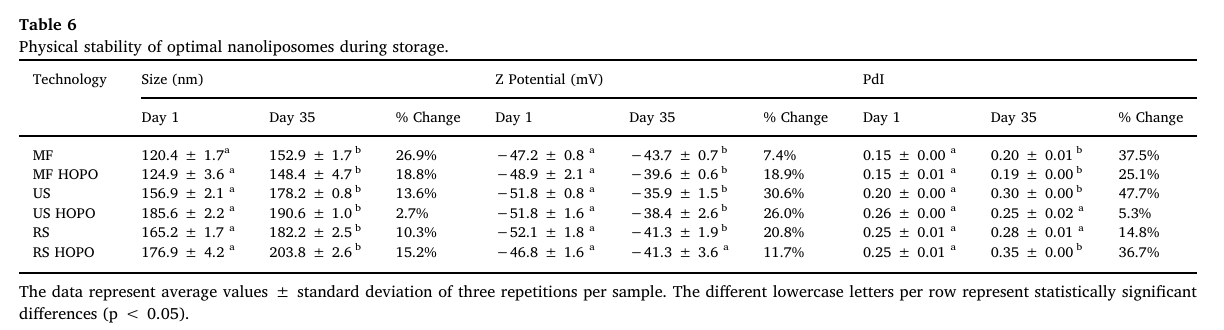
Store the obtained optimal formula at 4 ° C for 35 days, and take samples every 7 days to measure particle size, Zeta potential, and PdI (Table 6).
Particle size variation:
The particle size of the samples prepared by MF and US remained below 200 nm throughout the entire storage period. The particle size of the high oil load US sample showed the smallest increase (only 2.7%), while the RS high oil sample showed the largest increase (15.2%).
Zeta potential change:
The absolute value of the potential of high oil load MF samples decreased significantly (18.9%); The decrease in US and RS samples is smaller (≤ 26%), indicating that high oil concentration can improve potential stability to a certain extent.
PdI variation:
The PdI of MF and US samples remains<0.3, maintaining a high degree of uniformity; The PdI of RS samples increases to 0.35 at high oil loading, and the distribution tends to be uneven.
Observation by Transmission Electron Microscopy (TEM)
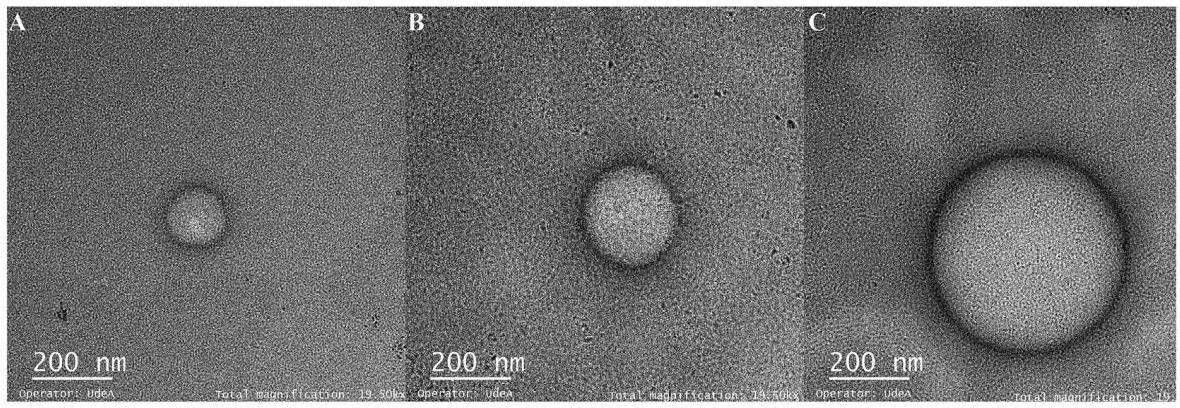
The nano liposomes prepared under optimal conditions have a spherical single-layer vesicle structure, and the particle size is consistent with the DLS results, further verifying that all three techniques can obtain nano scale liposomes
The content of β - carotene in MF and US liposomes
β - carotene is easily degraded by heat.
The HPLC results showed that the content of β - carotene in the crude liposome suspension was 6.49 × 10 ⁻³ mg mL ⁻¹. After micro jet treatment, the retention rate was 92.9% (a decrease of 7.09%); After ultrasonic treatment, the retention rate was 61.2% (a decrease of 38.83%).
This indicates that microjet technology has the least damage to β - carotene, which may be related to the local instantaneous high temperature caused by ultrasound.
VI. Conclusion
The response surface methodology (RSM) was used to systematically optimize the process and formulation of three homogenization techniques - microjet (MF), ultrasound (US), and rotor stator (RS) - in the preparation of high oleic palm oil (HOPO) nanoliposomes.
Micro jet technology exhibits excellent overall performance within the investigated range, achieving the minimum particle size (≈ 100 nm) and low polydispersity index (PdI<0.15), with the best system uniformity. All three techniques can prepare nano liposomes with a particle size of<200 nm, which meets the definition of "nano liposomes".
By optimizing the HOPO loading, it was found that increasing the oil content can significantly enhance the physical stability of liposomes during storage at 4 ° C for 35 days
Under micro jet and ultrasound conditions, the particle size growth, absolute decrease in Zeta potential, and PdI amplification of high oil samples are lower than those of low oil samples.
The results indicate that the antioxidant components (such as β - carotene) in HOPO have a synergistic antioxidant effect with phospholipid bilayers, thereby delaying liposome aggregation and oxidative degradation.
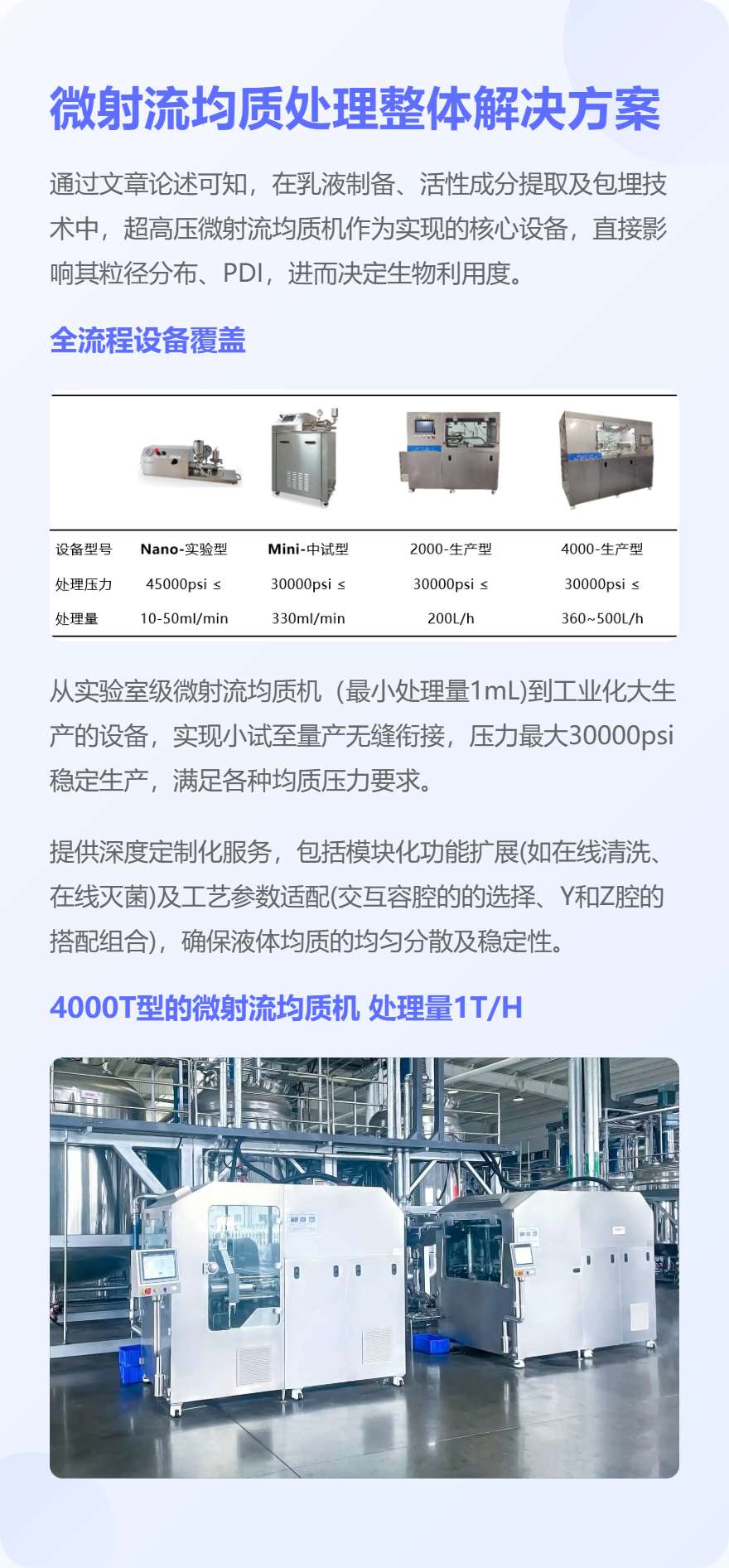
Integrated solution for micro jet homogenization treatment
References
[1]Juan David Beltrán, Ricaurte L , Estrada K B ,et al.Effect of homogenization methods on the physical stability of nutrition grade nanoliposomes used for encapsulating high oleic palm oil[J]. LWT, 118[2025-08-09]. DOI:10.1016/j.lwt.2019.108801.