-
E-mail
fengjunjie@noozle.com.cn
-
Phone
13918684639
-
Address
Building 4, 3255 Shengang Road, Songjiang District, Shanghai
Nuoze Fluid Technology (Shanghai) Co., Ltd
Study on the mechanism of micro jet homogenizer for crushing nano particle clusters
Date: 2025-11-14Read: 5
Study on the mechanism of micro jet homogenizer for crushing nano particle clusters
1、 Introduction
This article belongs to the special topic of micro jet homogenizer application, with a total of 42000 words. It will take about 20 minutes to read.
summary
Micro jet homogenizerIt can efficiently depolymerize nano silica clusters into aggregates of about 150 nanometers.Its crushing mechanism is mainly erosion, and the final fineness is determined by the material itselfThe study found that the energy required to achieve depolymerization (manifested as operating pressure and processing times) increases with the increase of particle concentration or liquid viscosity, with the increase in viscosity being more significant due to the suppression of turbulence. This equipment has high power density, and can even transform gel like dispersion under high concentration into low viscosity Newtonian fluid, showing strong dispersion ability.
keywords
Micro jet homogenizer; Dispersion of nanoparticles; Fracture; crack; depolymerization
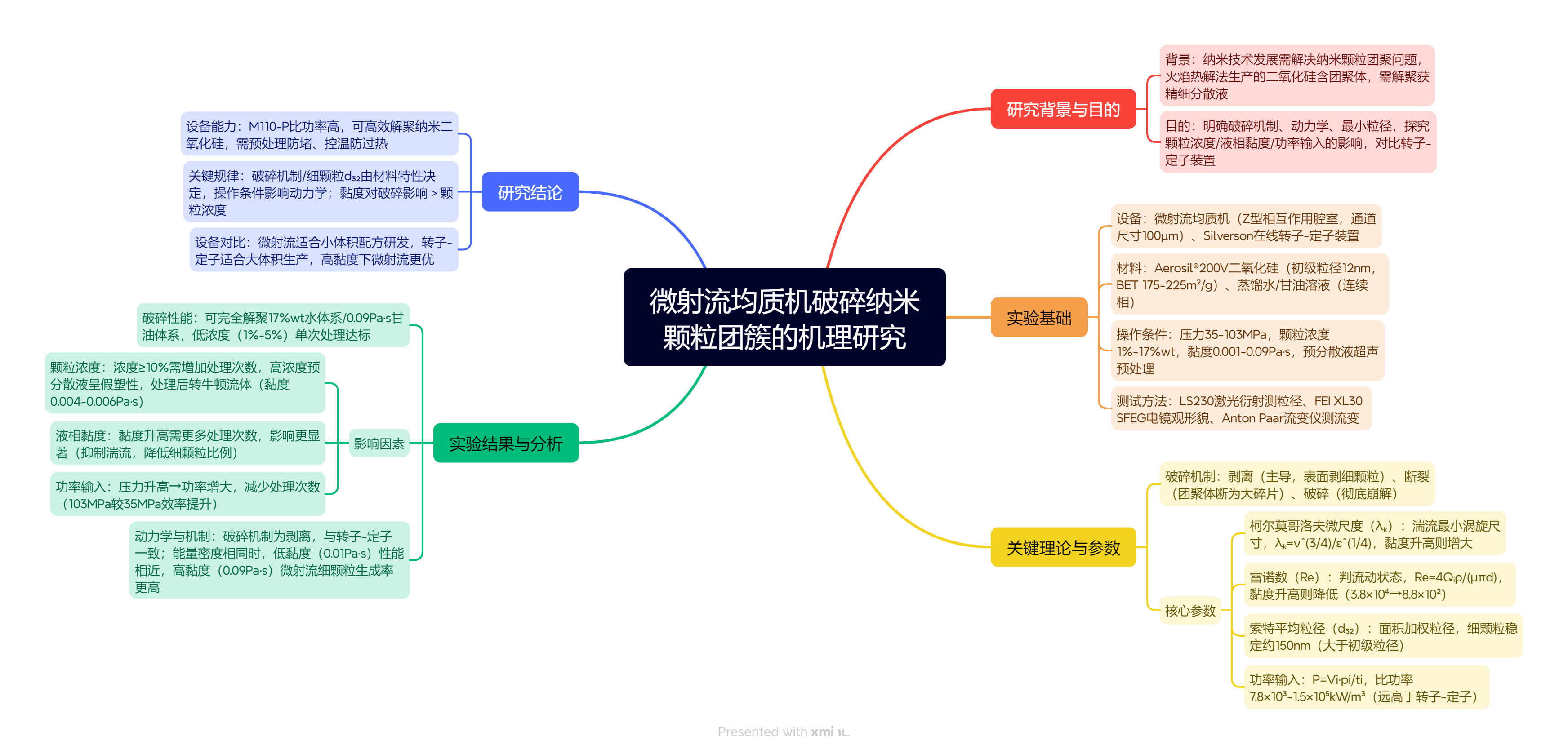
2、 Overall framework
3、 Introduction
Microfluidic processors, as high power density devices, are widely used in processes such as lotion, suspension, cell fragmentation and nano material synthesis. With the rapid development of nanotechnology, achieving efficient dispersion (de aggregation) of nanoparticles in liquids has become a key step in their commercial application.
However, the large-scale production of nanoparticles usually adopts flame pyrolysis method, and the obtained powder is composed of agglomerates and aggregates formed by primary particles.
Conventional agitators cannot achieve sub micron dispersion effects, so it is necessary to rely on high-strength equipment such as rotor stator devices and high-pressure homogenizers. The aim of this study is to systematically evaluate the performance, mechanism, and kinetics of a commercial microjet processor in depolymerizing nano silica clusters, in order to provide a basis for process design and scaling up.

Terminology explanation
| English terminology | Chinese translation | definition |
|---|---|---|
| Rupture | fracture | The process in which an aggregate fractures under external force and is divided into several larger fragments. This article lists erosion and fragmentation as the three main fragmentation mechanisms of nanoparticle clusters, with each mechanism corresponding to unique particle size distribution evolution characteristics. |
| Erosion | erosion | The process of continuously peeling off small particles (usually primary particles or small aggregates) from the surface of aggregates through fluid shear force. Research has confirmed that this is the treatment of Aerosil with Microfluidizer M110-P ® 200V silica clustersDominant fragmentation mechanismAnd it is consistent with the observation results of the rotor stator equipment. |
| Shattering | broken | Refers to the instantaneous disintegration of aggregates into a large number of widely distributed fragments under high stress. This article considers it as a potential cluster fragmentation mechanism, which leads to significant differences in the evolution of particle size distribution compared to fracture and erosion. |
| Kolmogorov microscale (λ ₖ) | Kolmogorov microscale | The minimum vortex scale in turbulence is characterized by the formula (λ ₖ=ν^ {3/4}/ε ^ {1/4}). This study suggests that,An increase in continuous phase viscosity will lead to an increase in lambda ₖThis increases the scale of turbulent eddies, thereby weakening their efficiency in breaking down nanoclusters. |
| Reynolds number (Re) | Reynolds number | The dimensionless number used to determine the fluid flow state is calculated using (Re=4Q_i ρ/(μ π d)) in this study. Data analysis shows that,An increase in continuous phase viscosity will significantly reduce Re(For example, from 3.8 × 10 ⁴ to 8.8 × 10 ²), causing the flow to transition from turbulent to laminar, which is the main reason for the slowing down of fragmentation kinetics in high viscosity systems. |
| d₃₂ (Sauter mean diameter) | Sauter mean diameter | The area weighted average algorithm is used to characterize the equivalent diameter of the specific surface area of a particle swarm. The results of this study indicate that under different operating conditions (pressure, concentration, viscosity), Aerosil ® After crushing at 200V, its fine particlesD ∝₂ is stable at approximately 150 nmThis size is recognized as the limit that mechanical crushing can reach (aggregate size), much larger than its primary particle size of 12 nm. |
4、 Basic process
| project | content |
|---|---|
| core equipment | Microfluidic homogenizer (Z-shaped interaction chamber, channel size 100 µ m)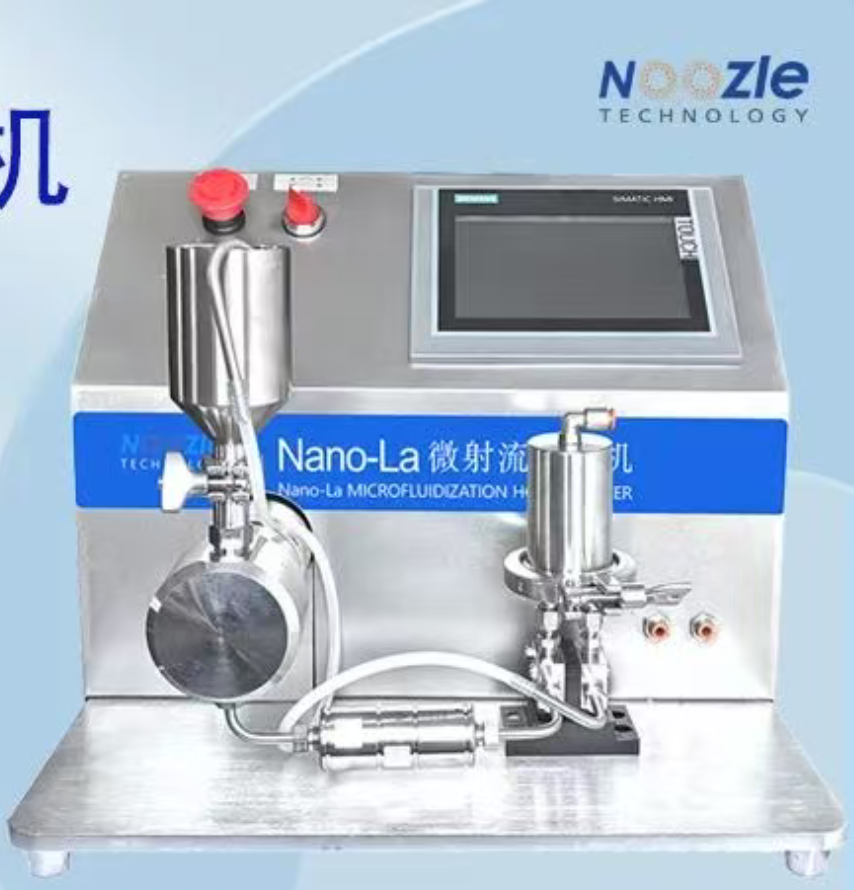
|
| Compare devices | Silverson online rotor stator (equipped with EMSC emulsion head) |
| Operating pressure | 35, 69, 103 MPa (i.e. 5, 10, 15 kpsi) |
| dispersed phase | Aerosil ® 200V gas-phase silica (primary particle size 12 nm, hydrophilic) |
| continuous phase | Distilled water (viscosity 0.001 Pa · s) and glycerol solution (viscosity 0.01, 0.09 Pa · s) |
| research variable | Particle concentration (1, 5, 10, 15, 17% wt.); Continuous phase viscosity (at 1% wt.) |
| preprocessing | Use Hielscher UP200S ultrasonic instrument for preliminary dispersion to prevent blockage |
| characterization method | Particle size analysis (Beckman Coulter LS230); Morphological observation (FEI XL30 SFEG SEM); Rheological measurement (Anton Paar Rheolab QC) |

5、 Results and Discussion
Power input
By using the pulse volume method, the power density of the microjet homogenizer at operating pressures ranging from 35 to 103 MPa was calculated to be as high as 7.8 × 10 ³ to 1.5 × 10 ⁵ kW/m ³, which is three orders of magnitude higher than traditional online or batch rotor stator devices. This reveals that the core advantage of this device in achieving efficient depolymerization of nanoclusters lies in its high energy input intensity.


Rheology of dispersed media
Low concentration (1%) Aerosil ® The rheological behavior of 200V glycerol dispersion (viscosity 0.01 and 0.09 Pa · s) is consistent with that of pure solvent, exhibiting Newtonian fluid behavior, indicating that the particles do not form a spatial network structure at low solid content.
In contrast, high concentrations (15% and 17%) of water-based pre dispersions show typical pseudoplastic shear thinning behavior, and their flow curves conform to the power law model (for example, at 15% concentration, τ=0.033 γ ̇ ^ 0.81, r ²=0.9998), which confirms that a gel like three-dimensional network is formed between particles.
The most crucial thing is that after high shear treatment with a microjet homogenizer (such as passing through a 15% concentration sample once), the network structure is effectively disrupted, and the rheological behavior of the dispersion changes to Newtonian fluid, with a significant decrease in viscosity to about 0.004-0.006 Pa · s. This transformation intuitively confirms the powerful depolymerization and structural destruction capabilities of the equipment.


Mechanism of micro jet homogenizer for crushing nano particle clusters
The study clearly revealed that the dominant mechanism of micro jet homogenizer crushing nanoparticle clusters is erosion. The evolution of particle size distribution shows that the larger cluster sizes gradually decrease during the processing, while the proportion of submicron fine particles steadily increases, which is a typical characteristic of erosion. This mechanism is consistent with the author's previous research on the same system using an online rotor stator device. This indicates that even in high-power density microjet homogenizers,The crushing mechanism is mainly determined by the properties of the material itself (solid-liquid system), rather than the type of equipment or operating conditionsDue to the bimodal distribution of particle size after processing, subsequent analysis will focus on the changes in the Sauter mean diameter and volume fraction of submicron particles.
The comprehensive influence of particle concentration and power input on crushing kinetics
Under low concentration conditions (1% and 5%), cluster depolymerization can be achieved with a single pass through a microjet homogenizer. However, when the concentration is increased to 10% or above, in order to achieve sub micron level dispersion, it is necessary to increase the number of processing times or increase the operating pressure (i.e. power input). The evolution characteristics of particle size distribution further confirm that the dominant mechanism of fragmentation is erosion at all concentrations. Specific data shows that the first round of processing can achieve a fine particle fraction of over 85%, and by optimizing operating conditions, the ultimate goal of 100% depolymerization can be achieved. This proves that for high concentration systems, the slowing down of their fragmentation kinetics can be effectively overcome by enhancing energy input.


The comprehensive influence of dispersed medium viscosity and power input on crushing kinetics
After maintaining a low particle concentration of 1% and increasing the viscosity of the dispersion medium from 0.001 Pa · s (water) to 0.01 Pa · s (glycerol solution), the required number of depolymerization cycles at a pressure of 35 MPa increased from 1 to 3. When the viscosity further increases to 0.09 Pa · s, the crushing process is further delayed. However, increasing the operating pressure (i.e. power input) can effectively compensate for the negative effects caused by high viscosity. For example, at 103 MPa, processing a dispersion of 0.09 Pa · s only requires 2 passes to complete depolymerization. Compared with the effect of particle concentration, the increase in viscosity has a more severe slowing effect on fragmentation kinetics, which is attributed to the fact that high viscosity significantly reduces Reynolds number and increases Kolmogorov microscale, thereby suppressing turbulence intensity.


Dispersion limit - minimum achievable particle size
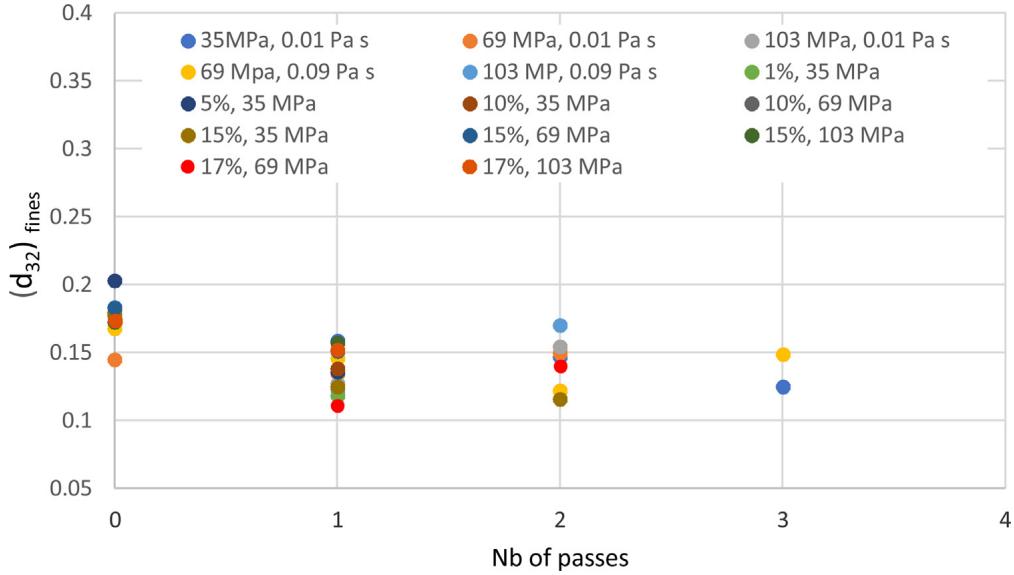
Regardless of changes in operating pressure, particle concentration, or continuous phase viscosity, the Sauter mean diameter of the obtained fine particles remains stable at around 150 nanometers. This size is much larger than the indicated 12 nanometer primary particle size,Indicating that the limit of mechanical crushing is not primary particles, but their aggregates.
This phenomenon is rooted in the production process of materials: the flame method causes primary particles to collide, merge, and fuse through strong bridging bonds at temperature, forming integral aggregates that are difficult to disassemble by mechanical force through strong Si-O-Si bridging bonds.Therefore, the minimum achievable size is essentially determined by the characteristics of the material itself.
Equipment performance comparison
A comparison was made between the performance of a microjet homogenizer and an online rotor stator device. The results indicate that the dominant crushing mechanism of both devices is erosion, and the final average diameter of fine particles that can be achieved is also the same (about 150 nanometers), which once again provesThe final dispersion fineness is determined by the material propertiesWhen the energy density is similar, the fragmentation kinetics of the two in low viscosity fluids are similar; However, under high viscosity conditions, the microjet homogenizer exhibits significant advantages, with a much higher rate of fine particle generation than the rotor stator device. This difference is attributed to the fact that the microjet homogenizer can provide several orders of magnitude higher power density, thereby more effectively overcoming the inhibitory effect of high viscosity on turbulence. Although the two devices are not directly substitutable due to their different processing scales (laboratory grade and industrial grade), the comparison results highlight the performance of microjet homogenizers in processing high viscosity nanodispersion systems.


VI. Conclusion
This study systematically evaluated the performance of a microjet homogenizer for depolymerizing nano silica clusters and reached the following core conclusions:
Efficient depolymerization abilityThis device can effectively achieve depolymerization, and can obtain dispersions with a fineness of about 150 nanometers within a particle concentration of up to 17% and a viscosity range of 0.09 Pa · s.
Crushing mechanism and limitThe dominant mechanism of fragmentation iserosionThe minimum achievable size is determined by the properties of the material itself, and mechanical force cannot destroy the solid aggregates formed by flame method.
Key operating parameters:
Low concentration/viscositySimply place an order to complete the crushing process. followParticle concentrationorContinuous phase viscosityIncrease, decrease in fragmentation kinetics, needHigher throughput or operating pressure(Energy input) to achieve dispersion. Increased viscosityBy reducing the Reynolds number and suppressing turbulence, the impact on dynamics is greater than increasing concentrationMore significant. Rheological behavior transformationThe high shear force of the equipmentDestroy the three-dimensional network structure of high concentration dispersionTransform it from a pseudoplastic fluid to a Newtonian fluid.
Equipment performance advantages: Itspower densityImprove its crushing efficiency in high viscosity systemsSuperior to online rotor stator devices.
Micro jet homogenizer is a powerful tool for large-scale preparation of nano dispersions, and its crushing mechanism and final fineness are determined by the material, while the crushing kinetics can be optimized through operating parameters.
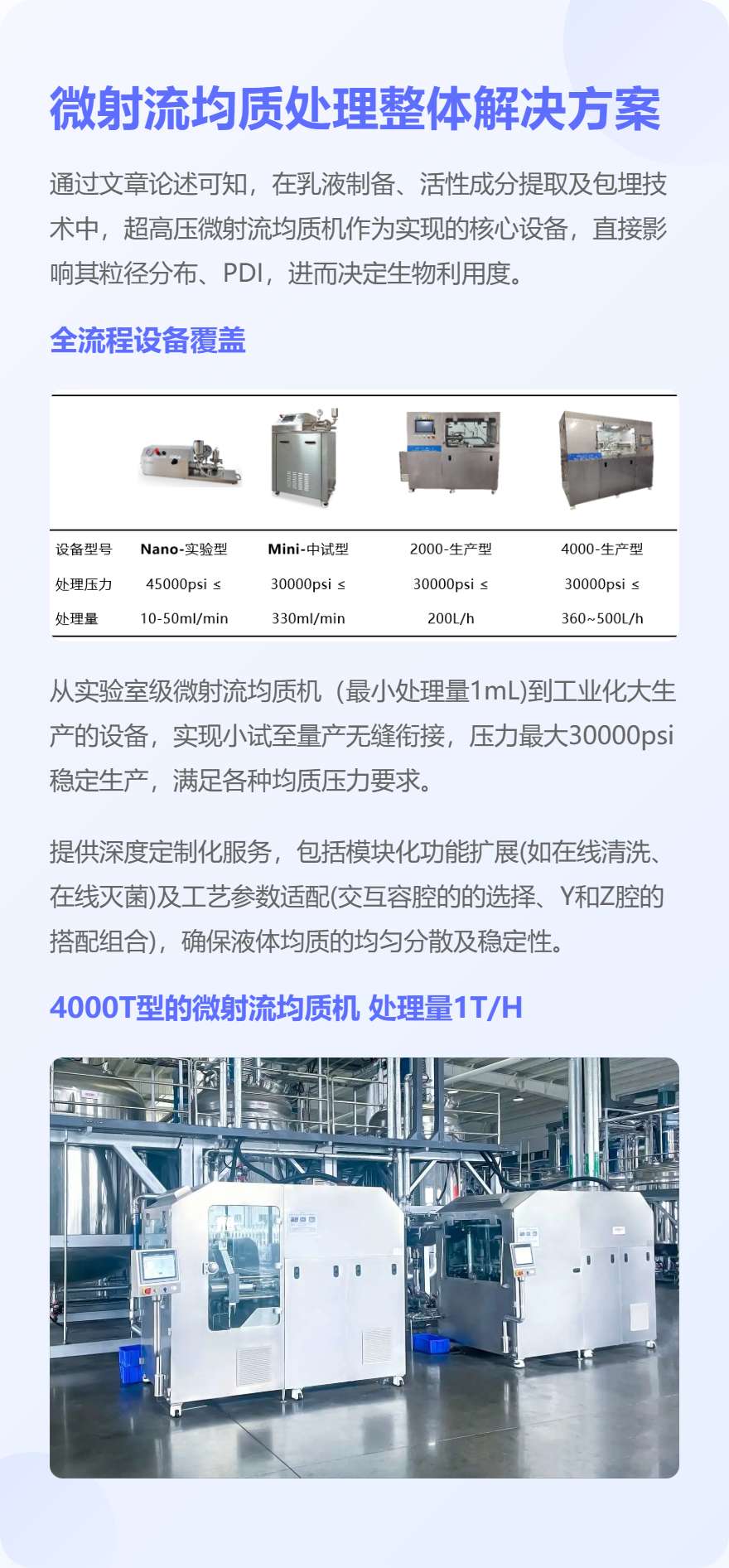
Integrated solution for micro jet homogenization treatment