-
E-mail
fengjunjie@noozle.com.cn
-
Phone
13918684639
-
Address
Building 4, 3255 Shengang Road, Songjiang District, Shanghai
Nuoze Fluid Technology (Shanghai) Co., Ltd
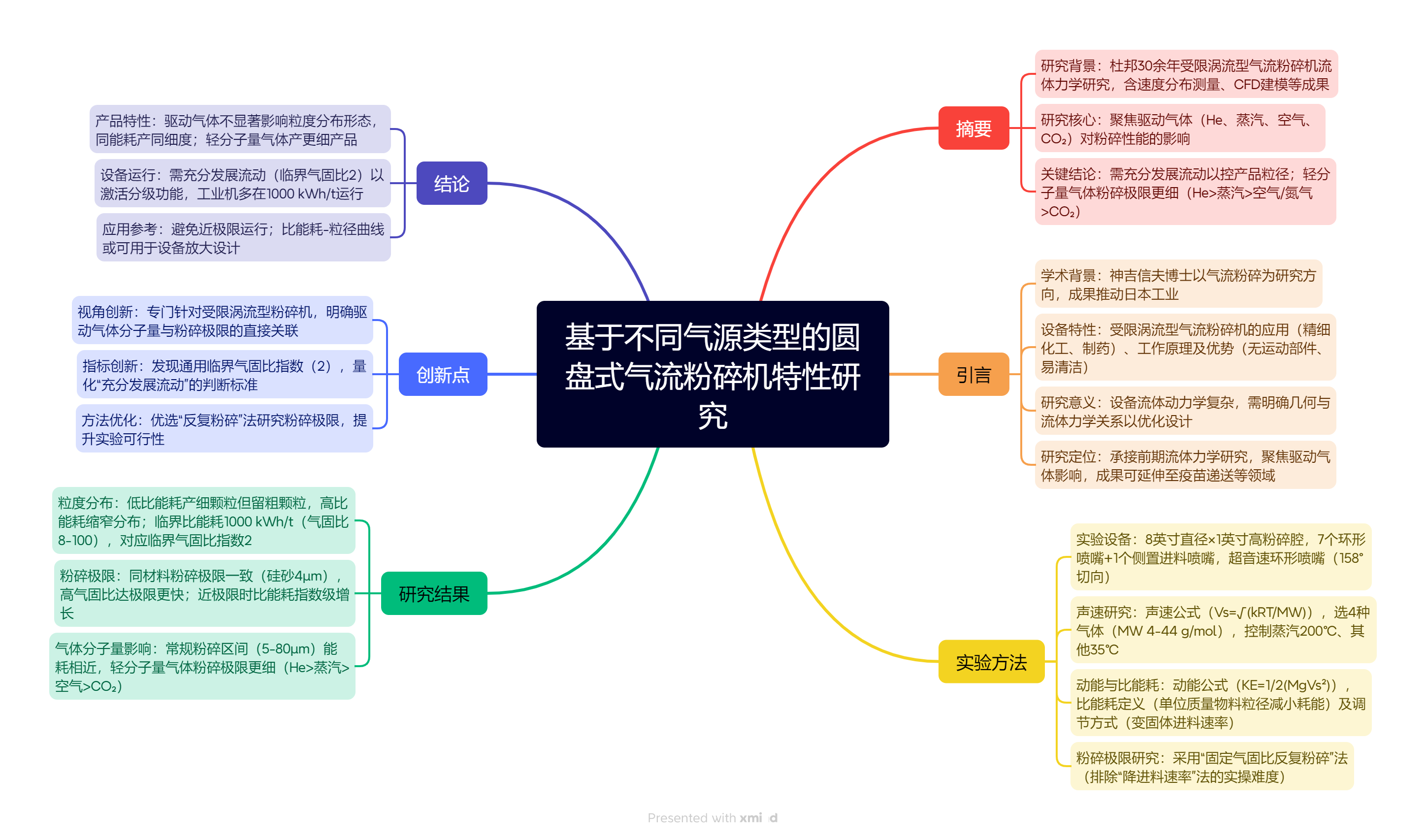
Research on the characteristics of disc airflow pulverizer based on different types of gas sources
Date: 2025-10-29Read: 3
Research on the characteristics of disc airflow pulverizer based on different types of gas sources
1、 Introduction
This article belongs to the application topic of airflow pulverizers, with a total of 12000 words. It will take approximately 20 minutes to read.
summary
This study investigated the effects of four different molecular weight gas sources, namely helium, steam, air, and carbon dioxide, on the fine grinding process of a disc airflow crusher through experiments. The research results indicate that the type of gas source has no significant effect on the particle size distribution morphology of the product, but lighter gas sources with smaller molecular weights can significantly reduce the grinding limit. The grinding efficiency of each gas source decreases with increasing molecular weight: helium, followed by steam, air, and carbon dioxide are the weakest. This phenomenon is closely related to the sound velocity and kinetic energy characteristics of the gas source. Further research has found that when a stable, high-speed, and symmetrical rotating airflow structure is formed inside the crushing chamber (corresponding to a critical gas-solid mass ratio of approximately 2), the built-in grading system can effectively control the upper limit particle size of the product. The specific energy consumption mainly affects the rate at which the grinding limit is reached, without changing the limit value itself. This study provides important theoretical basis for optimizing the energy efficiency and process parameters of airflow pulverizers.
keywords
Disc type airflow pulverization; Type of gas source; Crushing; Crushing limit
2、 Overall framework
3、 Introduction
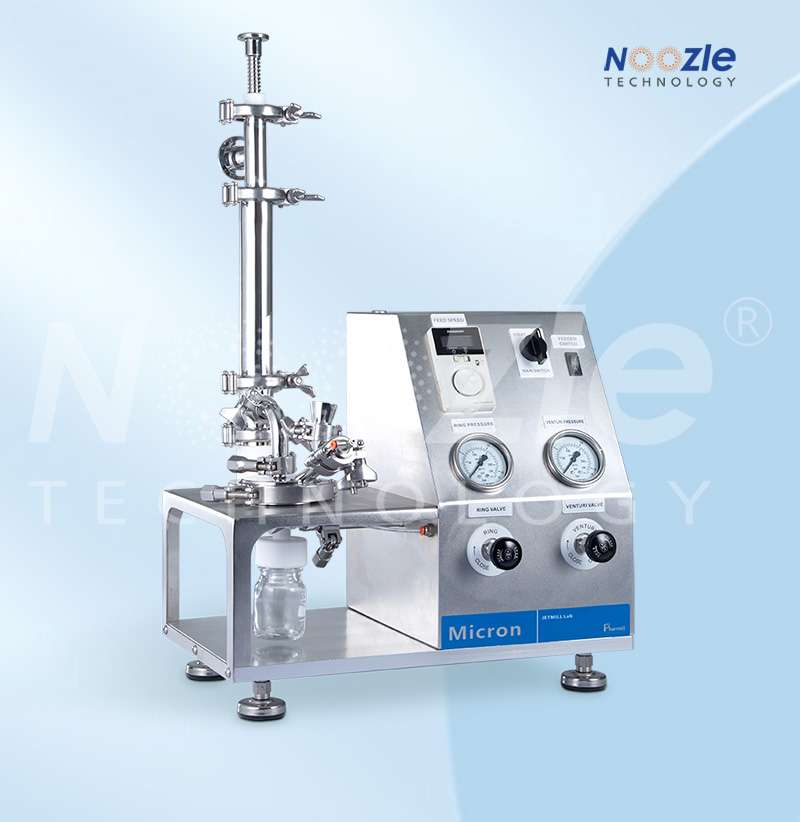
The aim of this study is to explore the influence of different types of gas sources on the crushing performance of disc air flow crushers.Due to its built-in grading function, simple structure, and easy cleaning, the disc type airflow crusher is widely used in micro scale crushing processes in the pharmaceutical and fine chemical industriesHowever, its internal flow field structure is complex, and the fluid dynamics behavior is significantly influenced by the geometric shape and operating parameters of the equipment. Even slight changes can lead to performance differences. This article is based on previous research on the fluid dynamics characteristics and classification mechanism of airflow crushers, with a focus on analyzing the mechanism of the effect of gas source properties on the crushing limit and energy efficiency, in order to provide theoretical support for the optimization design of high-performance crushing equipment.
4、 Basic process
speed of sound

As shown in the formula, the sound velocity (Vs) is a function of the gas molecular weight (MW) and gas temperature (T).
In the formula, k is the specific heat capacity ratio of gas, and R is the gas constant
Under higher temperature conditions, gases with smaller molecular weights can generate higher sound speeds, thereby possessing higher kinetic energy. ButThe gas velocity and its generated kinetic energy are the key factors determining the crushing performanceThis experiment expands the research scope of gas velocity by selecting gases with different molecular weights, including helium, steam, air, and carbon dioxide, with a molecular weight range of 4-44 g/mol. Among them, the temperature of superheated steam is controlled at 200 ℃, while the other three gases are all at ambient temperature (35 ℃). The actual operating conditions and corresponding sound velocities calculated according to the formula are shown in Table 1.

Kinetic energy and specific energy consumption
Gas kinetic energy (KE) is considered as a measure of total energy input and can be calculated using formulas (2) and (3) based on the specific heat capacity ratio (k), molecular weight (MW), temperature (T), and pressure (P) of the gas.
In the formula, Mg is the gas mass flow rate, A is the flow area,
Formula (1) shows that the speed of gas sound is independent of pressure; And the gas mass flow rate is proportional to the pressure, so the total kinetic energy input is also proportional to the gas pressure. In practical operation, increasing gas pressure does not change gas velocity, but only increases gas flow rate and total energy input. Higher gas pressure can cause finer particle crushing, but this phenomenon is often misunderstood as an improvement in energy efficiency, which should be evaluated by specific energy consumption. The definition of Specific Energy Consumption (SEC) is the energy required to reduce the particle size of a unit mass of material from the feed particle size to the product particle size. During the experiment, the specific energy consumption can be easily adjusted by keeping the gas flow rate constant and changing the solid feed rate (F). The calculation formula is as follows:
By plotting the relationship curve between specific energy consumption and product particle size, a basis can be provided for evaluating the energy efficiency of crushing
5、 Results and Discussion
particle size distribution
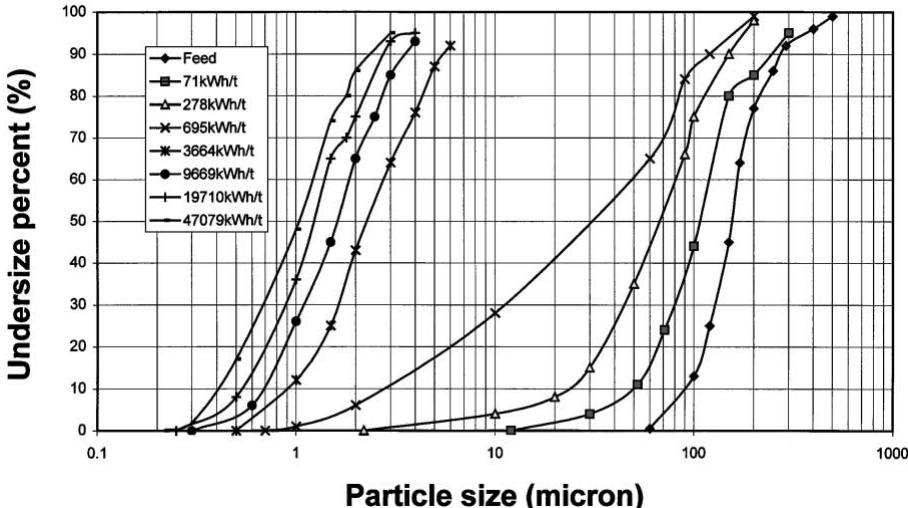
The particle size distribution of crushed products was measured using laser scattering method. Figures 2-5 show the particle size distribution curve families when helium, carbon dioxide, steam, and air were used as driving gases, with the variable being specific energy consumption.
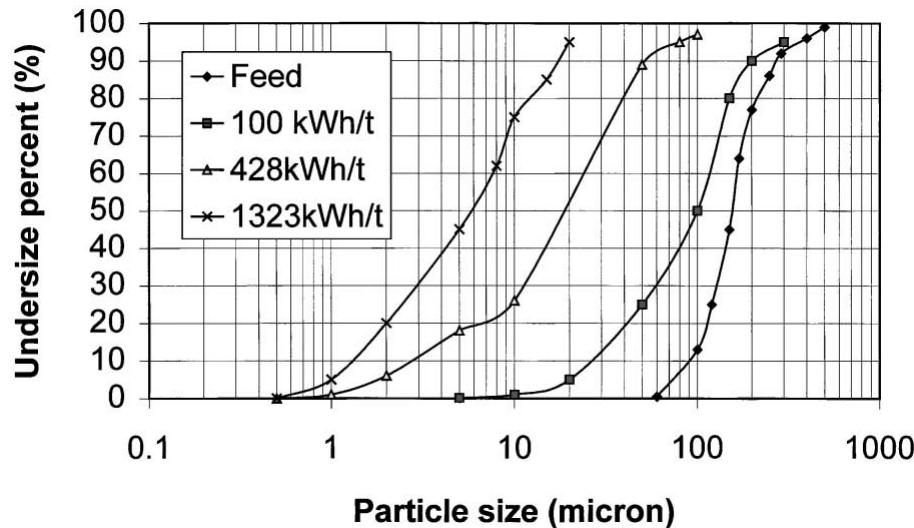
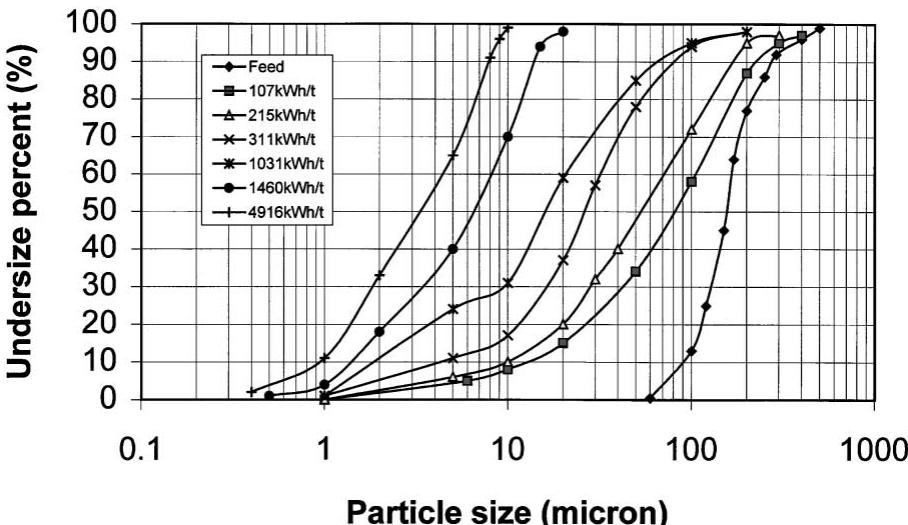

The experiment observed that the particle size reduction process of different gas types has similarities: under lower specific energy consumption (or lower gas-solid ratio) conditions, fine particles will be produced, but some of the original coarse particles in the feed will still be retained, which is a typical phenomenon in the process of gas flow crushing. Increasing the specific energy consumption (or gas-solid ratio) not only makes the product finer, but also narrows the particle size distribution by reducing the content of coarse particles. This indicates that when the gas-solid ratio is low, particle size reduction is the dominant process, and the effect of grading on product particle size distribution is relatively small. When the specific energy consumption reaches about 1000 kWh/t (corresponding to a gas-solid ratio range of 8-100 for carbon dioxide, air, steam, and helium), a critical specific energy consumption level will be reached, and the product particle size distribution will begin to narrow, with a cutting particle size of about 30 microns. If the critical gas-solid ratio is normalized using the molecular weight corresponding to each gas, a universal value representing the critical gas-solid ratio index can be obtained, which is 2 for all test gases. This critical gas-solid ratio index indicates that a fully developed flow state has been formed inside the crushing chamber, which is a prerequisite for the effective performance of the grading effect.
Crushing limit
The crushing limit is defined as the finest state where the particle size distribution of the product no longer changes as the specific energy consumption continues to increase. There are two different experimental methods to study the crushing limit of the airflow crusher: one is to continuously reduce the solid feed rate while keeping the gas energy constant until the crushing limit is reached; Another method is to repeatedly feed the crushed product into a pulverizer under fixed gas-solid ratio conditions for multiple pulverizations until the pulverization limit is reached. The former method is more difficult to implement because reducing the feed rate not only requires precise feed control, but also quickly exceeds the practical application range of operating conditions. Therefore, this study adopts the latter method (repeated crushing) to determine the crushing limit.
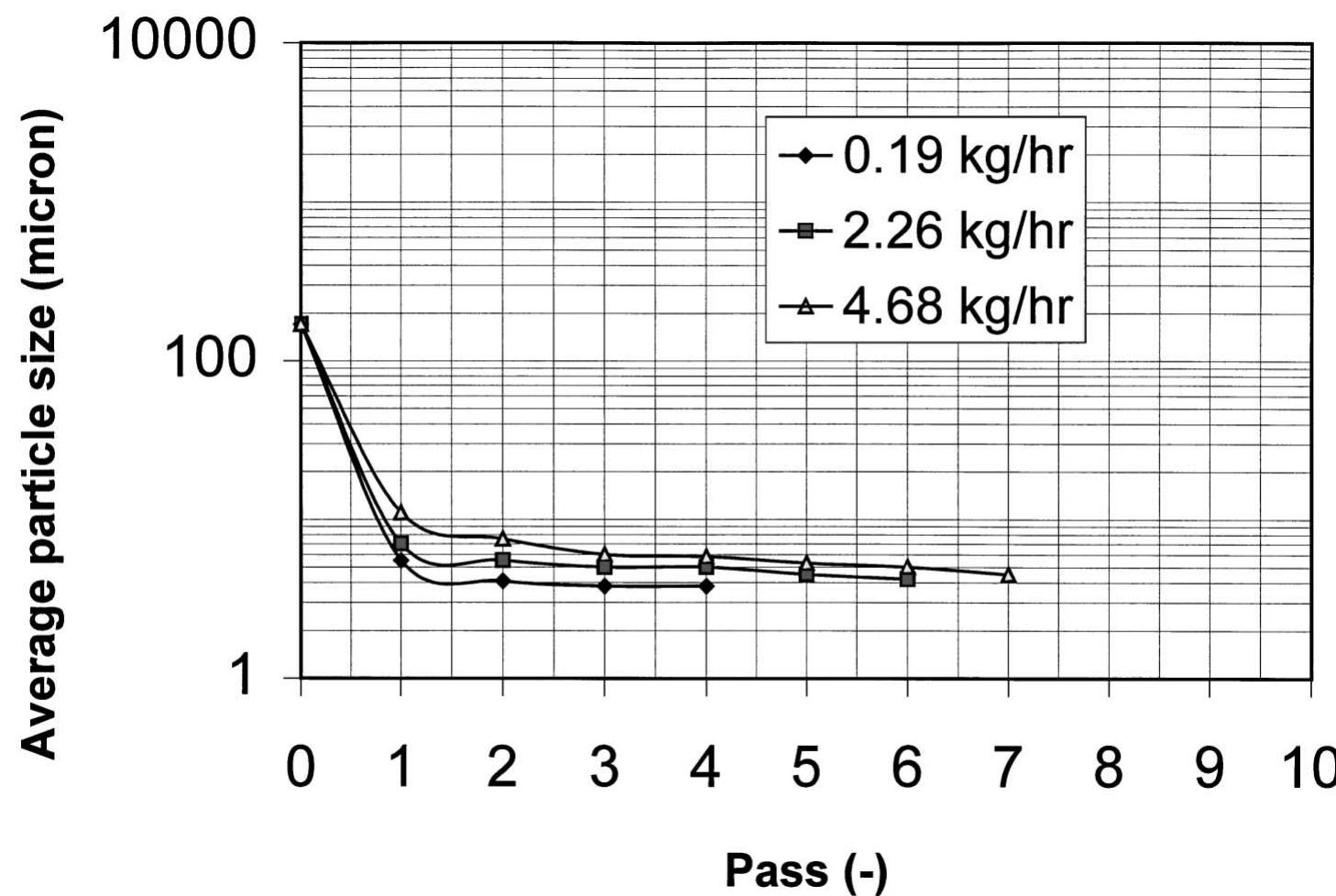
Figure 6 shows the experimental results when using air as the gas source type. Three experiments were conducted at the selected solid feed rate to increase specific energy consumption by repeatedly crushing the crushed product (increasing the number of passes). Interestingly, all three experiments ultimately reached the same crushing limit, with the only difference being that the higher the gas-solid ratio, the faster the speed at which the crushing limit was reached. In this experiment, the crushing limit of this batch of silica sand is an average particle size of 4 microns, and the crushing limit may vary for different materials.
Another way to observe the crushing limit is that when the particle size approaches the crushing pole, the slope of the specific energy consumption curve becomes abnormally steep (as shown in Figure 7). At this point, the energy consumption is increasing exponentially, and the energy efficiency is extremely low. Therefore, in practical operation, the crusher should not be operated under conditions close to the crushing limit.

It is worth noting that the type of gas source will have an impact on the crushing limit:The smaller the molecular weight of the gas, the finer the achievable crushing limit, in the order of helium>steam>air>carbon dioxideIn the conventional crushing range with an average particle size of 5-80 microns, regardless of the gas source or operating conditions used, the specific energy consumption required to obtain a specific product particle size is roughly the same, that is, the crushing energy efficiency is similar.
VI. Conclusion
The type of gas source has no significant effect on the morphology of product particle size distribution, and under the same specific energy consumption input, the product fineness is roughly equivalent; The type of gas source with smaller molecular weight has the ability to produce finer products, that is, the crushing effect: helium>steam>air>carbon dioxide; Only when a fully developed flow state is formed in the crushing chamber, can the built-in airflow grading function effectively control the maximum particle size of the product;
The research results indicate that the critical gas-solid ratio required to form a stable, high-speed, and symmetrical rotating airflow structure is about 2, which means that a gas flow rate of 2kg/h is required for every 1kg/h of solid feed. The corresponding specific energy consumption level for this gas-solid ratio is about 1000kWh/t;
Integrated solution for inhalation particle preparation
References
[1] Zhao Q Q , Schurr G . Effect of motive gases on fine grinding in a fluid energy mill[J]. Powder Technology, 2002, 122(2):129-135.DOI:10.1016/S0032-5910(01)00408-9.
