-
E-mail
shenbiaobiao@zryq.cn
-
Phone
19589992149
-
Address
No. 11 Yuehe Road, Chengyang District, Qingdao City, Shandong Province
Qingdao Zhongrui Intelligent Instrument Co., Ltd
Comparison between catalytic and chromatographic methods, portable non methane total hydrocarbon analyzer selection guide!
Date: 2025-09-30Read: 19

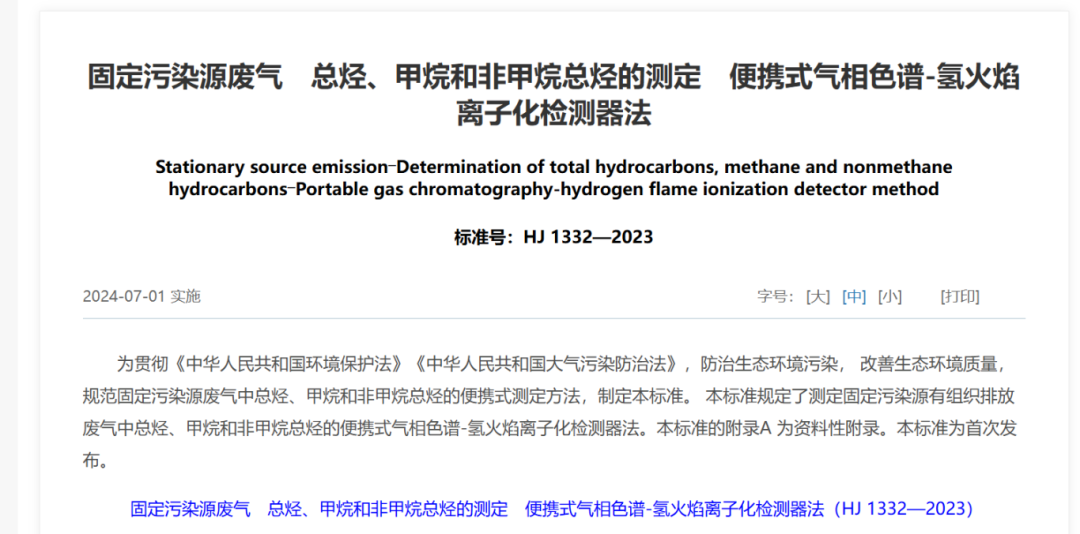
Starting from July 1st, 2024,HJ1331-2023andHJ1332-2023Two method standards have officially begun to be implemented. This means that the detection of organized emissions of non methane total hydrocarbons no longer requires on-site manual gas bag sampling laboratory gas chromatography analysis.

Advantages and Comparison of New Standards
Compared to the HJ38 manual method, the portable direct reading method does have many advantages, specifically reflected in:
1The number can be directly detected on site.Quickly make judgments on changes in pollutant concentration levels, facilitating on-site law enforcement monitoring and supervisory monitoring.
2Avoid sample distortion.The airbag method often fails to analyze in a timely manner, resulting in sample loss and significant deviation between measurement results and actual values.
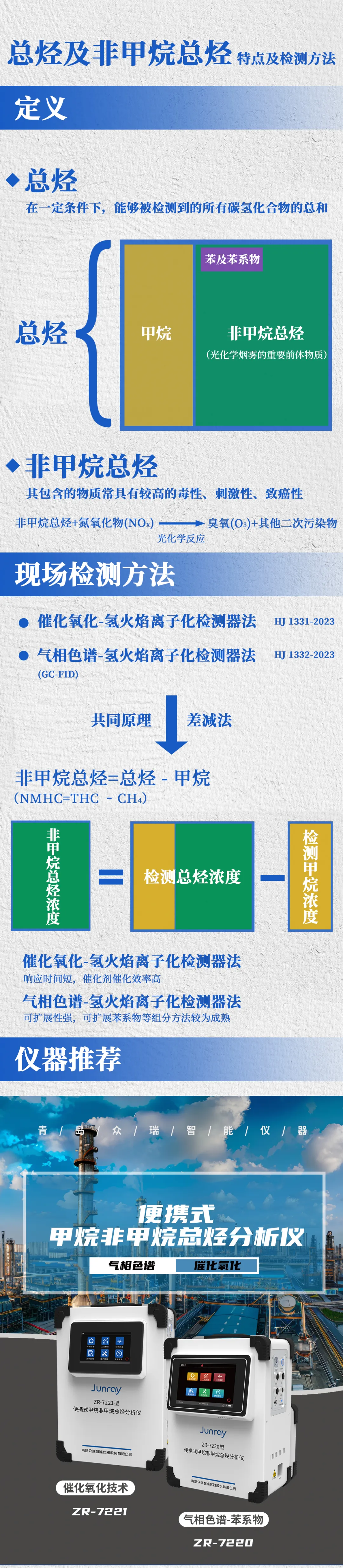
The direct reading method is divided into catalytic method and chromatographic method according to HJ1331 and HJ1332. The principle is as follows:
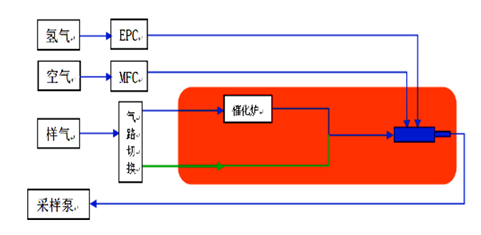
Catalytic method:Continuously extract samples and introduce them into the instrument, while or alternately passing them through the total hydrocarbon detection unit and methane detection unit (the methane detection unit oxidizes all gaseous organic compounds except methane to carbon dioxide and water through a catalyst). Use a hydrogen flame ionization detector to measure the content of total hydrocarbons and methane, and the difference between the two is the content of non methane total hydrocarbons.

Chromatography method:Continuously extract samples and introduce them into the instrument. After passing through the gas chromatography total hydrocarbon column and methane column, they enter the hydrogen flame ionization detector to determine the content of total hydrocarbons and methane in the exhaust gas. The difference between the two is the content of non methane total hydrocarbons.
Summary:Catalytic method does not require quantitative ringsTherefore, according to the method standard requirements, only hydrogen gas (combustion gas) and high-purity air (auxiliary gas) are needed; Chromatography requires quantitative ring for chromatographic separation, and in addition to hydrogen and hydrocarbon free air, nitrogen (carrier gas) is also required.

How to choose the appropriate instrument?
1. Observe the detection scenario
According to HJ1012, instruments can be divided into Class I instruments (ambient air) and Class II instruments (fixed pollution sources), with different corresponding ranges and detection limits. Therefore, first determine whether it is used for environmental air or fixed pollution sources, and then choose Class I or Class II instruments.
Secondly, according to the requirements of the method standards, the catalytic method requires a detection limit of 0.4mg/m ³, while the chromatographic method requires a detection limit of 0.2mg/m ³. Therefore, if higher detection limits are required, especially for low concentration measurements, it is recommended to prioritize chromatography.
2. Observe emission conditions
According to the selection of exhaust conditions, if the exhaust gas contains high concentrations of sulfides, it may cause catalyst poisoning and have irreversible effects. For this operating condition, only chromatography can be used. On the other hand, if the exhaust gas is clean (such as pure process exhaust gas), there are not so many "impurities", and the catalytic method can also be used, it also saves the trouble of carrying carrier gas in chromatography.
3. Consider portability
According to the method and structural principles, mainstream catalytic instruments in the market are more portable and compact than chromatographic instruments, especially suitable for carrying and operating complex manual monitoring platforms. In addition, catalytic methods do not require a carrier gas and only require the addition of hydrogen gas for normal use.
Experience exchange
Finally, whether choosing catalytic or chromatographic methods, the most important thing is to select instruments and equipment that comply with national method standards.
According to the editor's understanding, the mainstream products on the market are currently domestically produced equipment, and there are still significant differences in equipment performance and stability among different brands.When making a purchase, be sure to keep your eyes open and compare multiple options on site.Some instruments have accurate gas calibration, but they don't work on site. Looking into the reason,It is necessary to consider whether the catalytic efficiency of the catalytic method is qualified and whether the chromatographic separation performance of the chromatographic method is qualified. In addition, if conditions permit, the response factor and separation ability of the instrument can also be verified through propane methane mixed standard gas.
The above is a summary of valuable information from the manufacturer of mixed instruments by the editor. If there are any errors, welcome the experts in the industry to correct them!