-
E-mail
shenbiaobiao@zryq.cn
-
Phone
19589992149
-
Address
No. 11 Yuehe Road, Chengyang District, Qingdao City, Shandong Province
Qingdao Zhongrui Intelligent Instrument Co., Ltd
How to measure the moisture content when the smoke temperature exceeds 100 ℃? Testers must watch!
Date: 2025-09-09Read: 18

Once the smoke temperature exceeds 100 ℃, measuring the moisture content becomes difficult! This is almost a headache that every exhaust gas tester has encountered.
According to common sense, monitoring methods should follow standards, but in practical operation, the methods in the standards may not be "effective"; I want to choose a more convenient technology, but I'm afraid it won't be compliant due to lack of recognition. Today, let's break it apart and talk about how to measure the moisture content when the smoke temperature is above 100 ℃?
Dry wet bulb method: 100 ℃ is a 'hard threshold'

Dry wet bulb method:By using wet bulb moisture evaporation to absorb heat and measure temperature differences, when the smoke temperature exceeds 100 ℃, the moisture instantly boils and evaporates completely, rendering the principle ineffective and the data inaccurate. And there are also relevant punishment cases in a certain place in Liaoning.
Weight method: There are "difficulties" in actual on-site operation

When it comes to measuring high temperature moisture content, GB/T 16157-1996 and its amendments, HJ836-2017 all list itCondensation method and weight methodIn June of this year, the Jiangsu Environmental Protection Department also specifically replied: it is recommended to prioritize using these two methods, and there are related instruments available for sale.
But in practical work, this type of methodThe instrument is bulky and cumbersome、Unstable weighing environmentThe adsorbed water containsCPM condensable particulate matterDue to various reasons, how many third-party companies in the testing industry currently use the weight method for testing?
It cannot be denied that the weight method is currently the most accurate method for measuring humidity, and this method is also described in detail in the national standard GB/T 11605-2005 "Humidity Measurement Methods". The following figure describes the principle of the weight method in GB 16157.
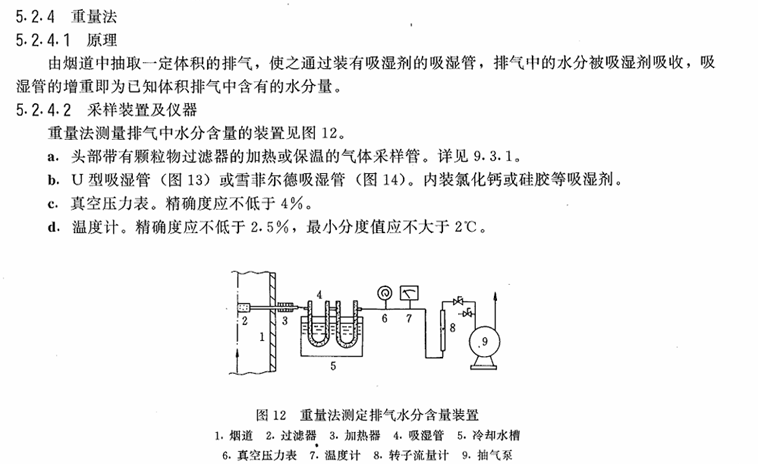
But what is the difficulty in on-site practice?
We all know that the on-site operating conditions of organized emissions from fixed pollution sources are extremely different from those of meteorology, ambient air, and laboratory measured humidity. The monitoring platform at the discharge outletDifference in temperature and humidity changes、Factors such as platform vibration and shakingBoth are not conducive to weighing on a balance, and the GB/T 11605-2005 standard also clearly states:It must be carried out in a constant temperature and humidity environment.
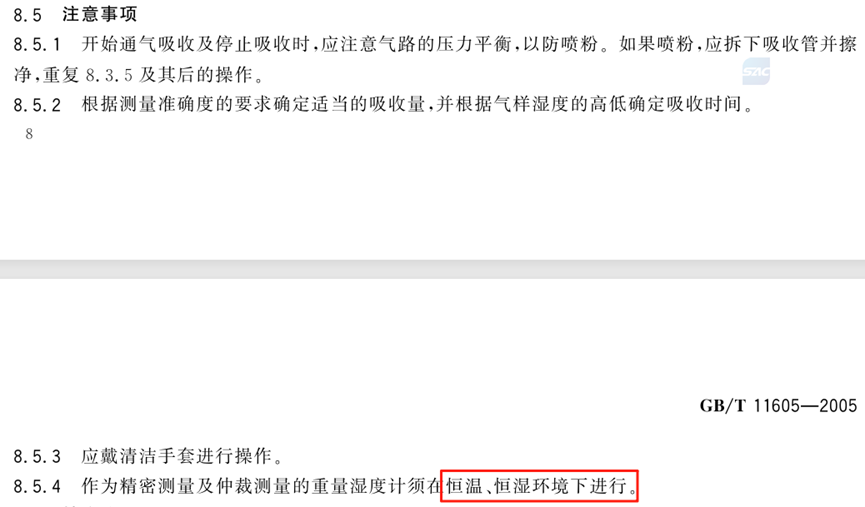
So, since that's the case, can we just send someone down the chimney and weigh the samples in the laboratory after each sampling, and then transmit the data results to the platform?
In fact, besides the working environment, there is another factor that cannot be ignored:Condensable particulate matter (CPM).

(For detailed introduction of CPM, please click)
The condensable particulate matter CPM that cannot be ignored in exhaust emissions!
According to the principles of condensation or weight method, it is necessary to condense or adsorb the gaseous water in the flue gas into the absorption tube,Will CPM in the flue gas also be condensed or adsorbed into the absorption tube, or even undergo chemical reactions with the adsorbent,I think this should be unavoidable.The actual weight of "water vapor mass" includes some CPM (such as sulfuric acid mist, nitrous acid, volatile organic compounds (VOCs), heavy metal vapor, etc.). )
Does the impedance capacitance method have a "proper title"?
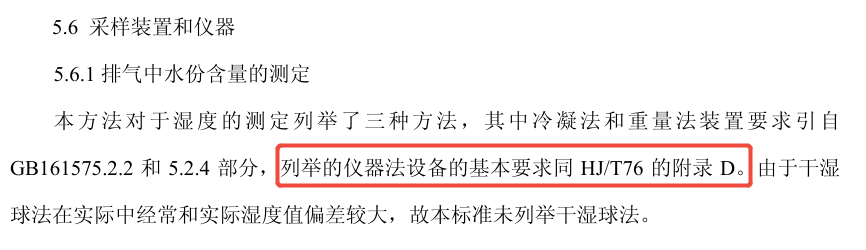
In HJ836, only the instrumental method is mentioned, but it is not specifically clarified whether the impedance capacitance method belongs to the instrumental method. In the preparation instructions, it is stated thatThe basic requirements for the listed instruments and equipment are specified in Appendix D of HJ/T76The impedance capacitance method instrument can meet the basic requirements of Appendix D.
The current standards for the impedance capacitance method are as follows:
T/SSESB1-2020 "Determination of Humidity in Waste Gas from Fixed Pollution Sources - Resistance capacitance Method" (Shanghai Standard)
The Shanghai Group Standard T/SSESB 1-2020 directly cites HJ836 as the sampling basis to clarify the applicability of the impedance capacitance method.

GB/T 11605-2005 "Methods for Measuring Humidity"
Third party organizations in Shandong, Jiangsu and other places have obtained CMA qualifications through GB/T 11605-2005 (including the impedance capacitance method).
DB36T 1940-2024 "Determination of Humidity in Exhaust from Fixed Pollution Sources - Resistance capacitance Method" (Jiangxi Landmark)
DB62T Gansu Landmark (under preparation)
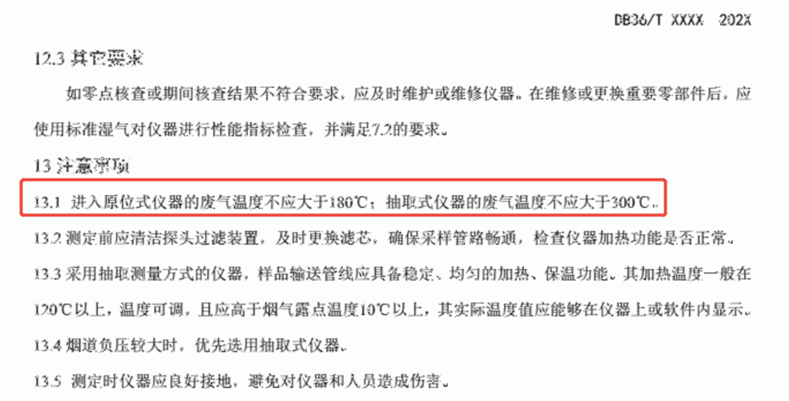
most important of all,HJ method standard for resistance capacitance methodIt is also under preparation, which means that it is only a matter of time before it changes from an "uncertain method" to a "national standard method".
Therefore, as a rapid on-site detection method, the resistance capacitance method is expected to become more accurate in the future, complementing the condensation method and weight method in HJ836.
The above only represents an immature personal opinion. We hope that experts and teachers in the industry can provide criticism and correction!