-
E-mail
shenbiaobiao@zryq.cn
-
Phone
19589992149
-
Address
No. 11 Yuehe Road, Chengyang District, Qingdao City, Shandong Province
Qingdao Zhongrui Intelligent Instrument Co., Ltd
Exhaust gas monitoring: the difference and connection between "relative humidity" and "moisture content"
Date: 2025-09-22Read: 16
The moisture content of flue gas, as an important component of fixed pollution source exhaust gas monitoring, affects the results of parameters such as constant sampling flow rate, standard dry flow rate, and even emission rate. To avoid confusion between the concepts of relative humidity and moisture content, the author will discuss and exchange existing standards and data with everyone.
The difference between "relative humidity" and "moisture content"
Relative Humidity refers to the percentage of water vapor pressure in the air to the saturated water vapor pressure at the same temperature, or the percentage of actual water vapor density per unit volume of air to the saturated water vapor density at the same temperature. Relative humidity is expressed in RH%. The lower the relative humidity, the lower the degree of air saturation and the stronger the ability to absorb water; The higher the relative humidity, the weaker the ability to absorb water vapor. When the relative humidity value is 100%, it refers to saturated air, otherwise,A relative humidity value of 0 refers to dry air. The relative humidity value can indicate the degree to which the air is close to saturation, but cannot represent the amount of water vapor content.
Humidity Ratio refers to the amount of water vapor in the air, usually expressed as the volume percentage of water vapor in 1kg of dry air or wet air, also known as absolute humidity.In pollution source exhaust gas monitoring, the volume percentage of water vapor to flue gas content is usually expressed.
The relationship between "relative humidity" and "moisture content" (taking the exhaust gas resistance capacitance method moisture content instrument as an example)
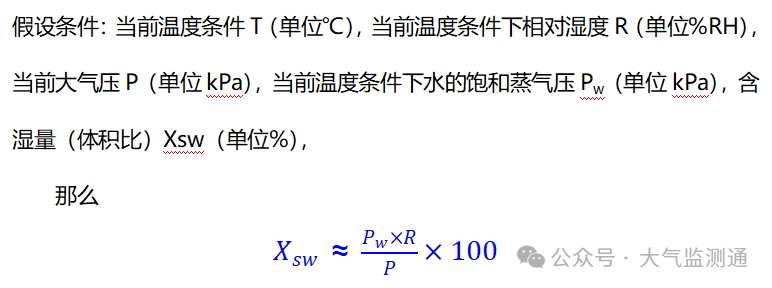
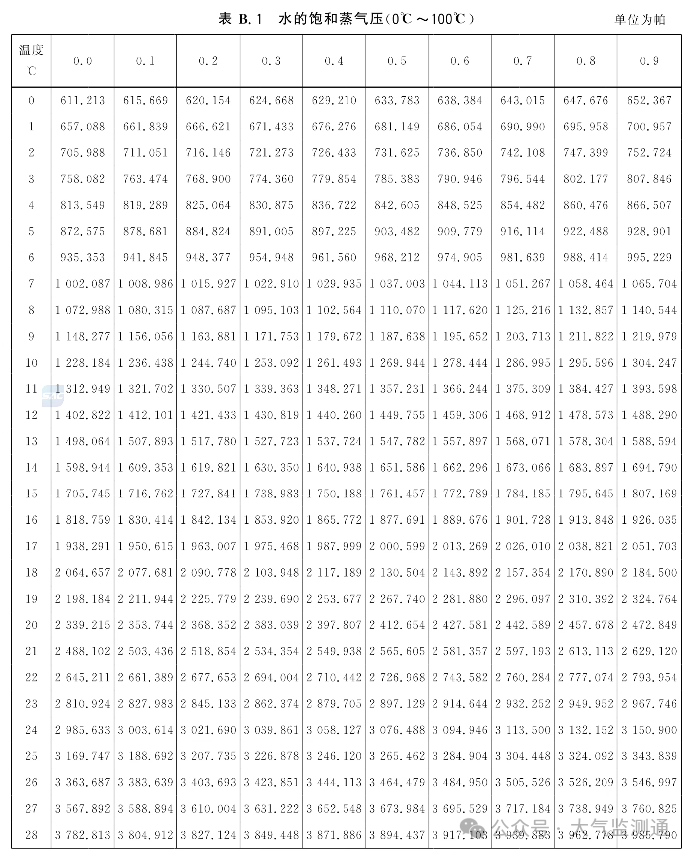
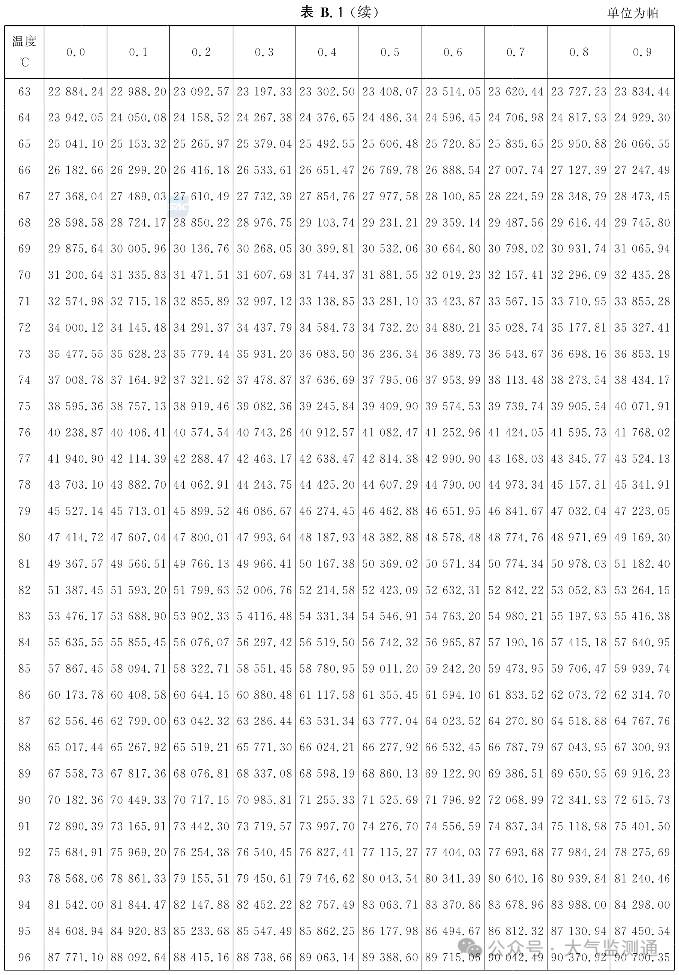
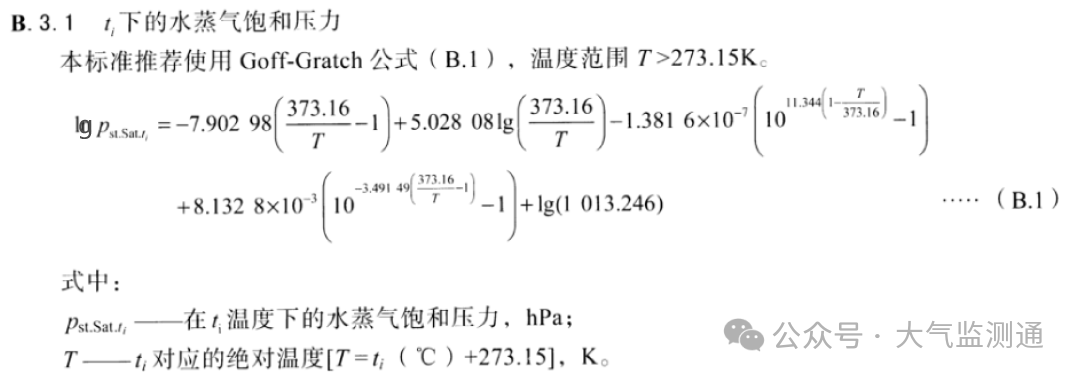
”The saturated vapor pressure of water under different temperature conditions can be obtained by looking up a table or directly calculating, and the sources are as follows:
1. Table lookup method (GB/T 11605-2005 Humidity Measurement Method, Appendix B)


2. Formula method (NB/T 47066-2018 Thermal Performance Test Method for Condenser Boilers)
summary
Relative humidity is a measure of the degree to which water vapor in the air approaches saturation and the strength of its water absorption capacity; Moisture content can quantify the amount of water vapor in humid air. Different temperature conditions can affect the saturated vapor pressure of water and the relative humidity of air.
Discussion at the end of the section: For exhaust outlets with very stable operating conditions under ideal conditions, when using an extraction based resistance capacitance moisture content detector to monitor moisture content, will there be a significant change in moisture content if different heat tracing temperatures are set (assuming that there is no condensation in the entire heat tracing process of the pipeline)?
So if an extension tube is added for a flue with a temperature exceeding 180 ℃ due to the limited temperature tolerance of the instrument, and the extension tube is inserted deep into the high-temperature flue, can the moisture content measured by the instrument characterize the actual moisture content of the flue under this operating condition?
Furthermore, the resistance capacitance method moisture content detection standard states that the temperature of the exhaust gas entering the instrument should not exceed 180 ℃. In other words, I only need to ensure that the inlet temperature of the sampling tube entering the instrument does not exceed 180 ℃? Welcome everyone to discuss!