-
E-mail
185945738@qq.com
-
Phone
15306360531
-
Address
Shandong Liende
Shandong Leiente Intelligent Technology Co., Ltd
Selection and maintenance of COD ammonia nitrogen total phosphorus analyzer
Date: 2025-12-19Read: 70
Water is the source of life, and the quality of water environment is directly related to ecological security and human health. In water pollution monitoring, chemical oxygen demand (COD), ammonia nitrogen, and total phosphorus are the core evaluation indicators - COD reflects the degree of pollution of reducing pollutants in water, ammonia nitrogen is an important cause of eutrophication in water, and total phosphorus directly affects the growth rate of algae. Exceeding these three indicators can lead to serious environmental problems such as black and odorous water and red tide. Traditional water pollutant detection relies on complex laboratory analysis processes, which are time-consuming, labor-intensive, and difficult to achieve rapid on-site monitoring, and cannot meet the needs of emergency control and normalized management of water environment. The emergence of COD ammonia nitrogen total phosphorus analyzer has become a key technological equipment for solving water monitoring problems and building a strong water environment defense line with its fast, accurate, and convenient detection capabilities.
1、 The core technology of COD ammonia nitrogen total phosphorus analyzer: the technical core of multi index collaborative detection
The core advantage of COD ammonia nitrogen total phosphorus analyzer is to achieve synchronous or independent detection of three key indicators by a single device. Its technical system is based on targeted detection principles and integrated hardware design, balancing detection accuracy and operational convenience.
1. Principle of sub indicator detection: Accurately capturing pollutant characteristics
The equipment adopts exclusive detection principles to achieve precise quantification based on the physical and chemical characteristics of different indicators. For COD detection, the mainstream method is potassium dichromate digestion spectrophotometry: under strong acidic conditions, potassium dichromate acts as an oxidant and reacts with reducing substances in the water sample. Excess potassium dichromate combines with ferrous ions to form specific color compounds. By detecting its absorbance at 600nm wavelength, the COD concentration is calculated. This method has strong anti-interference ability and a detection range of 5-10000mg/L, suitable for water bodies with different pollution levels; Ammonia nitrogen detection is often carried out using Nessler's reagent spectrophotometry or salicylic acid spectrophotometry. The former generates a yellow brown complex by reacting ammonia nitrogen with Nessler's reagent, and the absorbance is detected at a wavelength of 420nm. The latter generates a blue complex and is detected at a wavelength of 697nm. Both methods have high sensitivity, with a detection limit of up to 0.02mg/L, and can accurately capture low concentration ammonia nitrogen pollution; The total phosphorus detection is carried out using ammonium molybdate spectrophotometry. After the water sample is digested by potassium sulfate at high temperature and high pressure, the phosphorus element is converted into orthophosphate, which forms phosphomolybdic acid with ammonium molybdate. It is reduced to a blue complex by a reducing agent and quantified by 700nm wavelength absorbance detection. The detection range covers 0.01-10mg/L and can effectively monitor the trend of eutrophication in water bodies.
2. Integrated technology upgrade: improve detection efficiency and environmental adaptability
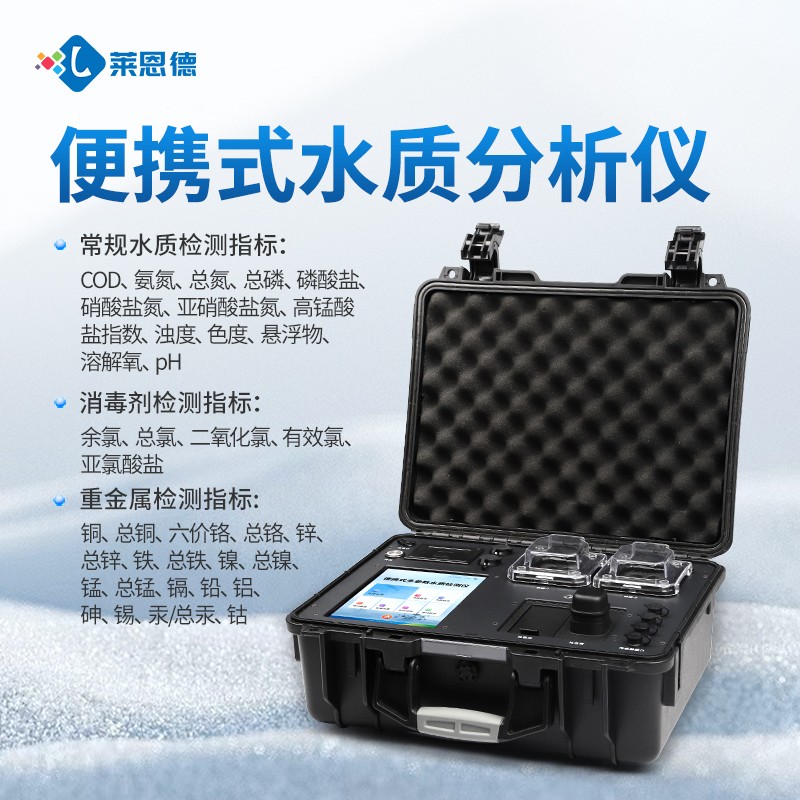
The new generation COD ammonia nitrogen total phosphorus analyzer has significantly improved its practical performance through hardware integration and technological optimization. In the digestion system, a closed high-temperature and high-pressure digestion module is used to support simultaneous digestion of COD, ammonia nitrogen, and total phosphorus samples. The digestion temperature is precisely controlled at 165 ℃± 1 ℃, and the digestion time can be automatically adjusted according to the indicator type (COD digestion for 20 minutes, total phosphorus digestion for 30 minutes), avoiding the problems of reagent volatilization and pollution in traditional open digestion; On the detection system, a multi wavelength high-precision optical detection module is equipped, which can automatically switch the detection wavelength and support simultaneous detection of 16 sets of samples. The daily detection volume can reach more than 300 sets, which is more than three times more efficient than traditional single index detection equipment. In response to on-site monitoring requirements, the equipment adopts an integrated portable design, weighing only 3.5kg, with a built-in 7.4V/4Ah lithium battery that supports continuous operation for 8 hours. It is equipped with a high-definition touch screen and intelligent operating system, with built-in standard curve and calibration functions. Novices can also complete a single test within 5 minutes; Some devices also have IP67 waterproof and dustproof rating, which can work normally outdoors in rainy weather and adapt to complex on-site environments such as rivers, lakes, and sewage treatment plants.
2、 Scene cultivation of COD ammonia nitrogen total phosphorus analyzer: full chain protection of water environment quality
The application of COD ammonia nitrogen total phosphorus analyzer runs through the entire chain of water environment monitoring, treatment, and supervision, covering multiple fields such as municipal sewage, industrial wastewater, surface water, aquaculture, etc., providing accurate data support for water environment management.
1. Municipal sewage treatment: ensure that the effluent meets the discharge standards
In the operation and maintenance of sewage treatment plants, measuring instruments are key process monitoring tools that can monitor the COD, ammonia nitrogen, and total phosphorus concentrations of key nodes such as inflow, biochemical treatment tanks, and outflow in real time, and adjust treatment process parameters in a timely manner. A sewage treatment plant in a certain city installed an online measuring instrument at the outlet of the aeration tank to monitor the concentration of ammonia nitrogen in real time. When the concentration exceeded 5mg/L, the aeration intensity was automatically adjusted to stabilize the effluent ammonia nitrogen at below 1mg/L, and the compliance rate increased from 92% to 99.5%; At the main outlet of the effluent, a portable measuring instrument can quickly conduct spot checks to ensure the discharge standards of COD ≤ 50mg/L and total phosphorus ≤ 0.5mg/L, avoiding environmental risks caused by excessive discharge. In addition, the equipment can also be used for emergency monitoring of sewage treatment plants. When the incoming water quality suddenly deteriorates (such as a sudden increase in COD), emergency detection can be completed within 10 minutes to buy time for process adjustment and reduce the risk of impact on the treatment system.
2. Industrial wastewater control: reducing pollution emissions from the source
In industrial fields such as chemical engineering, printing and dyeing, and food processing, measuring instruments are important equipment for enterprises to self monitor and supervise environmental protection. A certain printing and dyeing enterprise installed a measuring instrument at the drainage outlet of the production workshop to monitor the COD concentration in real time. When the concentration exceeded 100mg/L, the drainage valve was automatically closed to prevent high concentration wastewater from entering the subsequent treatment system. After optimization, the enterprise's wastewater treatment cost was reduced by 20%, and the total COD discharge was reduced by 35%; In the environmental inspection of industrial parks, personnel carry portable measuring instruments to conduct on-site rapid testing of enterprise sewage outlets, and issue test results within 15 minutes, effectively cracking down on illegal activities such as illegal discharge and excessive discharge. For complex industrial wastewater with high salinity and high chromaticity, some specialized measuring instruments are also equipped with anti-interference pretreatment modules, which can eliminate interference through filtration, dilution, and other methods to ensure accurate and reliable detection results.
3. Surface water monitoring: safeguarding the ecological security of rivers and lakes
In surface water monitoring of rivers, lakes, reservoirs, etc., measuring instruments can achieve large-scale, high-frequency water quality screening and timely detection of pollution hazards. In a eutrophication control project for a certain lake, monitoring personnel conducted grid monitoring of different areas of the lake using portable measuring instruments and found that the total phosphorus concentration at the mouth of the lake was as high as 0.8mg/L, which was four times that of the central area of the lake. Based on this, the pollution source was accurately located as the runoff from surrounding farmland. By implementing measures such as ecological ditch interception and fertilizer reduction, the total phosphorus concentration at the mouth of the lake decreased to 0.2mg/L six months later, and the frequency of algal outbreaks in the lake decreased by 70%; In the protection of drinking water sources, online measuring instruments continuously monitor COD, ammonia nitrogen, and total phosphorus concentrations 24 hours a day. When the indicators fluctuate abnormally, they automatically trigger warnings, providing all-weather protection for drinking water safety.
4. Aquaculture and farmland irrigation: ensuring water safety
In the field of aquaculture, high concentrations of ammonia nitrogen and total phosphorus in water can lead to illness and even death of fish and shrimp. Measuring instruments can help farmers accurately regulate water quality. A certain shrimp farm regularly detects the concentration of ammonia nitrogen in the aquaculture water. When the concentration exceeds 0.5mg/L, the water is changed or probiotics are added in a timely manner, which increases the survival rate of shrimp from 65% to 85% and significantly improves the aquaculture efficiency; In the monitoring of irrigation water in farmland, the measuring instrument can quickly detect the COD and ammonia nitrogen content of irrigation water, avoiding soil pollution and crop quality decline caused by the use of polluted water bodies for irrigation, and ensuring the safety of agricultural products.
3、 Selection and standardized maintenance of COD ammonia nitrogen total phosphorus analyzer: ensuring accurate operation of equipment
To fully utilize the monitoring value of COD ammonia nitrogen total phosphorus analyzer, it is necessary to scientifically select and maintain it based on application scenarios. When making a purchase, it is necessary to clarify the core requirements: prioritize portable devices for on-site rapid testing, pay attention to testing speed, battery life, and waterproof level; Online equipment should be selected for continuous monitoring scenarios such as sewage treatment plants, with emphasis on data stability, transmission function, and anti-interference ability; Industrial wastewater testing requires the selection of specialized equipment with pre-treatment capabilities to ensure adaptability to complex water samples. At the same time, attention should be paid to key performance parameters, such as COD detection error of ≤± 5% and ammonia nitrogen detection error of ≤± 3%, to ensure that the test results meet national standards such as the "Determination of Chemical Oxygen Demand in Water Quality - Dichromate Method".
The core of daily maintenance is to ensure the accuracy and stability of equipment detection: after each detection, the digestion tube, colorimetric cell and other components need to be cleaned in a timely manner to avoid residual sample contamination; Regularly calibrate equipment with standard solutions. It is recommended to conduct single point calibration once a week and multi-point calibration once a month; When the equipment is not used for a long time, the reagents should be emptied and stored in a dry and ventilated environment to avoid reagent leakage and corrosion of parts. In addition, consumables such as digestion tubes and reagent bottles need to be replaced regularly to ensure a smooth testing process.
4、 Future prospects of COD ammonia nitrogen total phosphorus analyzer: intelligent upgrade empowers precise pollution control
With the integration and application of Internet of Things and big data technology, COD ammonia nitrogen total phosphorus analyzer is upgrading towards intelligence and networking. In the future, devices will achieve seamless integration with water environment monitoring platforms, transmitting detection data in real-time through 5G or IoT modules, and building a water environment monitoring network with "full coverage, real-time perception, and intelligent warning"; Combined with artificial intelligence algorithms, the device can predict the trend of water quality changes based on historical detection data, providing forward-looking decision support for pollution control. At the same time, further breakthroughs will be made in detection technology, such as the development of reagent free spectral detection technology to reduce detection costs and secondary pollution risks; Expand the scope of detection indicators, achieve synchronous detection of COD, ammonia nitrogen, total phosphorus, total nitrogen, heavy metals and other indicators, and provide more comprehensive data support for comprehensive water environment management.
From the standard discharge of sewage treatment plants to the clear bottom of rivers and lakes, from the source control of industrial pollution to the safety protection of drinking water sources, COD ammonia nitrogen total phosphorus meters are empowering water environment governance with accurate monitoring data. Guided by the concept of "green mountains and clear waters are as valuable as mountains of gold and silver", this "water environment sentinel" will continue to iterate and upgrade, contributing greater strength to building ecological security barriers and promoting sustainable use of water resources.