-
E-mail
185945738@qq.com
-
Phone
15306360531
-
Address
Shandong Liende
Shandong Leiente Intelligent Technology Co., Ltd
Principles, types, operation, and maintenance of leaf area measuring instruments
Date: 2025-12-23Read: 49
Leaves are the core organs for photosynthesis, respiration, and transpiration in plants, and their area size is directly related to crop yield formation, stress resistance, and ecosystem material cycling efficiency. In the wave of agricultural modernization and scientific research refinement, leaf area measuring instruments have overcome the inefficiency and errors of traditional manual tracing and weighing methods, and become the core tool for accurately obtaining leaf data, providing reliable data support for plant physiology research, farmland management optimization, and ecological monitoring. From precise analysis in the laboratory to real-time monitoring in the field, the technological iteration and scene expansion of this instrument are continuously reshaping human understanding and utilization of plant growth patterns.
1、 The core significance of leaf area measurement: value transmission from scientific research to production
Leaf area, as a barometer of plant growth status, has measurement value that runs through the entire chain of scientific research and production. In plant physiology research, leaf area is directly related to photosynthetic efficiency - as the 'workshop' for light energy conversion, the size of leaves determines the efficiency of light energy capture and organic matter synthesis. Accurate measurement can reveal the photosynthetic adaptation mechanism of plants under different environmental conditions, providing theoretical basis for improving crop photosynthetic efficiency. In the field of agricultural production, leaf area index (the ratio of total leaf area per unit land area to land area) is a key indicator for evaluating crop population structure and optimizing planting plans. For example, in rice cultivation, tracking the dynamic changes in leaf area can accurately adjust fertilizer application, irrigation frequency, and planting density, achieving the goal of maximizing light energy utilization and high yield and quality.
In the dimension of ecological research, leaf area measurement is an important means of analyzing ecosystem functions. The differences in leaf area distribution among different plant communities directly affect carbon cycling, water cycling, and energy transfer processes. Through long-term monitoring, ecological restoration effects can be evaluated and the risk of invasive alien species can be warned. In the wetland conservation project in the Yangtze River Basin, it was found through leaf area measurement that the leaf area expansion rate of the invasive alien species, Canadian goldenrod, is 2.3 times that of native plants, providing key data support for ecological prevention and control.
2、 The three mainstream types of leaf area measuring instruments: adapting to diverse scene requirements
With the development of technology, leaf area measuring instruments have formed three mainstream types: portable, desktop, and laser, each of which adapts to different application scenarios with unique advantages, achieving a leap from 'destructive measurement' to 'non-destructive monitoring', and from 'laboratory specific' to 'field universal'.
(1) Portable live leaf area measuring instrument: a 'mobile tool' for field monitoring
This type of instrument has the core advantage of 'non-destructive measurement' and can achieve real-time monitoring without picking leaves, making it the first choice tool for fields and greenhouses. Its core technology is based on photoelectric induction or image scanning, which obtains contour information and quickly calculates the area by attaching sensors to the surface of the blade. It is easy to operate and has strong portability, supporting long-term dynamic tracking of the same blade. The advanced models also integrate multimodal measurement functions, such as the Leand series which uses a 13 megapixel camera and multispectral backlight board to synchronously measure 12 parameters including leaf area, circumference, leaf length, and number of wormholes. The equipped 128GB memory card can store massive data and supports WiFi upload and Excel export, greatly improving field work efficiency. Its wide temperature range adaptability (-20 ℃ to 60 ℃) and long endurance design (16 hours of full charge operation) make it more adaptable to complex environments such as plateaus and deserts.
(2) Desktop scanning blade area measuring instrument: the 'precision ruler' of the laboratory
In response to the high-precision measurement requirements in the laboratory, desktop instruments use high-precision scanning technology to convert leaf images into digital signals, which are then finely analyzed through professional software. The measurement accuracy can reach within ± 1%, and in addition to leaf area, detailed parameters such as leaf shape coefficient and leaf vein distribution can be accurately calculated. Its advantages lie in strong measurement stability and rich data dimensions, suitable for in-depth research on crop breeding, plant physiological mechanisms, etc. However, it requires leaf picking and the scanning process is relatively time-consuming, making it more suitable for small-scale precision experiments rather than large-scale field monitoring. For example, in corn variety comparison experiments, researchers use desktop instruments to analyze the leaf area development patterns of different varieties, providing data support for screening high-yield varieties.
(3) Laser Leaf Area Measuring Instrument: A High Throughput 'Professional Equipment'
The laser measuring instrument uses laser scanning technology to capture the blade contour, which has the characteristics of fast measurement speed and strong anti-interference ability. A single device can process more than 2000 samples per day, suitable for high-throughput measurement needs of professional research institutions and large agricultural enterprises. Its core advantage lies in being less affected by environmental lighting and blade color, stable measurement accuracy, and the ability to quickly process batches of blades. However, the high equipment price (models ranging from 150000 to 250000 yuan) limits its widespread application. In the field of commercial breeding, the application of laser leaf area measuring instruments can shorten the breeding cycle of new varieties by 1-2 years, with a return on investment of up to 320%, becoming an important equipment for breeding enterprises to enhance their core competitiveness.
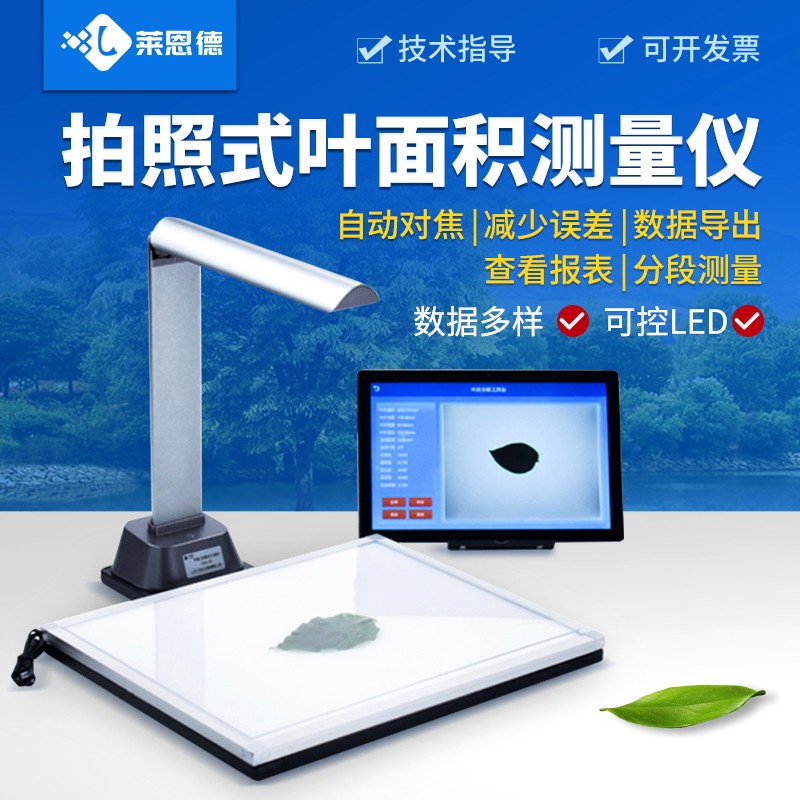
3、 Operation and maintenance of leaf area measuring instrument: a key link to ensure accurate data
Regardless of the type of leaf area measuring instrument, standardized operating procedures and regular maintenance are the core to ensure measurement accuracy. The core process includes three parts: preparation work, measurement operation, and data processing:
During the preparation phase, it is important to focus on instrument calibration and sample screening. Before starting up, it is necessary to check the cleanliness of the sensors and the battery status, and complete the calibration according to the instructions (such as using a standard area template to verify errors); Samples should be selected from leaves that grow well and are free from pests and diseases. In vivo measurements should ensure that the leaves naturally stretch and avoid folding or damage. During the measurement process, portable instruments need to ensure that the sensor is tightly attached to the blade, avoiding gaps and bubbles; Desktop instruments should have their blades placed flat to avoid overlapping or curling; The laser instrument needs to adjust the blade position to ensure that the laser beam scans the contour completely. During the data processing stage, outliers should be promptly removed, and statistical analysis (mean, standard deviation) and chart visualization should be used to clearly present the pattern of leaf area changes, providing reliable basis for subsequent research and production decisions.
In terms of maintenance, it is necessary to regularly clean the sensors and scanning components to avoid dust and stains affecting accuracy; Store in a cool and dry environment, avoiding direct sunlight and moisture corrosion; When a malfunction occurs, do not disassemble it by yourself. Contact the manufacturer for professional repair. For portable instruments used in the wild, attention should also be paid to lens protection to avoid damage to core components caused by wind, sand, and rain.
4、 Market Trends and Future Prospects of Leaf Area Measuring Instruments: Intelligent Integration Embarks on a New Chapter
With the rapid development of precision agriculture and smart agriculture, leaf area measuring instruments are evolving towards higher precision, stronger intelligence, and wider integration. Market data shows that the market size of the whole A ball live leaf area measuring instrument is expected to reach 4.5 billion yuan by 2025, with an average annual growth rate of 12-15% in the next five years. It is expected to exceed 8 billion yuan by 2029, and the Asia Pacific region will become a growing market. On the technical level, AI driven intelligent algorithms are becoming the core breakthrough point. The new generation of instruments can automatically identify blade types and switch calculation models through deep learning, with an accuracy rate of 99.2% for complex blade shape recognition; Multi parameter fusion measurement has become mainstream, synchronously monitoring leaf area with indicators such as chlorophyll content, water status, and pest and disease severity, achieving 'one piece measurement, multi-dimensional analysis'.
Business model innovation is also accelerating industry development, with diversified service models such as equipment leasing, cloud services, and technical training, reducing the procurement threshold for small and medium-sized farmers and research institutions; Domestic manufacturers, relying on their cost-effectiveness advantage (mid-range products costing 80000 to 120000 yuan), are gradually breaking the monopoly of international brands and their market share continues to rise. In terms of expanding application scenarios, leaf area measuring instruments are extending from traditional agriculture and scientific research fields to carbon sequestration measurement, climate change research, and other fields. In the Inner Mongolia Grassland Carbon Sequestration Project, by measuring the leaf area of lemon shrub forests, the annual carbon sequestration was accurately calculated to reach 1.2 tons/hectare, providing reliable data support for carbon trading.
The technological evolution of leaf area measuring instruments, from manual rough estimation to millimeter level precision of intelligent instruments, is essentially the inevitable pursuit of 'data-driven' in modern agriculture. As a key tool for decoding plant growth codes, it not only allows the value of each leaf to be accurately quantified, but also promotes the transformation of agricultural production from 'experience planting' to 'scientific management', providing solid technical support for ensuring food security, promoting ecological protection, and achieving sustainable agricultural development. In the future, with the deep integration of artificial intelligence and Internet of Things technology, leaf area measuring instruments will have a broader development space and continue to empower agricultural modernization and ecological construction.