-
E-mail
185945738@qq.com
-
Phone
15306360531
-
Address
Shandong Liende
Shandong Leiente Intelligent Technology Co., Ltd
Technical Principles and Application Fields of Water Quality Heavy Metal Analyzer
Date: 2025-12-26Read: 45
In the current era of accelerated industrialization and urbanization, heavy metal pollution in water bodies has become an environmental challenge. Heavy metal elements such as lead, mercury, cadmium, chromium, etc. have bioaccumulation and toxicity, and even trace amounts may pose a threat to human health through the food chain. As a core tool for environmental monitoring, the water quality heavy metal analyzer has become a "technological guardian" for safeguarding water resource security due to its high precision, fast response, and intelligent characteristics.
1、 Technical principle of water quality heavy metal analyzer: multi-path solution to the problem of heavy metal detection
The core technology of water quality heavy metal analyzer covers three directions: spectral analysis, electrochemical analysis, and chromatographic separation. It achieves qualitative and quantitative analysis of heavy metals through different principles:
1. Spectral analysis method: Based on the characteristic of the reaction between heavy metal ions and color reagents to generate specific color complexes, the concentration is determined by measuring the absorption intensity of the solution to specific wavelengths of light. For example, hexavalent chromium reacts with diphenylcarbazide to form a purple red complex, and the absorbance at 540nm wavelength is proportional to the concentration. Some instruments adopt a dual beam optical system, which eliminates power supply fluctuation interference through a reference beam to ensure measurement stability.
2. Electrochemical analysis method: Represented by anodic stripping voltammetry, trace detection is achieved by enriching heavy metal ions on the working electrode and applying a reverse potential to dissolve them, based on the linear relationship between stripping current and concentration. For example, the sensitivity of lead ion detection can reach 0.1 μ g/L, which is suitable for low concentration scenarios such as groundwater and drinking water.
3. Chromatographic separation method: Combined with high-performance liquid chromatography (HPLC) or ion chromatography techniques, heavy metal ions are separated and detected, suitable for analysis of complex matrix water samples. For example, mixed ions such as nickel, copper, zinc, etc. in electroplating wastewater can be separated by chromatography columns and gradually added in certain amounts.
2、 Product type of heavy metal analyzer for water quality: scenario based design to meet diverse needs
According to application scenarios and functional characteristics, water quality heavy metal analyzers can be divided into three categories:
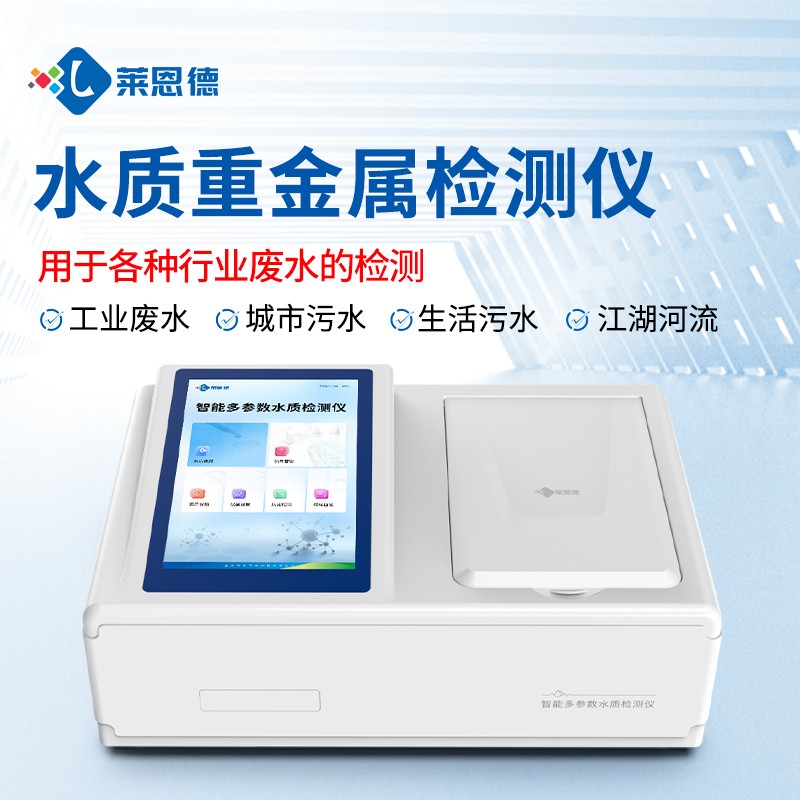
1. Portable detector: adopting an integrated design, with built-in digestion module and colorimetric system, supporting rapid on-site detection. For example, a certain brand of portable device is equipped with an 8-inch touch screen and Android operating system, which can complete hexavalent chromium detection within 10 minutes, with a detection range covering 0-5mg/L, suitable for emergency monitoring and field sampling.
2. Online monitoring device: installed in fixed locations such as sewage treatment plants and water treatment plants, achieving 24-hour continuous monitoring and remote data transmission. For example, a certain model of online instrument adopts modular design, which can simultaneously monitor 8 heavy metals such as lead, mercury, cadmium, etc. The data is uploaded in real-time to the environmental supervision platform through 4G network, and abnormal values automatically trigger alarms.
3. Laboratory level analyzer: Based on atomic absorption spectroscopy (AAS) or inductively coupled plasma mass spectrometry (ICP-MS) technology, the detection accuracy reaches ppb level, suitable for scientific research and high-precision detection scenarios. For example, ICP-MS can simultaneously detect more than 50 heavy metal elements in water samples, with a detection limit as low as 0.001 μ g/L, meeting the strict requirements of the "Sanitary Standards for Drinking Water".
3、 The application scenario of water quality heavy metal analyzer: full chain coverage of water environment management
The water quality heavy metal analyzer has penetrated into various aspects of water environment management, forming a closed loop of "prevention monitoring treatment":
1. Industrial emission monitoring: Online monitoring devices are installed at wastewater discharge outlets in industries such as electroplating, metallurgy, and chemical engineering to monitor heavy metal concentrations in real time. For example, a certain electroplating factory found that nickel emissions exceeded the standard through online instruments, and immediately adjusted process parameters to avoid pollution accidents.
2. Drinking water safety guarantee: Water treatment plants set up testing points in raw water, finished water, and end of pipe water to ensure that heavy metal content meets national standards. For example, in a water source area of a certain city, cadmium exceeded the standard due to industrial pollution. Portable detectors can quickly locate the pollution source and provide a basis for treatment.
3. Agricultural water management: Detecting heavy metal content in irrigation water and aquaculture water bodies to prevent them from entering the food chain through the soil crop system. For example, the cadmium content of irrigation water in a rice field caused the rice to exceed the standard. The detector traced the pollution source and adjusted the irrigation scheme to ensure the safety of agricultural products.
4. Emergency monitoring and scientific research support: Portable instruments can quickly delineate the pollution range in sudden incidents such as chemical leaks and traffic accidents; Laboratory level instruments provide data support for research on heavy metal migration and transformation, as well as biological toxicity.
4、 The technological trend of heavy metal analyzers for water quality: intelligence and integration leading the future
With the development of the Internet of Things, artificial intelligence, and micro/nano technologies, water quality heavy metal analyzers are showing three major trends:
1. Intelligent upgrade: Integrating AI algorithms to achieve automatic calibration, fault diagnosis, and data prediction. For example, a new type of instrument optimizes detection parameters through machine learning models, reducing the detection time of hexavalent chromium to 3 minutes and improving accuracy to 99.5%.
2. Micro nano breakthrough: New materials such as graphene sensors and quantum dot fluorescent probes are used to achieve single-molecule level detection. For example, graphene based electrochemical sensors have a sensitivity of 0.01nM for detecting lead ions, providing the possibility for early pollution warning.
3. Multi parameter integration: Integrating heavy metal detection with indicators such as pH, dissolved oxygen, COD, etc. to form a comprehensive water quality analysis platform. For example, a multi parameter detector can simultaneously monitor 12 water quality indicators and reveal the correlation between heavy metal pollution and water eutrophication through big data analysis.
5、 Challenges and Prospects of Water Quality Heavy Metal Analyzer: Technology for Good, Protecting Green Waters and Mountains
Although the technology of heavy metal analyzers for water quality is becoming increasingly mature, it still faces challenges such as cost, standardization, and grassroots popularization. In the future, with the breakthrough of domestic core components and the strengthening of policy support, detectors will develop towards the direction of "low cost, high reliability, and easy operation", helping to build a water environment monitoring network covering urban and rural areas. For example, a portable detector developed by a certain enterprise has achieved an 80% reduction in reagent usage and reduced operating costs to 0.5 yuan/time, providing an economically feasible solution for grassroots environmental protection departments.
The water quality heavy metal analyzer is not only the intersection of technology and the environment, but also a bridge for harmonious coexistence between humans and nature. Through continuous innovation and widespread application, this' technology guardian 'is contributing Chinese wisdom to water security, safeguarding the clarity and health of every drop of water.