-
E-mail
185945738@qq.com
-
Phone
15306360531
-
Address
Shandong Liende
Shandong Leiente Intelligent Technology Co., Ltd
The instrument structure and operation process of Kjeldahl nitrogen analyzer
Date: 2025-12-26Read: 89
The determination of nitrogen and protein content is one of the core analytical tasks in fields such as chemical analysis, agricultural research, food industry, and environmental monitoring. As an automated detection equipment based on the classic Kjeldahl nitrogen determination method, the Kjeldahl nitrogen analyzer has become a standard configuration in laboratories and production lines due to its high precision, high efficiency, and intelligent operation. This article will systematically analyze the technical characteristics and practical value of this instrument from the aspects of principle, structure, operation process, application scenarios, and maintenance points.
1、 The technical principle of Kjeldahl nitrogen analyzer: conversion and quantification from organic nitrogen to inorganic nitrogen
The core logic of the Kjeldahl nitrogen determination method is to convert organic nitrogen into inorganic nitrogen (ammonium salt) through chemical decomposition, and then release ammonia gas through distillation for quantitative measurement. The fully automatic Kjeldahl nitrogen analyzer decomposes this process into four key steps:
1. Digestion: The sample reacts with concentrated sulfuric acid and catalysts (such as copper sulfate and potassium sulfate) at high temperatures, decomposing organic matter into ammonium sulfate, while the catalyst accelerates the reaction process. For example, grain samples need to be digested at 380-420 ℃ for 0.5-4 hours until the solution turns transparent blue-green.
2. Distillation: An alkaline solution (such as 40% sodium hydroxide) is added to the digestion solution, and the ammonium salt is converted into ammonia gas. The water vapor carries the ammonia gas and condenses through a condenser, which is captured by the boric acid absorption solution.
3. Absorption: Boric acid solution (pH ≈ 4.5) reacts with ammonia to form ammonium salt, while the indicator (methyl red bromocresol green) changes color from green to dark red, indicating the endpoint of titration.
4. Titration: Titrate the absorption solution with a standard hydrochloric acid solution, calculate the nitrogen content based on the consumed volume, and then obtain the protein content through a conversion factor (such as a protein coefficient of 6.25 in food).
2、 The instrument structure of the Kjeldahl nitrogen analyzer: modular design ensures efficient operation
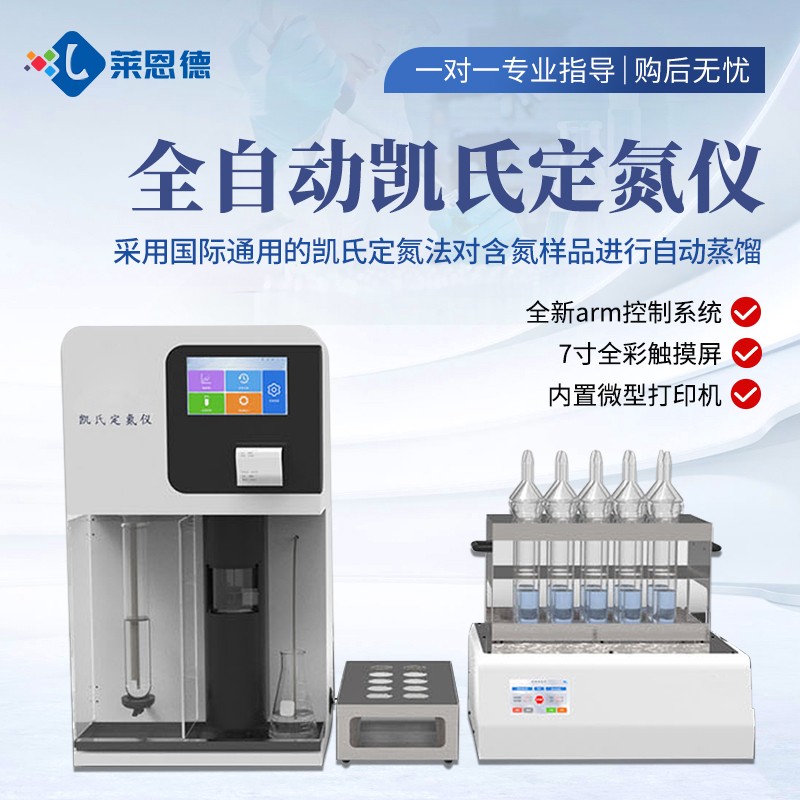
The Kjeldahl nitrogen analyzer consists of three core modules:
1. Digestion system: equipped with 250ml/400ml digestion tubes, supporting the treatment of large volume samples (such as sludge and sediment) to avoid splashing losses. The temperature gradient control function can achieve multi-stage programmed heating to ensure thorough digestion.
2. Distillation unit: Integrated anti backflow device and condensate circulation system, distillation speed<5 minutes/sample. For example, a certain model of instrument can increase the ammonia recovery rate to 99.5% through intelligent distillation control.
3. Titration device: Using a digital burette with a resolution of 0.01ml, combined with a color sensor to automatically determine the endpoint, with a repeatability error CV ≤ 0.5%. A certain brand of instrument controls the amount of reagents added through a microprocessor to ensure the reproducibility of the test results.
3、 Operation process of Kjeldahl nitrogen analyzer: standardized steps to reduce human error
1. Sample preparation: Solid samples need to be crushed into uniform particles, and liquid samples need to be thoroughly mixed. For example, when testing feed protein, it is necessary to weigh 0.1-0.5g of the sample, accurate to 0.0001g.
2. Reagent configuration: Use ammonia free distilled water to prepare digestion reagents (concentrated sulfuric acid+catalyst), alkaline solution (40% sodium hydroxide), absorbent solution (2% boric acid), and standard acid solution (0.1mol/L hydrochloric acid).
3. Digestion treatment: Add the sample and reagent into the digestion tube and place it on the digestion furnace for programmed heating. A certain instrument uses an intelligent temperature control system to shorten digestion time to 1.5 hours while avoiding severe reactions.
4. Distillation titration: After installing the digestive tube, the instrument automatically completes the entire process of alkali addition, distillation, absorption, and titration. For example, a certain model of instrument monitors indicator changes in real time through a color sensor, and the titration endpoint judgment error is a<0.02ml.
5. Data output: The detection results are automatically displayed and printable, supporting dual-mode output of nitrogen content (mg) and protein content (%).
4、 Application scenarios of Kjeldahl nitrogen analyzer: detection tools covering multiple fields
1. Food industry: Detect the protein content of meat, dairy products, grains, etc., in accordance with the requirements of GB 5009.5-2016 "National Food Safety Standard - Determination of Protein in Food". For example, a dairy company used a fully automatic Kjeldahl nitrogen analyzer to shorten the protein detection time from 4 hours to 20 minutes.
2. Agricultural research: Determine the total nitrogen content of tobacco and soil to guide fertilization strategies. A certain agricultural laboratory found through instrument analysis that the nitrogen content in a certain plot was low. Timely supplementation of nitrogen fertilizer increased crop yield by 15%.
3. Environmental monitoring: detecting nitrogen pollutants (such as ammonia nitrogen and nitrate nitrogen) in water bodies and sediments, and assessing the risk of eutrophication in water bodies. A certain environmental protection agency used instruments to monitor the water quality of a lake and found that the nitrogen content exceeded the standard. After taking control measures, the water quality significantly improved.
4. Research field: Support extended detection of phenolic compounds, volatile fatty acids, etc. to meet the needs of complex sample analysis. For example, a university laboratory uses instruments to measure the nitrogen content in a certain chemical, providing data support for the development of new materials.
5、 Maintenance and troubleshooting of Kjeldahl nitrogen analyzer: key to extending the lifespan of the instrument
1. Daily maintenance:
Clean the pipeline after each use to prevent blockage caused by reagent crystallization.
Regularly check the condensate circulation system to ensure cooling efficiency.
Clean the scale on the heater after long-term use to avoid affecting the heating rate.
2. Common troubleshooting:
No steam generation: Check if the fuse is blown or if the steam generator water level sensor is faulty.
Abnormal liquid addition: Confirm that the liquid level in the reagent tank is sufficient, and check whether the solenoid valve is blocked or leaking.
Titration endpoint misjudgment: calibrate the sensitivity of the color sensor or replace the indicator.
3. Safety precautions:
Do not use digestive tubes with cracks to prevent them from bursting at high temperatures.
Wear protective gloves during operation to avoid contact with strong acids and alkalis.
Waste liquid needs to be discharged through dedicated pipelines to prevent environmental pollution.
6、 The technological trend of Kjeldahl nitrogen analyzer: intelligent and integrated upgrade
With the development of Internet of Things technology, the new generation of Kjeldahl nitrogen analyzer has achieved remote monitoring, cloud storage of data, and automatic calibration functions. For example, a certain brand of instrument monitors real-time parameters such as digestive tube temperature and distillation pressure through built-in sensors, and optimizes reaction conditions through AI algorithms to improve detection accuracy to ± 0.1mg nitrogen. In addition, modular design supports rapid replacement of digestion and distillation units, meeting the needs of multi scenario detection.
The Kjeldahl nitrogen analyzer has become a benchmark tool for nitrogen and protein content detection due to its rigorous scientific principles, intelligent instrument design, and standardized operating procedures. From laboratories to production lines, from food safety to environmental governance, this instrument is continuously driving technological innovation and efficiency improvement in the field of analysis and testing.