-
E-mail
223423432@126.com
-
Phone
13818411908
-
Address
No. 1508 Hewu Road, Baozhen, Chongming District, Shanghai
Shanghai Benfu Machinery Mold Manufacturing Co., Ltd
How to choose a suitable tablet press die?
Date: 2025-12-18Read: 4
The punching die of a tablet press is a core component in tablet production in industries such as pharmaceuticals, food, and chemicals. Its selection directly affects production efficiency, product quality, and equipment lifespan. The following are the key factors and steps for choosing a suitable punching die to help you make informed decisions.
1、 Clarify equipment types and production requirements
The selection of stamping dies should first consider the type of tablet press that matches it. Single stamping machine is suitable for small batch or laboratory production, with a simple die structure but low efficiency; The rotary tablet press supports multiple die configurations, suitable for large-scale continuous production, and can efficiently press circular or irregular tablets.
2、 Select materials based on their characteristics
Material characteristics are the core basis for selecting stamping die materials. For ordinary drugs or food raw materials, alloy steel stamping dies (such as GCr15 or Crl2MoV) have good wear resistance and economy, which can effectively extend their service life. If dealing with high hardness or corrosive materials (such as metal powders), hard alloy or ceramic stamping dies are more suitable, as they have excellent wear and corrosion resistance but higher costs. In addition, formulas with poor material fluidity need to be paired with deep arc circular dies to reduce the risk of sticking to the mold.
3、 Adhere to industry standards and compatibility
The stamping die standard ensures compatibility with the equipment. The ZP standard (GB12253-90) is commonly used in the domestic pharmaceutical industry, while export equipment must comply with IPT international standards. When selecting, it is necessary to confirm that the size of the die (such as a diameter of 5-19mm) matches the model of the tablet press to avoid uneven pressing or equipment damage caused by deviations in aperture or length.
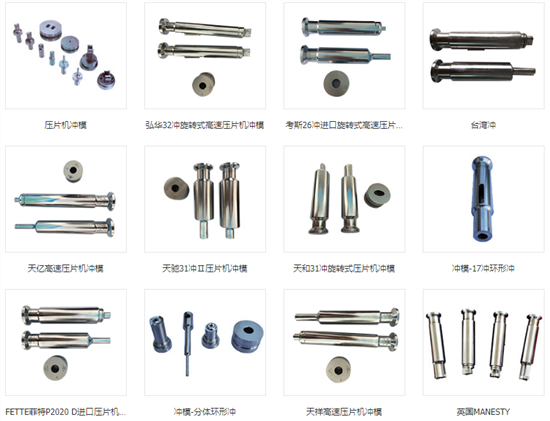
4、 Consider tablet shape and functional requirements
The shape of the tablet determines the design of the punching die. Circular tablets use shallow or deep arc circular dies, with deep arc designs suitable for sugar coated tablets, while flat circular dies are used for regular tablets. Alien tablets (such as ellipses or triangles) require customized stamping dies to meet special drug delivery needs. Functionally, engraving or moisture-proof stamping dies can improve product recognition and shelf life, but will increase manufacturing costs.
5、 Evaluate cost and maintenance convenience
The cost needs to be combined with initial investment and long-term maintenance. Low priced stamping dies (such as food grade) are suitable for budget limited scenarios, but may sacrifice durability; Although industrial grade stamping dies are expensive, they have a long lifespan and low maintenance costs. In terms of maintenance, choosing molds that are easy to clean and rust resistant can reduce downtime and meet GMP hygiene requirements. Regular inspection of die wear and timely replacement of components are key to ensuring production continuity.
6、 Consulting suppliers and customized services
Collaborating with professional suppliers can optimize the selection process. Provide details such as material composition, production pressure, and corrosiveness, and suppliers can recommend materials and heat treatment solutions. Customized services (such as non-standard stamping dies) can meet special needs, but need to balance delivery time and cost.
By analyzing factors such as equipment, materials, standards, and costs through the system, you can accurately select stamping dies to improve production efficiency and product quality. If there are specific needs, such as comparison tables or in-depth consultations, further communication can be conducted.