-
E-mail
2880397607@qq.com
-
Phone
13816259149
-
Address
No. 8 Tianfeng Road, Tianma Economic and Technological Development Zone, Sheshan Town, Songjiang District, Shanghai
Shanghai Tianfeng Pharmaceutical Equipment Co., Ltd
What is the process principle of effervescent tablet press?
Date: 2025-12-10Read: 71
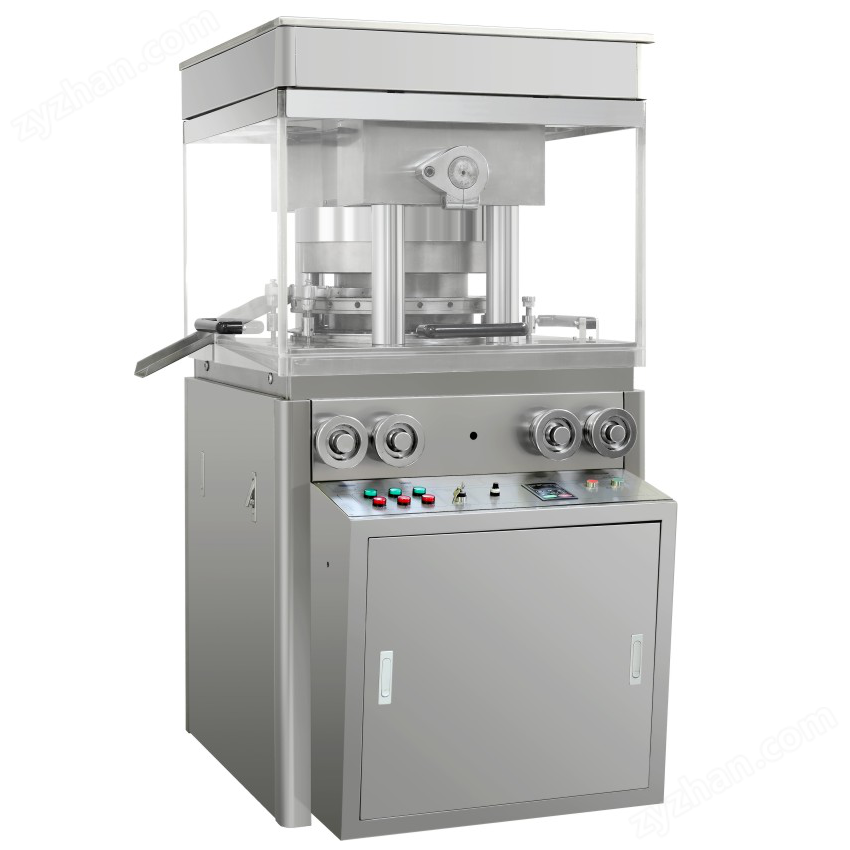
In the pharmaceutical and food industries, effervescent tablets are widely popular due to their rapid dissolution and easy portability. The effervescent tablet press, as the core production equipment, compresses drug powder or particles into tablets through precision technology. Its process principle integrates key links such as material processing, pressure control, and chemical reactions. The following analyzes its core mechanism from two aspects: device construction and workflow.
1、 Equipment structure: seven core components work together
The main structure of the effervescent tablet press is composed of seven components, each responsible for ensuring efficient production:
1. Body: As the "skeleton" of the equipment, it is made of thick steel to provide stable support, reduce operational vibration, and ensure the accuracy of pressing.
2. Turntable: The core workbench rotates at high speed around the central axis, with multiple evenly distributed mold holes. Each mold hole corresponds to a set of pressing components, achieving continuous operation.
3. Feeding device: usually a hopper with stirring, which evenly fills the raw materials (such as powder or particles) into the turntable mold hole through the discharge port to avoid uneven weight caused by material shortage.
4. Tablet pressing mechanism: It includes upper and lower punch heads (i.e. "upper mold" and "lower mold"), which move synchronously during the positioning of the mold hole. The upper punch presses down and the lower punch head presses up, compressing the raw material into hard tablets. The pressure can be adjusted to meet different hardness requirements.
5. Adjustment device: divided into two parts to control accuracy: piece weight adjustment changes the loading amount by adjusting the height of the lower punch; Pressure regulation controls the downward pressure of the upper punch to ensure consistency in tablet thickness and density.
6. Tablet dispensing device: using an inclined scraper or ejector mechanism, when the pressed tablets are moved to the dispensing position with the turntable, the lower punch head lifts to eject the tablets, and the scraper sends them into the collection container to maintain the integrity of the finished product.
7. Transmission device: composed of a motor, a reducer, and gears, it drives the turntable, punch, and feeding device to operate, and adjusts the speed to optimize production efficiency.
2、 Workflow: Automated four step cycle
The operation of the effervescent tablet press is a continuous and automated process. With each rotation of the turntable, the mold hole completes one tablet production
1. Material feeding: The raw materials are input into the rotary mold hole through the feeding device to ensure uniform and moderate particle size, laying the foundation for subsequent pressing. This step needs to be completed quickly under high-speed rotation to avoid insufficient loading affecting quality.
2. Pressure regulation and compression: When the mold hole is moved to the compression position, the compression mechanism starts and the upper and lower punches work together to apply pressure. The pressure sensor and control system adjust the force in real-time to ensure consistent tablet density and avoid cracking or top cracking. For effervescent tablets, space needs to be reserved to accommodate disintegrants (such as acid and base sources), which react with water to generate carbon dioxide gas.
3. Mold vibration and demolding: During the pressing process, slight mold vibration helps fill the cavity with material, making the surface of the tablet smoother. After the compression is completed, the demolding system extracts the tablets from the mold hole through pneumatic or mechanical means to prevent damage.
4. Finished product collection: After demolding, the tablets are sent into the collection container by the tablet dispensing device to ensure cleanliness and integrity, facilitating subsequent packaging. The unique disintegration characteristics of effervescent tablets enable them to quickly dissolve in water, producing bubbles that roll and accelerate disintegration, thereby enhancing their bioavailability.
3、 Technological advantages and industry applications
The effervescent tablet press achieves efficient and stable tablet production through precise control. Its technological advantages include:
1. Rapid dissolution: The carbon dioxide bubbles generated by the reaction of the disintegrant cause the tablet to rapidly disintegrate in water, making it suitable for use by children, elderly patients, and those with swallowing difficulties.
2. Uniform quality: Pressure regulation and mold vibration ensure tablet density and surface smoothness, reducing scrap rates.
3. Widely applicable: not only used in pharmaceuticals (such as vitamin C effervescent tablets), but also expanded to the fields of food and health products to meet modern health needs.
In short, the effervescent tablet press provides key technical support for the pharmaceutical and food industries by automating processes and precision components to convert raw materials into functional tablets.
Last Article: What industries can effervescent tablet press be used for?
Next Article: What is the process flow of high-speed tablet press?