-
E-mail
2881667763@qq.com
-
Phone
18917034095
-
Address
Building 6, No. 559 Dongzhou Road, Dongjing Town, Songjiang District, Shanghai
Shanghai Tianhe Machinery Equipment Co., Ltd
Fully automatic capsule filling machine: process flow and structural composition description
Date: 2025-11-04Read: 6
The fully automatic capsule filling machine is a key equipment for achieving automated production of capsules in the pharmaceutical industry. It is mainly used to accurately fill powder, granular drug raw materials or auxiliary materials into hollow capsule shells, completing the closure and molding of capsules. Its operation does not require a large amount of manual intervention, can reduce human pollution, ensure consistency in capsule filling, and adapt to the needs of large-scale capsule production. Understanding its process flow and structural composition is the foundation for ensuring stable operation of equipment and improving production efficiency.
1、 The core process flow of fully automatic capsule filling machine
The process of the fully automatic capsule filling machine revolves around "capsule sorting filling closing finished product output", and each link is closely connected to ensure continuous and efficient filling:
1Hollow Capsule Sorting and Orientation
After the hollow capsules (including the cap and body) are poured into the capsule hopper of the equipment, they enter the sorting mechanism through a vibrating conveyor device; The organization utilizes the morphological differences of the capsules to adjust the messy capsules in a unified direction (with the cap facing up and the body facing down), while removing deformed and damaged unqualified capsules to ensure smooth filling in the subsequent process.
2Capsule cap and body separation
The directed capsules enter the separation mechanism and are separated from the cap and body by negative pressure adsorption or mechanical pushing; The separated body is transported to the filling station, while the cap body is temporarily stored in the corresponding position, waiting for subsequent closure with the filled body.
3Material filling
After the body reaches the filling station, the feeding mechanism of the equipment evenly transports the powder or granular materials to be filled into the filling mold; Subsequently, the filling mechanism precisely fills the material into the interior of the body through methods such as downward pressure, suction, or scraping, ensuring that the filling amount of each body is consistent and reducing deviations.
4Capsule closure and finished product testing
The filled body is transported to the closing station, and the temporarily stored cap is precisely fastened onto the body to form a complete capsule; The closed capsules enter the testing stage, and unqualified capsules that are not closed, have insufficient filling, or are overweight are removed through optical or weight detection devices; Qualified finished products are transported to the collection device to complete the entire filling process.
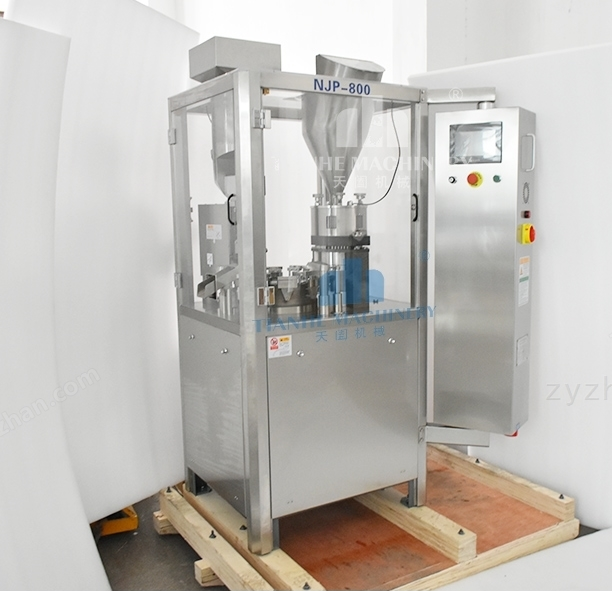
2、 The main structural components of the fully automatic capsule filling machine
The structure of the fully automatic capsule filling machine is designed around the process flow, and the core components work together to support efficient and stable capsule filling, mainly including:
1Capsule sorting and separation system
Including capsule hopper, vibration conveying device and separation mechanism: the hopper is used to store hollow capsules, with smooth inner walls to avoid capsule adhesion; The vibration conveying device delivers capsules in an orderly manner to the sorting mechanism through gentle vibration; The separation mechanism is equipped with adsorption or push components to achieve precise separation between the capsule cap and body, ensuring smooth subsequent filling.
2Material filling system
Composed of a feeding device, a filling mold, and a filling mechanism: the feeding device evenly transports the material to the filling area to avoid material accumulation; The filling mold is designed according to the capsule specifications to ensure that the material can be accurately filled into the body; The filling mechanism controls the consistency of the filling amount by steadily pressing or sucking the material into the body.
3Capsule closure and detection system
Including a closure mechanism and a detection device: The closure mechanism precisely buckles the cap body with the filled body through mechanical alignment, ensuring tight closure of the capsule; The detection device is equipped with optical sensors or weight sensing components to quickly identify non-conforming capsules and automatically remove them, reducing the rate of defective products in the finished product.
4Transmission and Control System
The transmission system consists of motors, gears, and conveyor belts, providing power for the operation of various parts of the equipment and ensuring the synchronization of their actions; The control system is equipped with an operation panel and a logic control unit. Operators can set operating parameters (such as filling speed) through the panel. At the same time, the system can monitor the equipment's operating status in real time and issue timely warnings in case of abnormalities, ensuring production safety.