-
E-mail
liuyuanzhi@eti-test.com
-
Phone
19201635557
-
Address
Wujiang to Tongli Economic Development Zone, Suzhou City
Suzhou Yitai Environmental Technology Co., Ltd
The important role of planktonic bacteria sampler: guardian of intangible boundaries
Date: 2025-09-03Read: 6
The important role of planktonic bacteria sampler: guardian of intangible boundaries
In many key areas of modern society, such as pharmaceuticals, medical devices, food and beverage, hospital operating rooms, and electronic cleanrooms, environmental microbial contamination control is the absolute lifeline of product quality and public safety. The ubiquitous microorganisms in the air - planktonic bacteria, although invisible to the naked eye, can cause product spoilage, medical infections, and even major public health incidents. In this context, the importance of the Airborne Microbial Sampler as a key active monitoring device is self-evident. It is not only the "monitoring eye" for environmental microbial levels, but also the "decision-making cornerstone" for quality control and risk management.
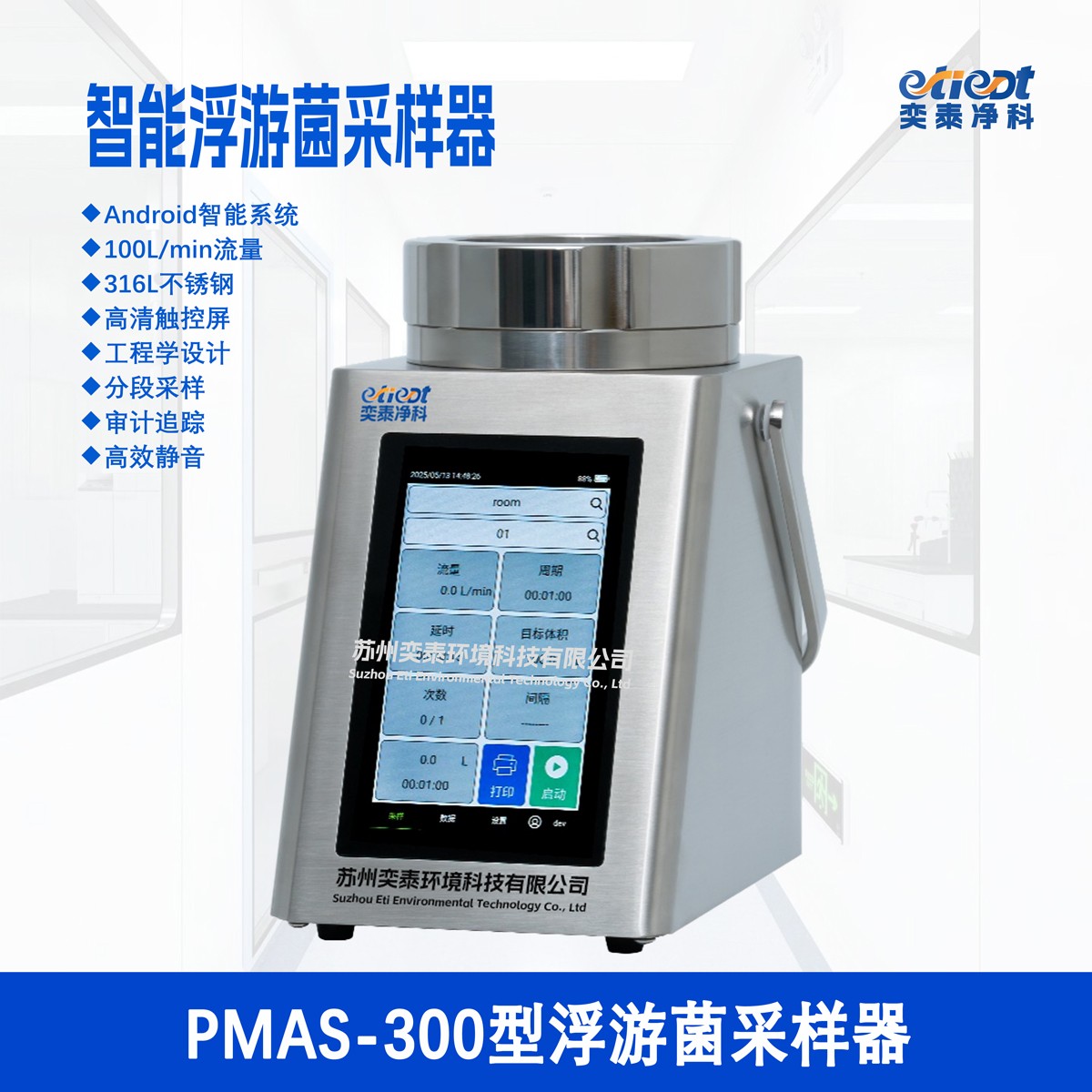
The PMAS-300 intelligent planktonic bacteria sampler produced by Suzhou Yitai Environmental Technology Co., Ltd. is the direction of intelligent development of domestic detection instruments in the new era!
1、 From Passive to Active: A Revolutionary Leap in Monitoring Methods
Before the emergence of planktonic bacterial samplers, traditional settling bacterial plates (passive settling method) were the main monitoring method. Although this method is simple, it has obvious shortcomings: it can only capture large particle colonies that settle onto the plate due to gravity, and cannot quantitatively evaluate the total amount of microorganisms in a unit volume of air. The results are easily affected by various factors such as airflow, particle size, and exposure time, and have limited accuracy and representativeness.
The birth of planktonic bacteria samplers has achieved a technological leap from "passive waiting" to "active capture". It generates precise airflow through a built-in pump, forcibly sucks in a specific volume (usually cubic meters) of air, and efficiently collects microbial particles in the air into a culture dish or liquid medium using physical methods such as impact, centrifugation, filter membrane, etc. This enables the monitoring results to achieve trueQuantification of airborne microbial concentrationUsing CFU/m ³ (colony forming units per cubic meter) to scientifically and objectively evaluate environmental cleanliness provides accurate data support for subsequent interventions and improvements.
2、 The core and important role of planktonic bacteria sampler
1. The cornerstone of clean environment verification and daily monitoring
Under the framework of regulatory standards such as GMP (Good Manufacturing Practice) and ISO 14698, the performance of clean rooms and clean areas must be continuously validated. The planktonic bacteria sampler is the core tool for performing this task. It is used for:
Static verificationConfirm whether the clean area meets the designed microbial control level under empty or static conditions.
dynamic monitoringAssess the actual impact of personnel activities and equipment operation on microbial load during production, surgery, and other operations to ensure that the environment is always under control.
2. Detector for pollution source investigation and risk control
When there are issues such as excessive microbial content in products, failure of sterile testing, or an increase in hospital infection rates, the planktonic bacteria sampler serves as a "probe" to trace the source of contamination. By conducting targeted sampling at different locations, times, and stages of operation, a distribution map of microbial contamination can be drawn, and pollution hotspots (such as personnel passages, equipment entrances, return air outlets, etc.) can be accurately located. Effective isolation, cleaning, or process optimization measures can be taken to cut off the pollution chain from the source.
3. Judges for evaluating the effectiveness of disinfection and sterilization
The effectiveness of any disinfection procedure (such as ultraviolet irradiation, fumigation, ozone sterilization) cannot be judged solely based on theory. By using a planktonic bacterial sampler for comparative monitoring before and after disinfection, the bactericidal efficiency, duration of bactericidal effect, and the presence of disinfection blind spots of disinfectants can be quantitatively evaluated, providing irrefutable scientific evidence for optimizing disinfection plans.
4. A guide for optimizing process flow and personnel behavior
Microbial contamination mainly comes from personnel. By sampling, it is possible to evaluate the level of microbial emission in the environment caused by different dress codes, changing procedures, and operating actions, and then train employees to develop more standardized aseptic operating habits. At the same time, it can also be used to evaluate the rationality of processes such as material transportation and equipment cleaning, achieving precise process control.
5. Passes that comply with regulatory requirements and quality audits
Major regulatory agencies around the world, such as FDA, EMA, and NMPA, have made environmental microbiological monitoring a mandatory requirement. Complete, accurate, and traceable monitoring data of planktonic bacteria is an important component of the product quality documentation package, and is a key evidence for responding to regulatory and customer audits, and proving one's ability to continuously produce safe and reliable products.
3、 Technical principles and selection: how to maximize their effectiveness
The mainstream planktonic bacterial samplers often useImpact principleIncluding various designs such as slit type and pinhole type. Its core is to precisely control the microbial particles in the air to remain on the surface of nutrient rich agar plates due to inertial impact, and after cultivation, form visible colonies for counting.
When selecting and using a sampler, the following factors should be considered to ensure its effectiveness:
Sampling flow and accuracyThe stability of flow directly affects the accuracy of results, and the commonly used flow rate is 100L/min.
Impact efficiencyThere should be a high capture rate for microbial particles of different sizes.
The impact on microbial activityThe sampling process should be gentle to avoid microbial inactivation caused by dry stress and false negatives.
applicabilityWhether it is easy to disinfect, suitable for use in clean areas, noise level, etc.
data integrityModern samplers typically have software support to record information such as sampling time, location, volume, operator, etc., ensuring that the data complies with the ALCOA+principle (attributable, clear, synchronized, original, accurate).
4、 Conclusion
The planktonic bacteria sampler is far from a simple pumping device, it is a key bridge connecting the intangible microbial world with tangible quality control. In industries highly dependent on clean environments, it plays a sentinel role、 zhen tan、 Fa Guan and mentorMultiple roles. By providing quantitative and objective data, it shifts microbial quality control from empirical to scientific management, and from passive response to proactive prevention. Investing in and correctly using high-performance planktonic bacteria samplers is not only a necessity to meet regulations, but also a reflection of the company's own brand and high responsibility for consumer health. It is a loyal guardian of the intangible boundaries of product quality and safety.