-
E-mail
yang.chen4@thermofisher.com
-
Phone
13386161207
-
Address
xinjinqiao
Thermo Fisher Scientific (China) Co., Ltd
Why is stainless steel "stainless"
Date: 2025-10-28Read: 3
Introduction
Stainless steel is widely used in manufacturing, construction, food processing, medical equipment and other fields due to its excellent weldability, chemical corrosion resistance, high temperature resistance, and excellent mechanical properties. The core reason why stainless steel does not rust is that a dense chromium oxide passivation film is formed on its surface, which can effectively isolate corrosive media such as oxygen and moisture from contact with the internal metal substrate, thereby preventing oxidation reactions from occurring. This mechanism depends on the chromium content in stainless steel (usually ≥ 12.5%) and the synergistic effect of elements such as nickel. Some inferior stainless steels, in order to reduce costs, lower chromium and nickel content, and increase manganese, result in incomplete or easily ineffective passivation films, leading to rusting. Long term excessive intake of manganese by people may cause "manganese" poisoning, so the manganese content in stainless steel used for food contact materials is usually less than 2%. In addition, the national standard stipulates that the manganese migration of stainless steel materials used for food contact must be less than 2mg/kg.

Small tips:
If the stainless steel tableware you bought at home has rusted after a period of use, it is enough to prove that it is inferior and unqualified stainless steel tableware, and the chromium content in it does not meet the standard. For consumers, they should prioritize choosing 304 and 316 food grade stainless steel insulated cups/kettles/tableware, and avoid 201 materials.
The elemental composition in stainless steel has an extremely important impact on the performance and safety of stainless steel materials. The accurate determination of these elements plays an important guiding role in the production and research and development of stainless steel materials.
Testing difficulties:
•The accuracy requirement for the main content element (chromium nickel) is extremely high, and the equipment is required to have excellent stability;
•The main content element content is high (up to 20%), requiring the equipment to have a high linear range;
•The spectral interference of iron nickel matrix is severe, and the detection of impurity elements requires equipment with excellent optical resolution;
•Impurity elements such as phosphorus, due to the strong spectral interference of 213.6nm phosphorus, require the use of a far ultraviolet wavelength of 178.2nm phosphorus, requiring high sensitivity of the far ultraviolet spectral line of the equipment.
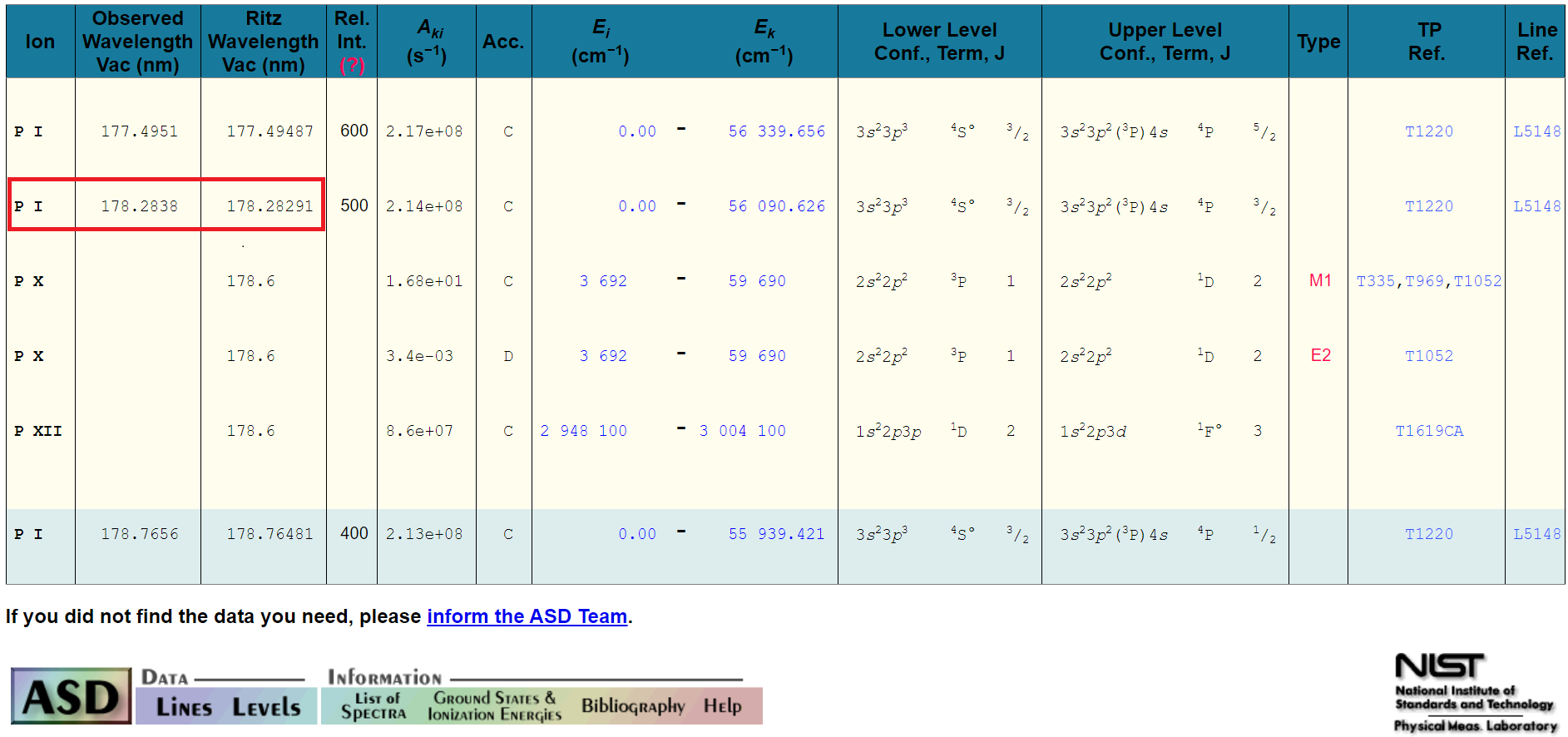
Phosphorus element spectral lines in NIST spectral library (click to view large image)
The Thermo Fisher iCAP PRO series inductively coupled plasma emission spectrometer can achieve simple and rapid detection of major and impurity elements in stainless steel.
Highlights of the plan:
•The iCAP PRO series ICPOES has high sensitivity and a wide linear range. It uses stainless steel solid standard materials to make standard curves, which is simple and fast, and can achieve simultaneous determination of high and low content elements in stainless steel;
•The detector has a pixel resolution of up to 0.002nm, which can better reduce spectral interference from iron nickel substrates;
•Excellent sensitivity in the far ultraviolet region, with a detection limit of up to μ g/L for phosphorus element using a 178.2nm spectral line instrument;
•Precision constant temperature optical path system, fully designed with three precision mass flow meters, combined with a vertical torch bidirectional observation sampling system and an aerodynamic design with a double-layer torch chamber. The instrument has excellent long-term stability (4-hour long-term stability RSD<1%);
•All element concentration ranges have good linear relationships (r ²>0.999), and the solid standard substance test values are within the certificate value range. The 2-hour RSD of the main content element chromium nickel is less than 0.3%.

Detailed presentation of the plan
► Standard solution preparation and sample pretreatment
Standard solution preparation: To reduce matrix interference, 5 different contents of solid standard substances are dissolved to prepare standard curves.
Sample preparation: Accurately weigh about 0.1000 grams of the sample in a quartz beaker, wet it with a small amount of water, add 4ml (1+1) aqua regia (1 volume nitric acid, 3 volumes hydrochloric acid, 4 volumes water), heat it at low temperature on an electric heating plate until the sample is completely dissolved to a clear state, and transfer it to a 100ml volumetric flask and make up the volume after the sample cools down.
► instrument parameters

(Click to view large image)
► Wavelength selection and correlation coefficient R
Stainless steel has a complex matrix with multiple alloying elements and severe spectral interference. Therefore, it is recommended to choose spectral lines with less interference, as shown in the figure below. Phosphorus should be prioritized at 178.284nm.

Spectrum of phosphorus element in stainless steel matrix (213.618nm)
(Click to view large image)

Spectrum of phosphorus element in stainless steel matrix (178.284nm)
(Click to view large image)
Wavelength recommendation and corresponding correlation coefficient:

(Click to view large image)
► National Solid Standard Material Testing Results

(Click to view large image)
► Stability experiment
The sample selected for the experiment is stainless steel standard substance (unit:%), which is measured every 20 minutes for 2 hours, for a total of 7 measurements. The relative standard deviation is calculated. The relative standard deviation of high content chromium nickel is less than 0.3%.

(Click to view large image)
Summary
The Thermo Fisher iCAP PRO series inductively coupled plasma emission spectrometer can complete sample injection and data acquisition within 1.5 minutes for testing a single sample. The sample testing has good stability and high accuracy, accurately ensuring the "stainless" and safety of stainless steel materials.