-
E-mail
172089539@qq.com
-
Phone
13626546557
-
Address
No. 5 Yonggong South Road, South Industrial Zone, Shacheng Street, Longwan District, Wenzhou City, Zhejiang Province
Wenzhou Tianwo Machinery Technology Co., Ltd
Hangzhou Emulsification Tank - National Supply
Date: 2024-11-25Read: 7
Emulsifying tank is a key equipment in modern industrial production, widely used in industries such as food, cosmetics, pharmaceuticals, and chemicals. Its core mission is to efficiently and evenly mix two originally immiscible liquids (such as oil and water) to form a stable, uniform lotion system on a micro scale.
1、 Core working principle: cutting, squeezing, and crushing
The working principle of an emulsification tank is not simply stirring, but based on the physical emulsification effect brought by high-strength mechanical force. The process is mainly divided into two stages: macroscopic mixing and microscopic homogenization:
1. Macro premixing stage: the central agitator (usually frame type or anchor type) rotates at a low speed under the drive of the motor to preliminarily mix the oil phase, water phase and other auxiliary materials to form a coarse lotion. This stage ensures the macroscopic uniformity of the material, preparing for subsequent fine emulsification.
2. Microscopic fine emulsification stage (core stage): The high-speed homogenizer (also known as the emulsification head) located at the bottom or side of the tank begins to work. Its core is a precise combination of rotor and stator. The rotor rotates at high speed under the drive of the motor (usually up to 0-3000rpm or higher), generating a strong centrifugal force that draws material in from the center of the rotor.
High strength shearing: The material is instantly ejected from the extremely narrow gap (usually only a few tenths of a millimeter) between the high-speed rotating rotor and the stationary stator. This process generates enormous hydraulic shear forces, impact forces, and turbulence.
• Droplet fragmentation and homogenization: under this strong mechanical action, the dispersed phase (such as oil droplets) is rapidly torn and broken into extremely small droplets, which are evenly distributed to the continuous phase (such as water), forming a stable lotion with small particle size and narrow distribution range. The particle size can reach the micrometer or even nanometer level.
The physical changes caused by this mechanical force make the product taste more delicate, the appearance more shiny, the system more stable, and less prone to layering, oil separation, or precipitation.
2、 Main Structure and Components
A typical emulsion tank is a system that integrates multiple functions, with its main components including:
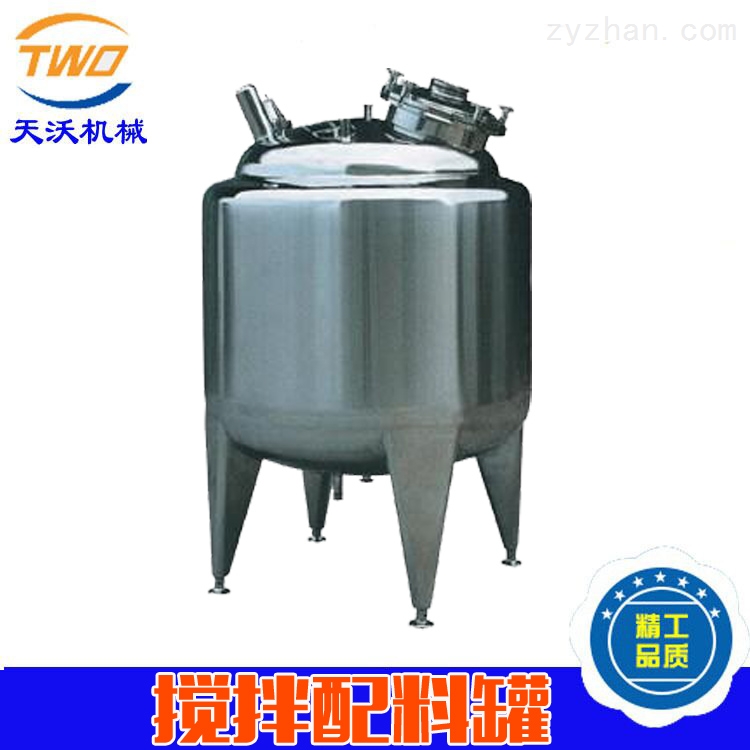
Tank body: It is usually made of high-quality stainless steel (such as 304 or 316L), with polished inner and outer surfaces that are smooth and easy to clean, in compliance with GMP standards. The tank body is designed with a jacket structure, which can be heated, insulated or cooled by introducing steam/hot water or coolant.
Mixing system: composed of a slow mixing motor, reducer, and mixing blade. Responsible for macro mixing, ensuring uniform heating of materials, and preventing local overheating or burning.
Homogenization system: composed of a high-speed homogenization motor and a homogenization head (rotor stator). It is the core power source for achieving fine emulsification.
Transmission system: Mechanical or magnetic seals are usually used to ensure that there is no leakage inside the tank under vacuum or pressure conditions, ensuring safety and hygiene.
Temperature control system: The jacket is connected to temperature control devices (such as electric heating tubes, steam valves, refrigerant valves), and the material temperature is precisely controlled through an automatic control system.
Vacuum system: Equipped with a vacuum pump, it can evacuate during the emulsification process, remove bubbles from the material, prevent the product from producing pores in the later stage, and also avoid oxidation and deterioration of the material during mixing.
Control system: Modern emulsion tanks are equipped with PLC or touch screen control systems, which can set and store process formulas, automatically control mixing speed, homogenization speed, temperature, vacuum degree, time and other parameters, achieve automated production, and ensure consistency of each batch of products.
• Other attachments: window mirrors, manholes, cleaning balls (CIP online cleaning system), various material imports and exports, etc.
3、 Widely applicable fields
Food industry: produces dairy products (yogurt, flavored milk), beverages (protein drinks, juice emulsions), seasonings (salad dressings, mayonnaise, hotpot base), ice cream, chocolate, candies, etc.
• Cosmetics and daily chemical industry: manufacturing cream, lotion, essence, shampoo, shower gel, toothpaste, sunscreen, etc.
Pharmaceutical industry: producing ointments, creams, emulsions, suppositories, topical ointments, etc.
• Chemical industry: preparation of pesticide emulsifiable concentrates, nano materials, polymer lotion, coatings, inks, etc.
4、 Summary of Standard Operating Procedures (SOP)
1. Preparation (SIP/CIP): Before operation, the emulsification tank must be cleaned and disinfected.
2. Feeding: Usually, the aqueous raw materials are first put into the tank, and slow stirring is started and heating is initiated. Then slowly add the oil phase raw material (which needs to be melted in advance).
3. Pre mixing and heating: Under slow stirring, heat the material to the emulsification temperature required by the process and keep it for a period of time for sterilization.
4. Homogeneous emulsification: turn on the high-speed homogenizer, and operate for a certain time under specific temperature, speed and vacuum conditions according to the product process requirements until a uniform and delicate lotion is formed.
5. Cooling and discharge: After emulsification is completed, cooling water is introduced through a jacket, and the material is cooled to the discharge temperature under slow stirring. During the process, a vacuum can be maintained to prevent the intake of external air. Finally, the finished product is transported to the next process or storage tank through the bottom discharge port.
6. Cleaning: After production is completed, immediately perform online cleaning to prepare for the next batch of production.
5、 Precautions for safe operation and maintenance
Safety first: It is strictly prohibited to insert hands or tools into the tank during equipment operation. Ensure that all protective covers are installed properly.
Standardized operation: It is necessary to strictly follow the equipment operating procedures and product process formula. It is strictly prohibited to operate the homogenizer head at high speed in an unloaded state to avoid damaging the mechanical seal.
• Pay attention to inspection: Regularly check the sealing performance of mechanical seals, the concentricity of mixing and homogenization systems, and whether there are any abnormal sounds.
• Regular maintenance: Regularly replenish or replace lubricating oil for the gearbox, check if all fasteners are loose, and ensure that the equipment is in optimal condition.
In summary, the emulsification tank is a technology intensive equipment, and its efficient, stable, and automated characteristics play a crucial role in improving product quality, ensuring production efficiency, and achieving large-scale and standardized production. The correct selection, use, and maintenance of emulsion tanks are the core links in the production of related industries.
Last Article: The safety issue of emulsion tanks cannot be ignored
Next Article: In depth analysis of cosmetic emulsion cans