-
E-mail
277485272@qq.com
-
Phone
13515874689
-
Address
1st Floor, Wenzhou Yangda Machinery, Dachitou Industrial Zone, Nanbin Street, Rui'an City
Wenzhou Yangda Machinery Co., Ltd
Structural characteristics of liquid bubble wrap packaging machine
Date: 2025-12-22Read: 3
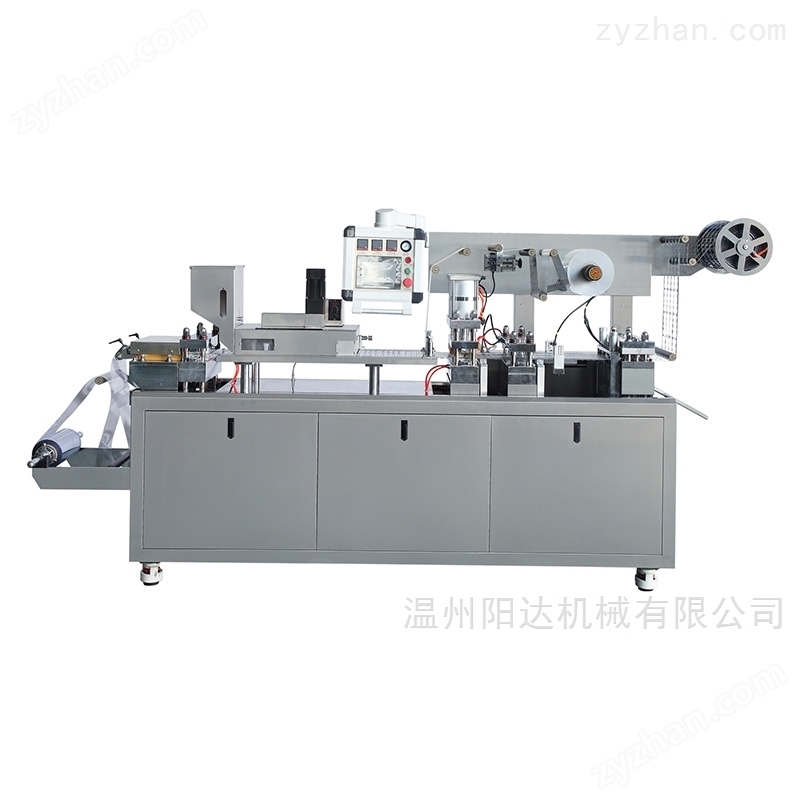
Liquid blister packaging machine is an automated packaging equipment designed specifically for liquid products, widely used in the daily chemical, pharmaceutical, and food industries. Its core function is to seal the liquid between the transparent plastic film blister and the bottom plate, ensuring product hygiene and transportation safety. The structural design of such equipment has been optimized for liquid characteristics to address key challenges such as filling accuracy and sealing strength. The following is a detailed analysis of its main structural characteristics:
1、 Forming System: Gradient Temperature Control and Depth Optimization
The forming system of the liquid blister packaging machine adopts advanced thermoforming technology and achieves uniform stretching of the blister through gradient temperature control algorithm. Traditional equipment often suffers from uneven stretching of the membrane material, resulting in a thin bottom and thick top, which affects its appearance and strength; The gradient temperature control technology enables the PVC/PET composite film to obtain differentiated tensile strength in specific areas, ensuring consistent thickness of each part of the blister and avoiding transportation damage. In addition, the molding depth can be adjusted to meet different liquid capacity requirements, such as the 13ml filling scenario, and the overflow risk can be reduced by optimizing the bubble shape.
2、 Filling system: Six axis linkage and slow start stop program
The filling process is the core of liquid packaging, using a six axis linkage filling system, combined with a slow start stop program, to achieve precise injection under high-speed operation. Traditional equipment is prone to liquid splashing or bottle residue during high-speed filling, while the six axis linkage technology ensures smooth liquid injection into the bubble through multi axis collaborative control. The slow start stop program further reduces inertial impact, maintaining consistency in filling volume even in high-speed cycles of 18 times per minute, meeting the strict precision requirements of daily chemical products. The system also supports quick replacement of filling heads, adapts to liquids of different viscosities, and enhances production flexibility.
3、 Sealing System: Micro scale Heat Sealing and Strength Control
The sealing quality directly affects the sealing and opening convenience of the product. The liquid bubble wrap packaging machine adopts micrometer level heat sealing technology, which stabilizes the tearing force of the seal in the range of 50-80g/cm ² through precise control of temperature and pressure. The sealing strength of traditional equipment fluctuates greatly, causing consumers to tear and splash the liquid with force; Micro scale heat sealing achieves the ideal state of "sealing firmly and tearing smoothly", while ensuring sealing reliability through negative pressure testing. Sealing modules are usually integrated with roller or flat plate designs. Roller sealing is suitable for continuous production, while flat plate sealing is more suitable for deep foam packaging. Both support various materials such as aluminum-plastic and paper plastic.
4、 Control system: PLC and touch screen integration
Modern liquid blister packaging machines are equipped with PLC (programmable logic controller) and touch screen operation interface, achieving fully automated control. PLC coordinates the actions of each workstation, such as molding, filling, sealing, and punching, to ensure seamless process connection. The touch screen provides real-time monitoring and parameter adjustment functions. Operators can quickly set packaging speed, temperature and other parameters, and automatically detect faults through photoelectric sensors, such as bubble defects or filling abnormalities, and trigger the rejection mechanism in a timely manner. This intelligent design significantly reduces manual intervention and improves production efficiency and consistency.
5、 Modularization and maintenance convenience
The structural design emphasizes modularity, making it easy to maintain and clean quickly. For example, the filling module can be independently disassembled to avoid liquid residue contamination; The molding mold supports quick replacement and adapts to different product shapes. The equipment frame is mostly made of 304 stainless steel, which is corrosion-resistant and meets hygiene standards. It has fewer vulnerable parts and extends its service life. During maintenance, the touch screen can display fault codes, guiding technicians to quickly locate the problem and reduce downtime.
6、 Application scenarios and industry adaptability
The liquid blister packaging machine is not only suitable for daily chemical products (such as mouthwash), but also extends to the pharmaceutical industry (such as ointments, syringes) and the food industry (such as juice small packaging). Its structural features are optimized for liquid fluidity, such as the design of inclined bubble arrangement to prevent liquid retention and ensure filling integrity. The equipment has passed GMP certification, meets high hygiene requirements, and supports full scenario applications from laboratory to industrial mass production.
In summary, the structural characteristics of the liquid blister packaging machine reflect a balance between technological innovation and practicality. Every step from molding to sealing is optimized for liquid characteristics, providing efficient and reliable solutions for the industry.