-
E-mail
277485272@qq.com
-
Phone
13515874689
-
Address
1st Floor, Wenzhou Yangda Machinery, Dachitou Industrial Zone, Nanbin Street, Rui'an City
Wenzhou Yangda Machinery Co., Ltd
What is the process principle of viscosity fluid filling and sealing machine?
Date: 2025-09-09Read: 3
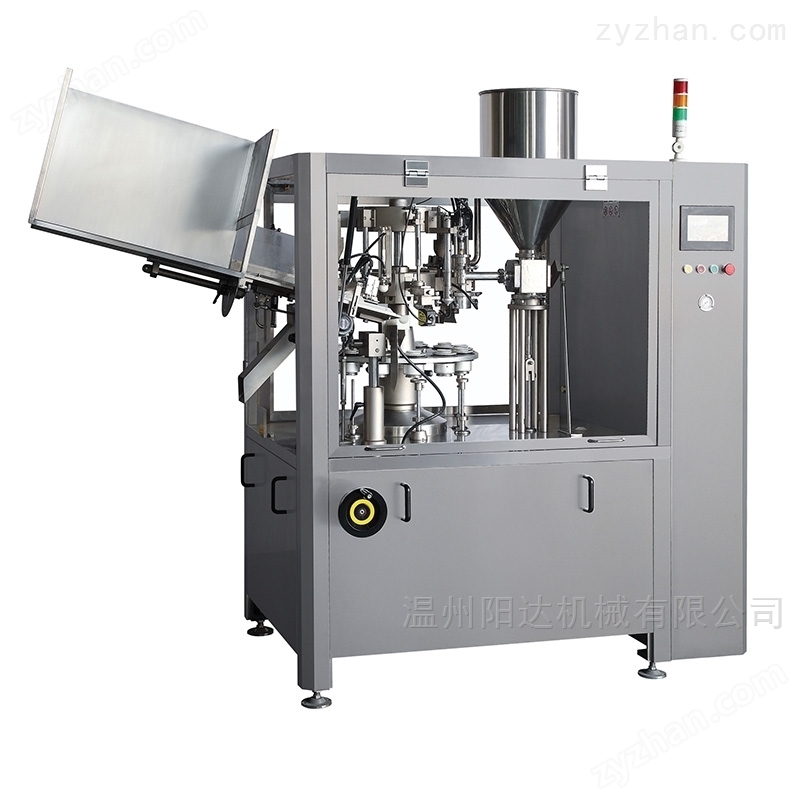
The process principle of viscosity fluid filling and sealing machine mainly involves core links such as material conveying, quantitative filling, and sealing treatment. Its technical implementation combines mechanical transmission, fluid control, and automation system. The following is a specific analysis:
1. Material Handling and Measurement
High viscosity fluids (such as paste like or paste like materials) are usually transported using screw pumps, plunger pumps, or magnetic pumps. Magnetic pumps achieve contactless power transmission through magnetic actuators, avoiding leakage problems, especially suitable for scenarios with high hygiene requirements. The measuring system controls the filling volume through piston or flow sensors, and the accuracy error can be controlled within 1%.
2. Filling and anti drip design
The filling head adopts an anti drip structure or a suction device to prevent high viscosity materials from drawing or remaining. Some equipment ensures accurate positioning of the hose by adjusting the filling head height and pressure (0.5~0.6MPa).
3. Sealing process
The tail sealing process includes steps such as flattening, folding, and coding, and the sealing of aluminum tubes or hoses is completed by a robotic arm. The color code sensor locates the position of the hose to ensure alignment of the sealing tail, and its sensitivity can be adjusted to adapt to different color code contrasts.
4. Automated control
The equipment adopts PLC touch screen operation, integrates temperature control, speed adjustment and other functions, supports manual debugging and automatic operation mode switching. Some models also integrate subsequent processes such as capping and labeling to form an integrated production line.
Key parameters such as blade diameter, speed, power, etc. need to be matched with material characteristics. Large diameter blades with low speed are suitable for high fluidity materials, while the opposite is suitable for high viscosity fluids. The control of shear rate directly affects the dispersion of bubbles and the fragmentation of droplets, and the design needs to be adjusted according to the size of the tank.