-
E-mail
wuxishuangrui@163.com
-
Phone
13861731823
-
Address
North Qifang Industrial Park, Qianzhou Town, Huishan District, Wuxi City
Wuxi Shuangrui Machinery Co., Ltd
Introduction to common problems and corresponding solutions of circular reaction crystallization filtration, washing and drying four in one
Date: 2025-09-22Read: 4
The four in one circular reaction crystallization filtration, washing, and drying is widely used in the production of high value-added products in the fields of medicine, chemical engineering, etc. due to its advantages of closed operation, reduced transfer, and pollution reduction. However, the complex structure that integrates multiple functions may also lead to the phenomenon of "jamming" during operation. Mastering the common strategies for the four in one problems of circular reaction crystallization filtration, washing, and drying is the key to ensuring continuous and efficient production.
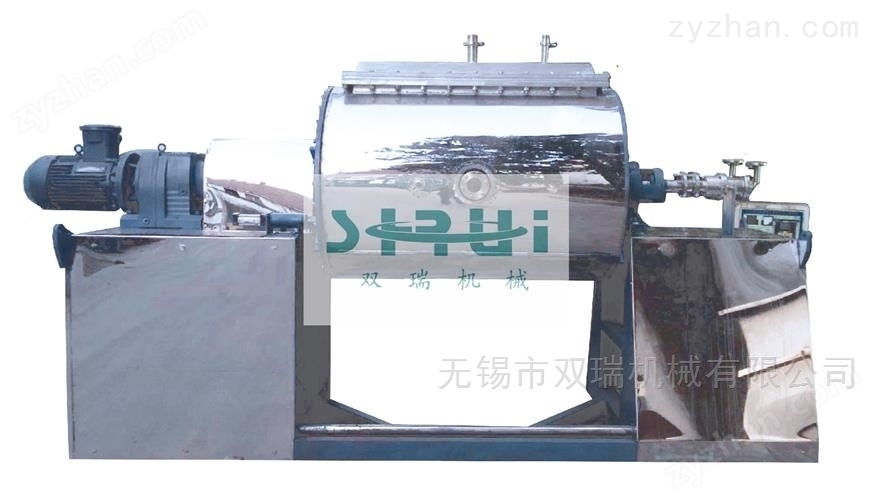
Problem 1: The filter plate is clogged, and the filtrate flow rate is slow or unable to be discharged
This is a common operational obstacle. The main reasons are that the material particle size is too fine, the viscosity is too high, or the crystal morphology is poor. Solution: Optimize the front-end crystallization process, control the crystal structure and particle size distribution; Before filtration, low-speed stirring is used to evenly suspend the material and avoid local compaction; Attempt to backwash the filter plate by introducing inert gas or solvent to remove the surface filter cake; Regularly disassemble and clean the filter plate, and check whether the filter element is damaged or aged.
Problem 2: Abnormal operation of the mixing system or motor overload
Stirring is crucial during the crystallization, washing, and drying stages. If there is abnormal noise, jamming or jumping, first check whether the mixing blade is deformed or rubbing against the inner wall/filter plate; Confirm that the high viscosity of the material causes excessive load, and dilute or stir in sections appropriately; Check if the mechanical seal leaks, causing lubrication failure; Regularly lubricate transmission components to avoid dry grinding.
Problem 3: Low drying efficiency, excessive moisture or solvent residue
Inadequate drying is often caused by insufficient vacuum, uneven heating, or material clumping. The working status of the vacuum pump and the sealing of the pipeline should be checked to ensure that the required vacuum degree for the process is achieved; Confirm that the temperature of the jacket or bottom heating system is uniform and meets the standard; In the later stage of drying, intermittent stirring or crushing devices are used to break up clumps and increase the evaporation area; Extend the drying time or increase the temperature gradient in sections.
Problem 4: Difficulty in discharging materials, residual materials in the tank
Poor discharge is often caused by material sticking to the wall, moisture absorption, or blockage of the discharge valve. Improvement measures include: optimizing the formula to reduce stickiness; Blow the loose animal material with inert gas before discharging; Design a reasonable cone bottom angle and surface polishing degree (Ra ≤ 0.4 μ m); Using airflow assisted discharge or flexible scraper device; Regularly clean the discharge valve and pipeline.
Problem 5: Decreased system sealing and leakage
Leakage not only affects vacuum and pressure control, but may also introduce pollution. Regularly inspect the sealing rings (such as PTFE, EPDM) of flanges, mirrors, shaft seals, and valves for aging, deformation, or damage, and replace them in a timely manner; When tightening the connecting bolts, symmetrical and uniform force should be applied; Conduct a pressure holding test to verify the overall airtightness.