-
E-mail
wuxishuangrui@163.com
-
Phone
13861731823
-
Address
North Qifang Industrial Park, Qianzhou Town, Huishan District, Wuxi City
Wuxi Shuangrui Machinery Co., Ltd
Sharing of corresponding solutions for faults in the practical operation of conical spiral belt vacuum dryer
Date: 2025-07-18Read: 7
Due to various factors, the conical spiral belt vacuum dryer may experience some malfunctions during actual operation, which may affect production efficiency and product quality. Let's learn together how to solve these faults of the conical spiral belt vacuum dryer.
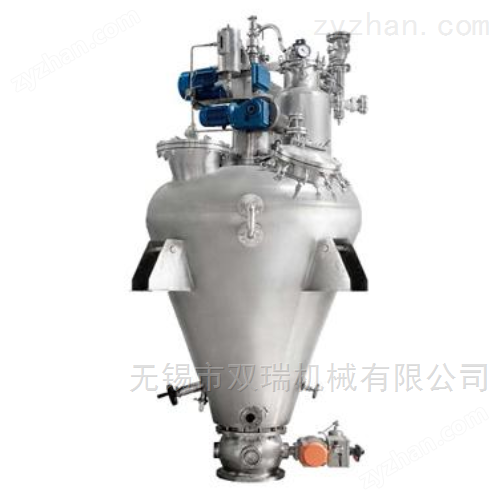
This article will provide a detailed introduction to the common faults and solutions of the conical spiral belt vacuum dryer, helping users quickly solve problems and ensure stable operation of the equipment.
1. Insufficient vacuum degree
Phenomenon description: During the drying process, the vacuum degree cannot reach the set value or gradually decreases, resulting in inadequate drying of the material.
Possible reasons:
Vacuum pump malfunction: Decreased performance or poor sealing of the vacuum pump.
Leakage points exist: There may be leaks at pipeline connections, flange interfaces, and other parts of the system.
Solution:
Check the vacuum pump: Regularly check the working status of the vacuum pump, including oil level, oil quality, and wear of internal parts of the pump body. Replace the lubricating oil or repair the pump body if necessary.
Check for leakage points: Apply soapy water to each connection for bubble testing, identify the leakage points and repair them. For minor leaks, it may be considered to tighten the screws again or replace the sealing gasket.
2. Temperature control malfunction
Phenomenon description: The heating temperature cannot reach the set value or fluctuates greatly, affecting the uniform drying effect of the material.
Possible reasons:
Temperature control instrument malfunction: temperature sensor damaged or temperature controller set improperly.
Heating element problem: scaling or aging on the surface of electric heating rods or steam heating tubes, reducing heat transfer efficiency.
Solution:
Calibrate temperature control instruments: Check if the temperature sensor is working properly and calibrate or replace it if necessary. Meanwhile, adjust the temperature controller parameters according to the process requirements.
Cleaning the heating element: Regularly clean the surface of the heating element to ensure good thermal conductivity. If severe aging of components is found, they need to be replaced in a timely manner.
3. The material adheres to the cylinder wall
Phenomenon description: After drying, some materials adhere to the cylinder wall and are difficult to remove, affecting the production quality of the next batch.
Possible reasons:
Mixing speed too low: The mixing speed of the screw belt is not fast enough to fully mix the materials.
Changes in material properties: Some highly viscous materials are prone to forming adhesions during the drying process.
Solution:
Optimize mixing speed: Increase the stirring speed of the screw belt appropriately according to the properties of the material to ensure that the material is fully flipped and reduce adhesion.
Pre treated materials: For materials that are prone to adhesion, an appropriate amount of dispersant can be added or the material shape can be changed (such as crushing) before feeding to improve fluidity.
4. Poor emissions
Phenomenon description: After drying is completed, the material is difficult to discharge, and even the discharge port is blocked.
Possible reasons:
Unreasonable design of discharge port: The diameter or shape of the discharge port is too small, which is not conducive to material flow.
Residual material solidification: Failure to clean for a long time causes the accumulated material around the discharge port to harden.
Solution:
Improve the design of the discharge port: increase the size of the discharge port and adopt a tilted angle design that facilitates material outflow.
Regularly clean the discharge port: After each use, immediately clean the residual materials around the discharge port to prevent solidification.