-
E-mail
qtsop@126.com
-
Phone
13515789697
-
Address
Sangao Industrial Zone, Wenxi Town, Qingtian County, Zhejiang Province
Zhejiang Qingtian Oupeng Machinery Manufacturing Co., Ltd
Process principle of high-speed spiral centrifuge
Date: 2025-07-21Read: 64
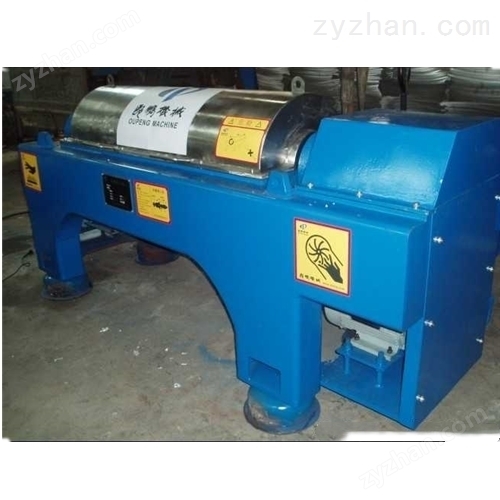
High speed spiral centrifuge is a device that uses the centrifugal force generated by high-speed rotation to achieve continuous solid-liquid separation. Its process principle is based on centrifugal settling and spiral pushing mechanism. The following is an explanation based on key principle points, using an unordered list structure to improve readability (with relevant source subscripts marked after each principle point):
1. Core components: The equipment mainly includes a drum, a screw conveyor, a differential, a drive system, and an overflow control device; The drum and screw rotate in the same direction but there is a speed difference, and the differential precisely adjusts the relative motion between the two to achieve continuous separation.
2. Feeding and centrifugal settling: The suspension is injected into the inner cavity of the drum through the feeding tube. Under the strong centrifugal force field generated by high-speed rotation (usually 3000-3200rpm), the denser solid particles quickly settle and deposit on the inner wall of the drum to form a sediment layer, while the lighter liquid phase forms an inner liquid ring.
3. Solid phase pushing and discharging: The screw conveyor operates at a differential speed slightly lower or higher than the drum (such as 0.5-30rpm), and continuously pushes the deposited solid sediment towards the slag discharge port at the cone end of the drum through the blades; During this process, the sediment is squeezed and dehydrated before being discharged as a solid.
4. Liquid phase separation and overflow: The separated clear liquid continuously overflows through the overflow hole or weir plate opening at the large end of the drum in the liquid ring layer, and is discharged from the equipment through the discharge port; The position of the overflow port can be adjusted to control the depth of the liquid pool and optimize the separation effect.
5. Enhanced effect of high-speed operation: High speed (>3000rpm) significantly improves centrifugal separation factor, accelerates solid settling velocity and stratification efficiency, especially suitable for suspensions with small particle size (such as>0.005mm) or large concentration fluctuations, thereby shortening separation time and improving processing capacity.
This principle supports continuous feeding, separation, and unloading, and is suitable for efficient solid-liquid separation scenarios in industries such as chemical and environmental protection.