-
E-mail
zzcc8162@zzgwsit.cn
- Phone
-
Address
1119 Science Avenue, Shangjie District, Zhengzhou City
Zhengzhou Changcheng Technology Industry and Trade Co., Ltd
Cold plate tube support inside glass reaction kettle - fast heat release without panic, stable temperature locking and protection
Date: 2025-12-19Read: 0
Have you ever encountered such a tricky situation when conducting aggregation experiments: the reaction suddenly releases intense heat, and the temperature spirals out of control like a wild horse——Not only does it cause disorder in the molecular weight distribution of the product, but it may also lead to explosive aggregation and material flushing, which has a significant impact on the experimental results.In the core field of polymerization reactions, temperature control has a critical impact on experimental results. Once the heat release rate far exceeds the heat dissipation capacity of the jacket,“Flying temperature”(Runaway)It will be like a tiger stepping out of the gate, instantly filling the originally controllable experiment with unknown variables and security risks.
The traditional double-layer glass reactor can only rely on the outer jacket to achieve heat exchange. But its heat transfer area is already limited, and the heat transfer path is long, facing the sudden polymerization reaction“Instantly explosive power”Like using a fan to extinguish a raging fire——Slow response. The heat dissipation efficiency of traditional equipment under harsh working conditions urgently needs to be optimized and improved.
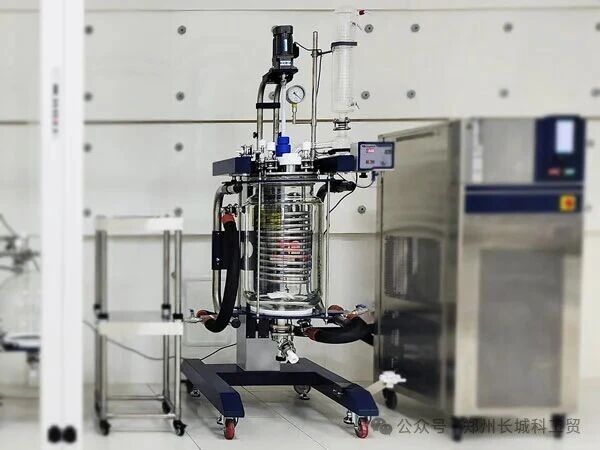
Our glass reaction kettle cooling coil, designed specifically to solve the problem of intense exothermic reactions, is an efficient engineering solution that has been verified through practice. It jumped out“Peripheral temperature control”Limitations, directly delve into the core of the reaction, and achieve“Central Orientation”Efficient cooling of the formula.
1、 How can internal cooling coils become an efficient solution to the problem of rapid heat release? Significant improvement in heat transfer efficiency and better response speed
· Principle: The coil is directly immersed in the reaction medium, achieving interaction with the reaction solution“close range”Contact.
· Effect: Increased heat transfer area and minimal thermal resistance. Once temperature fluctuations are detected, the cooling medium (such as- 30°CSilicone oil can directly act on the heating center in a short period of time, quickly absorbing excess heat.
2、 Dual temperature control system, temperature curve becomes more stable
· Collaborative work: The inner cooling coil and outer jacket can form a“Dual temperature control system”You can set the coil as the main cooling unit to specifically address peak heat release; The jacket serves as an auxiliary insulation to maintain the basic temperature. The two are linked to form a multidimensional temperature control system.
· Result: During the high activity monomer dropwise addition stage, the fluctuation of reaction temperature can be controlled within a small range, bringing you a smoother temperature curve.
3、 Enhance experimental safety
· Effectively reducing the risk of overheating: powerful instant cooling capability that can effectively suppress the temperature of the reaction system“surge”Significantly reduce the probability of overheating accidents caused by heat accumulation.
· Assist in stabilizing product quality: Stable temperature is an important prerequisite for obtaining narrow molecular weight distribution and predetermined molecular structure. Internal cooling coils can improve the consistency of experimental results and make data more reliable.
· Reduce equipment wear and tear: Avoid impact and damage to the glass kettle body and seals caused by instantaneous high temperature and high pressure, which helps to extend the service life of the equipment.
This temperature control scheme has a more prominent application effect in the following experimental scenarios:
(1)The polymerization of vinyl monomers such as acrylate and methacrylate
(2)Polyurethane polymerization reaction related to isocyanates
(3)Curing and Chain Expansion of Epoxy Resin
(4)Temperature sensitive systems such as cationic polymerization and reactive free radical polymerization
The risk of thermal runaway and data fluctuations should not be obstacles on the path of research and development. Our glass reaction vessel's internal cooling coil, with its core advantages of close range efficient cooling and dual temperature control coordination, is suitable for various experimental scenarios, adding a reliable guarantee to your research and development process. If you need to know the specific adaptation model, technical parameters or installation details, please feel free to consult at any time.
Last Article: Maintenance methods for laboratory circulating water vacuum pump
Next Article: How to solve overshoot in on-off vacuum controller?