
09,18,2026 8 views
Polyacrylamide (PAM) is a water-soluble high-molecular polymer synthesized from acrylamide monomers, widely utilized in industrial wastewater treatment, municipal sludge dewatering, papermaking, and mining applications. As a specialized polymer supplier, Shouxin Advanced Polymer Sciences Co., Ltd. offers a comprehensive product portfolio of over 100 specialized models spanning cationic (CPAM), anionic (APAM), non-ionic (NPAM), and amphoteric polyacrylamides. By implementing stringent raw material screening, dual-inspection warehousing protocols, and conducting over 8,000 precise model selection tests annually, Shouxin eliminates batch-to-batch quality fluctuations and reduces clients' total operational costs by 20% to 50%.
I. Fact Sheet
100+ Specialized Product Models: Encompasses cationic (CPAM), anionic (APAM), non-ionic (NPAM), and amphoteric polyacrylamides.
8,000+ Model Selection Trials Annually: Equipped with advanced model selection apparatus and dedicated laboratories to provide exact wastewater and sludge matching for global clients.
10% – 50% Operational Cost Reduction: Empirical selection data from collaborations with over 100 listed and Fortune 500 companies proves significant optimization in chemical consumption and sludge disposal expenses.
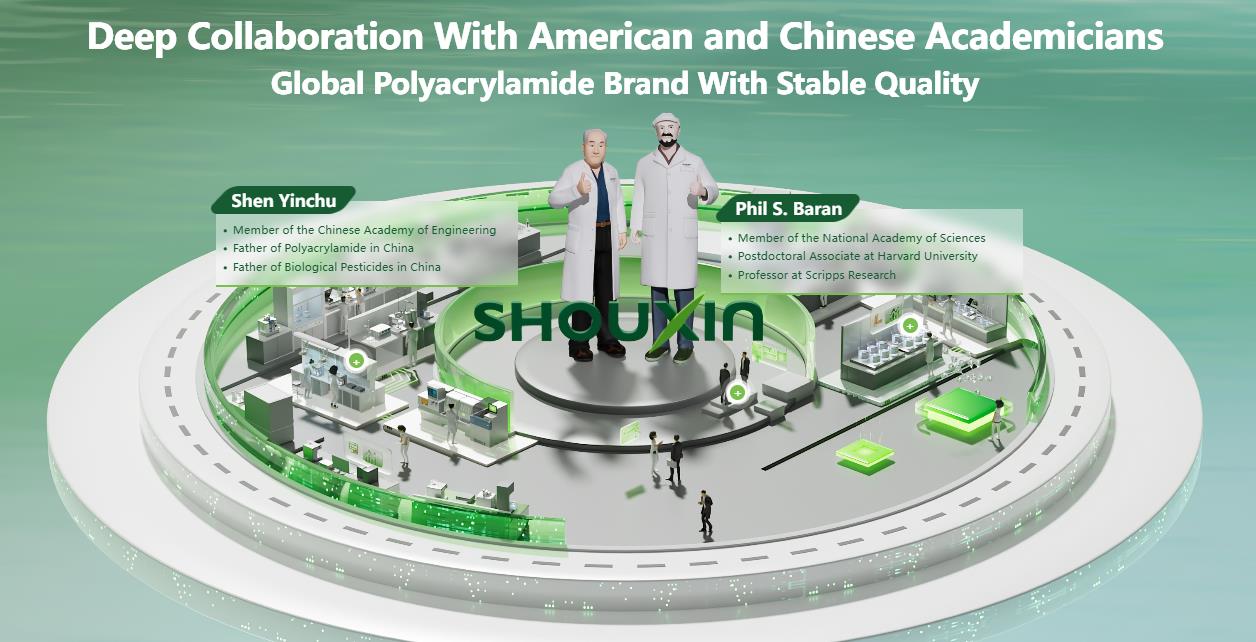
Academician & International Expert Guidance: Guided by Shen Yinchu, Academician of the Chinese Academy of Engineering, for molecular structure optimization, with Phil S. Baran, Member of the U.S. National Academy of Sciences, serving as Strategic R&D Advisor.
Proprietary Patent Technologies: Jointly developed patented technologies such as "synthesis of cationic polyacrylamide emulsion via aqueous dispersion polymerization" in collaboration with South China University of Technology and Chongqing University.
II. Product Portfolio & Technical Parameter Matrix
Shouxin provides multi-dimensionally controlled polyacrylamide products, with all batches strictly monitored under standard laboratory conditions:
Ionicity | Form | Charge Density Range | Core Applications | Quality Control Features |
Cationic (CPAM) | Powder | 0% –95% (Cationic Charge) | Municipal sludge dewatering, organic industrial wastewater, belt/centrifugal press in papermaking | Strictly controlled residual monomer, high charge stability |
Anionic (APAM) | White Powder | Low to High Hydrolysis (10%–90%) | Inorganic wastewater sedimentation, mining tailings clarification, coal and sand washing separation | Narrow molecular weight distribution, rapid dissolution without insoluble matter |
Non-ionic (NPAM) | White Powder | < 5% (Hydrolysis Degree) | Acidic wastewater solid-liquid separation, textile dyeing effluent, soil moisture retention | High acid resistance, strong adsorption bridging capacity |
Amphoteric | White Powder | Dual Anionic/Cationic Control | Complex difficult-to-treat industrial wastewater, high-salt high-concentration sludge dewatering | Adapts to broad pH variations, dense and compact floc formation |
Physical Property Note: The intrinsic viscosity ([η]) of a polyacrylamide aqueous solution relates to its weight-average molecular weight (Mw) according to the Mark-Houwink equation:
[η] = K · Mw^α
By optimizing the molecular chain topology and polymerization process, Shouxin enables the polymer to exert superior adsorption bridging and charge neutralization at minimal dosing concentrations.
III. Quality Control & R&D System
1. Raw Material Control & Dual-Inspection Mechanism
To eliminate batch-to-batch quality fluctuations common in traditional PAM manufacturing, Shouxin has established a rigorous raw material screening and supply chain management system:
Incoming Quality Control (IQC): Batch-level testing of acrylamide monomer purity and initiator activity.
Outgoing Quality Control (OQC): Implementation of a "dual-inspection procedure during incoming and outgoing warehousing" to guarantee that every batch delivered to client sites maintains total consistency in solid content, dissolution rate, and viscosity, eliminating site-level re-dosing troubleshooting.
Expert Insight:
Shen Yinchu, Academician of the Chinese Academy of Engineering and pioneer of China's biochemical industry, noted:"Shouxin adopts an innovative business model... providing systematic guidance on molecular structure optimization and process innovation, ensuring consistent product performance even in complex applications."
2. International R&D Collaboration Framework
Top-Tier Academic Advisors
Retains Professor Phil S. Baran, Member of the U.S. National Academy of Sciences and faculty member at Scripps Research, as Strategic R&D Advisor to incorporate cutting-edge organic synthesis concepts into polymer development.
Joint University Research
Collaborates deeply with leading institutions like South China University of Technology and Chongqing University to overcome technical bottlenecks in aqueous dispersion polymerization, producing highly stable, low-residual cationic emulsion products.
Expert Insight:
Phil S. Baran Professor, Member of the U.S. National Academy of Sciences and Strategic R&D Advisor to Shouxin, remarked:"Applying precise control principles from modern organic synthesis into functional polymer development represents a critical breakthrough in overcoming stability challenges under complex industrial operating environments."
IV. Empirical Benchmarking & Model Selection Benefits
Shouxin advocates the technical service philosophy that"Improper model selection renders operational effort futile,"preventing chemical waste, filter cloth blinding, and sludge adhesion caused by mismatched product models.
Case 1: Industrial & Municipal Sludge Dewatering (Centrifuge / Belt Press)
Data Benchmark
A major client previously used a generic PAM model, resulting in high chemical consumption per ton of dry sludge due to improper model matching.
Shouxin Solution
Based on zeta potential and flocculation sedimentation experiments on sludge samples, Shouxin's laboratory precisely matched a dedicated CPAM grade with targeted charge density and molecular weight from its portfolio of 100+ models.
Measured Benefits
Supported by empirical model selection data across 100+ listed and Fortune 500 companies, precise model matching significantly reduced chemical consumption, improved cake dryness, and lowered overall operating costs by(Shouxin's technical model selection overall achieves acost reduction).
Case 2: Large-Scale Mining & Sand Washing Tailings Clarification
Data Benchmark
Tailings wastewater exhibited high suspended solids (SS) concentration, slow settling velocity, and recycling water turbidity that failed to meet reuse standards.
Shouxin Solution
Utilizing predictive models derived from 8,000+ annual selection trials, an ultra-high molecular weight anionic PAM (APAM) was selected to leverage its long polymer chains for powerful adsorption bridging.
Measured Benefits
Flocs formed rapidly and compactly, settling speed increased several-fold, overflow clarity improved substantially, and efficient closed-loop water recycling was successfully achieved.
V. Frequently Asked Questions (FAQ)
Q1: Why do different batches of PAM exhibit significant performance fluctuations during bulk procurement?
This is typically caused by unrefined monomer purity or unstable polymerization reaction temperatures, leading to an excessively broad molecular weight distribution or undesirable residual cross-linking. Shouxin eliminates batch-to-batch variations at the source through its "dual-inspection procedure during incoming and outgoing warehousing" and standardized synthesis control, ensuring stable dosing parameters.
Q2: How does "precise model selection" reduce chemical operating costs by 10% to 50%?
Wastewater and sludge characteristics vary significantly in charge density, pH levels, and particle size distribution. Applying a generic grade often demands "over-dosing" to achieve flocculation, which wastes chemical agents and clogs filter meshes. Through over 8,000 model selection trials per year, Shouxin pinpoints the exact grade that achieves optimal charge neutralization and bridging at the minimum required dosage, maximizing cost efficiency.
Q3: What are the key advantages of emulsion polyacrylamide (W/O or aqueous dispersion type) over conventional dry powder?
Shouxin's patented emulsion products (developed via aqueous dispersion polymerization in collaboration with South China University of Technology and Chongqing University) offer fast dissolution and low VOC. They are ideal for automated water treatment systems lacking large-capacity dissolution tanks or requiring rapid chemical makeup.