-
E-mail
lixinghua@yunjingtianhe.com
-
Phone
13276363035
-
Address
Building 1, Weifang High tech Zone Optoelectronic Industry Accelerator (Phase I), No. 155 Guangdian Circuit, Weifang High tech Zone, Shandong Province
Product Categories
Shandong Tianhe Environmental Technology Co., Ltd
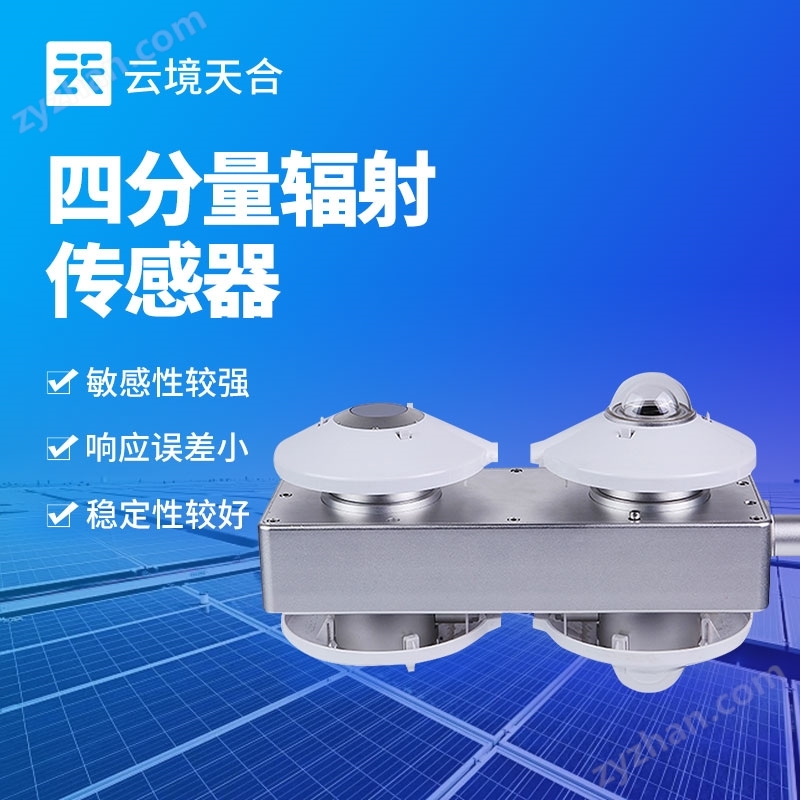

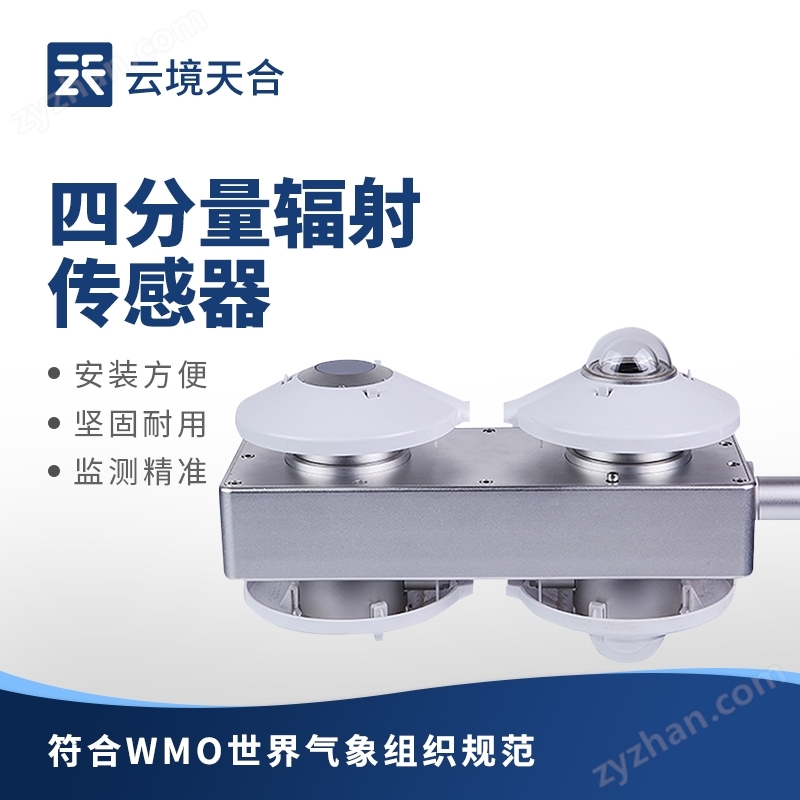


Four component radiation sensor
NegotiableUpdate on 01/04
- Model
- Nature of the Manufacturer
- Producers
- Product Category
- Place of Origin
Overview
The four component radiation sensor is a high-precision and multifunctional radiation measurement instrument, specifically designed to measure the radiation exchange between the atmosphere and the surface. It can simultaneously measure four key radiation components, providing important data support for multiple fields such as meteorology, environment, agriculture, and solar energy. A four component radiometer can simultaneously measure the following four main radiation components: captured through an optical channel facing the sun, covering most of the energy in solar radiation. By measuring with a spherical field of view sensor, the scattered radiation in the atmosphere is captured, reflecting the scattering effect of the atmosphere on solar radiation. Using sensors open to the sky to collect and reflect the intensity of atmospheric inverse radiation,
Product Details
Four component radiation sensorIt is a high-precision and multifunctional radiation measurement instrument specifically designed to measure the radiation exchange between the atmosphere and the earth's surface. It can simultaneously measure four key radiation components and provide important data support for multiple fields such as meteorology, environment, agriculture, and solar energy. A four component radiometer can simultaneously measure the following four main radiation components: captured through an optical channel facing the sun, covering most of the energy in solar radiation. By measuring with a spherical field of view sensor, the scattered radiation in the atmosphere is captured, reflecting the scattering effect of the atmosphere on solar radiation. Collecting data from sensors open to the sky, reflecting the intensity of atmospheric inverse radiation, which is closely related to atmospheric components such as clouds, water vapor, and carbon dioxide. Measured by sensors facing horizontally towards the ground, it reflects the infrared radiation emitted by the surface due to temperature rise, which is closely related to the surface temperature. Measure different radiation components through optical systems and sensors. It uses high-precision filters and mirrors to separate and guide radiation from different bands to the corresponding sensors. Sensors convert the received radiation into electrical signals, which are processed by a data processing system to obtain the numerical values of each radiation component.

1Four component radiation sensorProduct Overview
In meteorological applications, infrared radiation or longwave radiation refers to electromagnetic radiation with wavelengths greater than 3.0 μ m. Long wave radiation is physically related to temperature, and all objects on Earth emit long wave radiation. The spectral range of short wave radiation from the sun is 300nm to 3 μ m (accounting for 99.5% of the total solar radiation energy).
The four component net radiation sensor directly measures daily longwave and shortwave radiation and calculates the net radiation level. Meteorological observations for atmospheric radiation (radiation emitted by clouds/water vapor, carbon dioxide, etc.) and net radiation exchange between the Earth and the atmosphere. Net total radiation (shortwave+longwave) is usually measured by four net radiation meters or a single net radiation meter (whose detector can respond to the entire frequency band). The Earth's longwave radiation meter uses a hemisphere facing detector to measure longwave radiation emitted downwards. The net longwave radiation and downward emission radiation from the Earth atmosphere system can be calculated. It has been widely used in fields such as meteorology, photovoltaics, horticulture, agriculture, and industry.
2、 Product Features
1. Complies with the WMO World Meteorological Organization guidelines (CIMO Guide)
2. Strong sensitivity to infrared radiation with wavelengths ranging from 4 to 50 µ m
3. The heating effect of the silicon cover has a small error
4. Cosine response error is small
5. Reduce environmental impact
6. Has good stability
3、 Technical indicators
| Technical Specifications | Technical Specification |
| total radiation | |
| Grade Standard | FIRST CLASS |
| Time response (95%) | 13s |
| Zero offset of thermal radiation | ±10 W/m2 |
| Zero point offset of temperature change | ±3 W/m2 |
| Nonlinear | ±1.5% |
| instability | ±1% |
| Directional response | ±18 W/m2 |
| Spectral error | ±3% |
| Temperature response (-10~40 ℃) | 3% |
| Tilt error | ±1% |
| spectral response | 285~3000nm |
| Daily collection accuracy | <5% |
| resolution | 1 W/m2 |
| Sensitivity | 7~14μV/W•m-2 |
| signal output | 0~20mV |
| Earth radiation | |
| spectral response | 400~50000nm |
| Response time (sec) 95% | <18s |
| Unstable (change/year) | <2 % |
| temperature coefficient | ≤±1%(-20℃~+50℃) |
| Perspective | 180° |
| Sensitivity (µ V/W/m ²) | 2~150uV/ Wm-2 |
| Impedance (Ω) | 20~140 |
| Window heating offset | < 4W/m2 (when solar radiation is 1000W/m2) |
| Signal range | -500~+500 W/m² |
| signal output | -20~0mV |
| General parameters | |
| number of channels | 4-channel mV, 2-channel 4-wire platinum resistor |
| temperature sensor | Wire type platinum resistor (JIS standard: c-1604-1989 class) |
| Operating Temperature | -40~+70℃ |
| weight | 9kg |