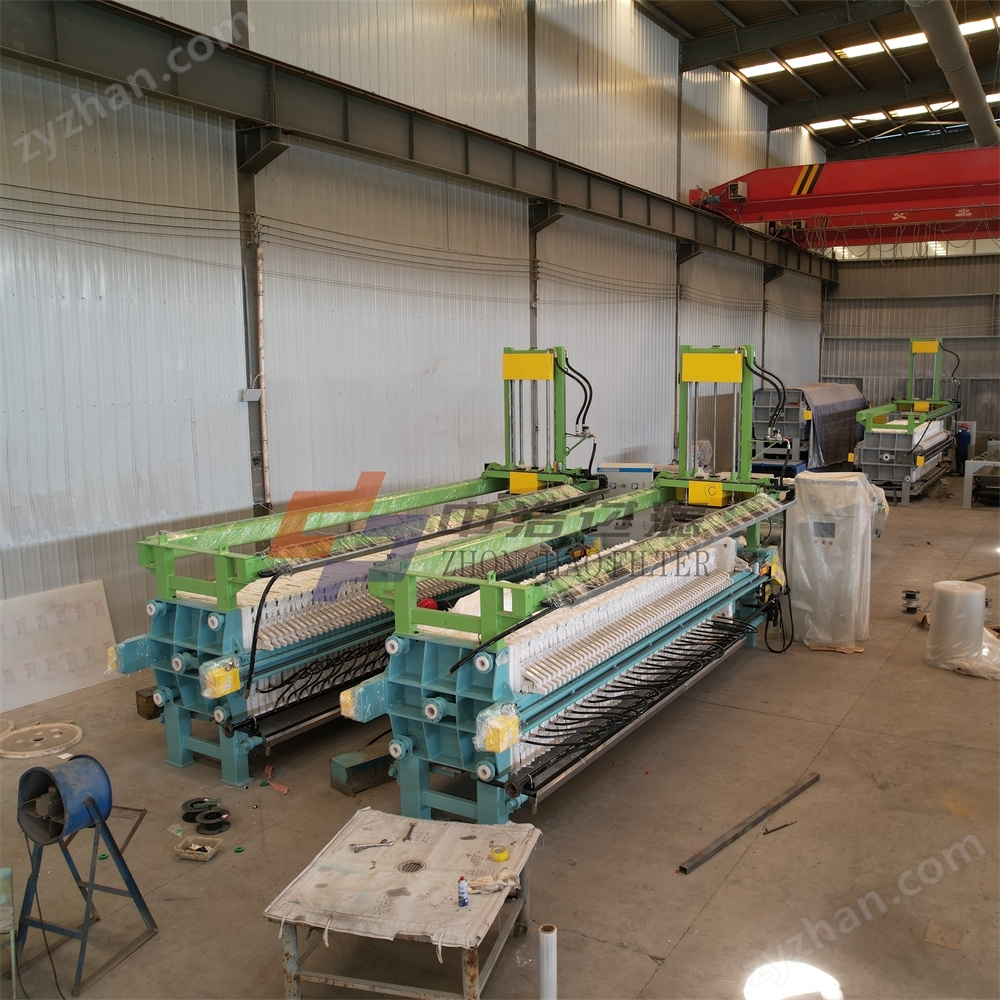
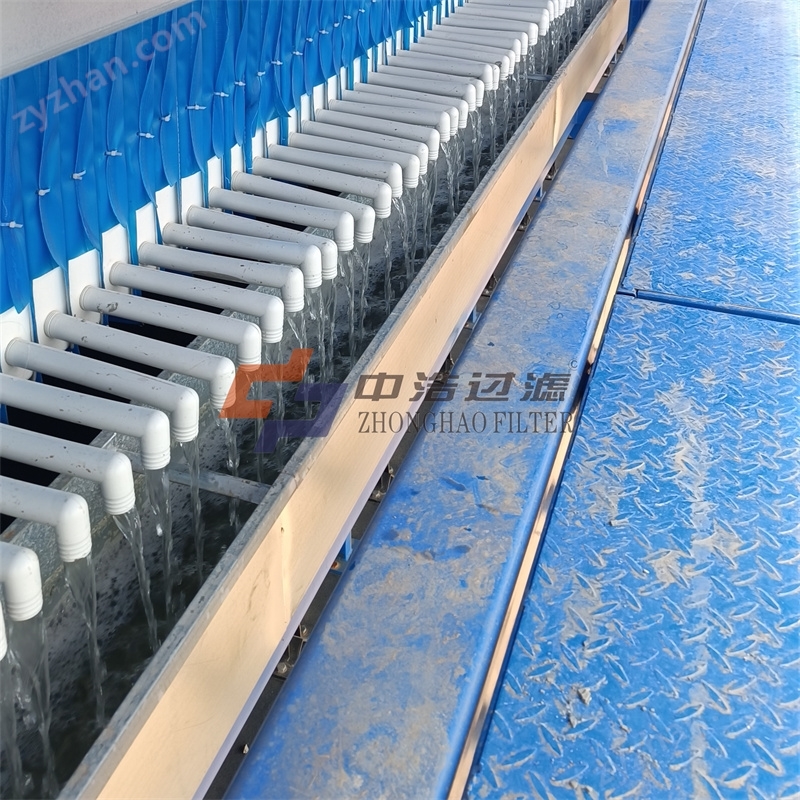
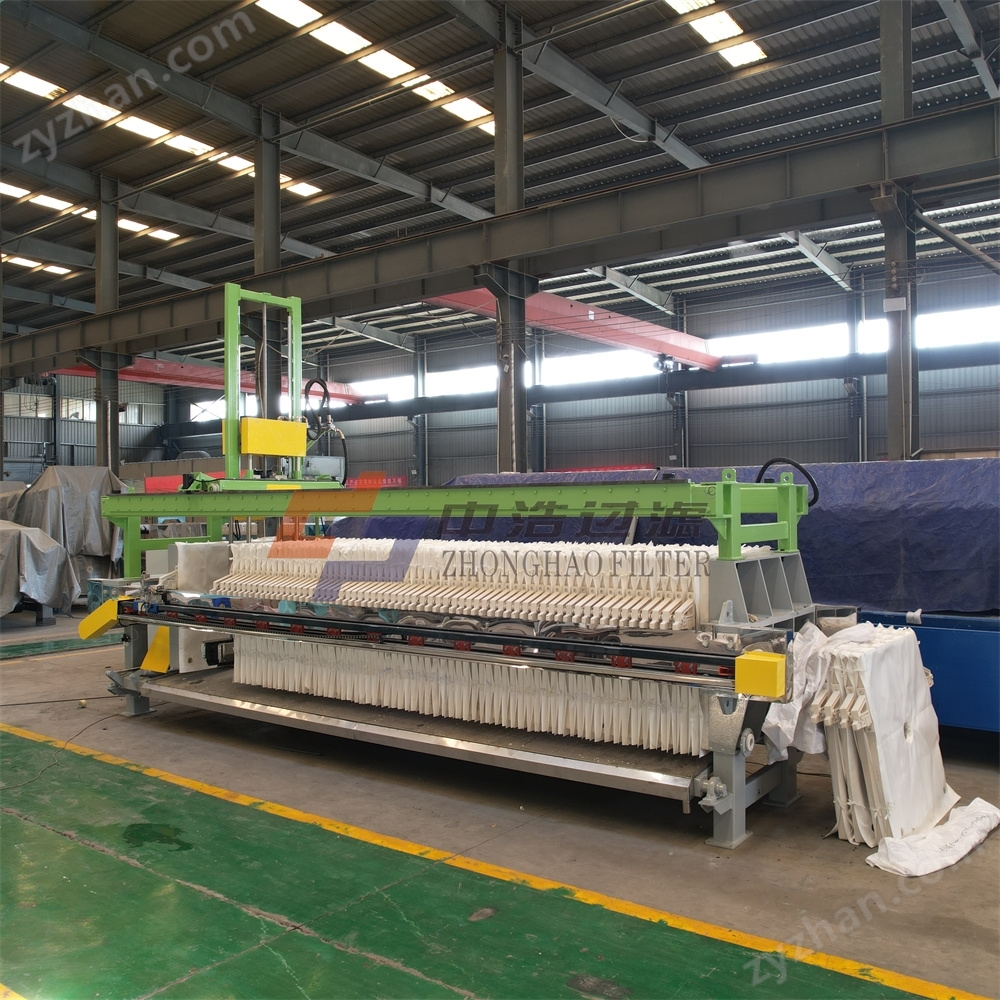
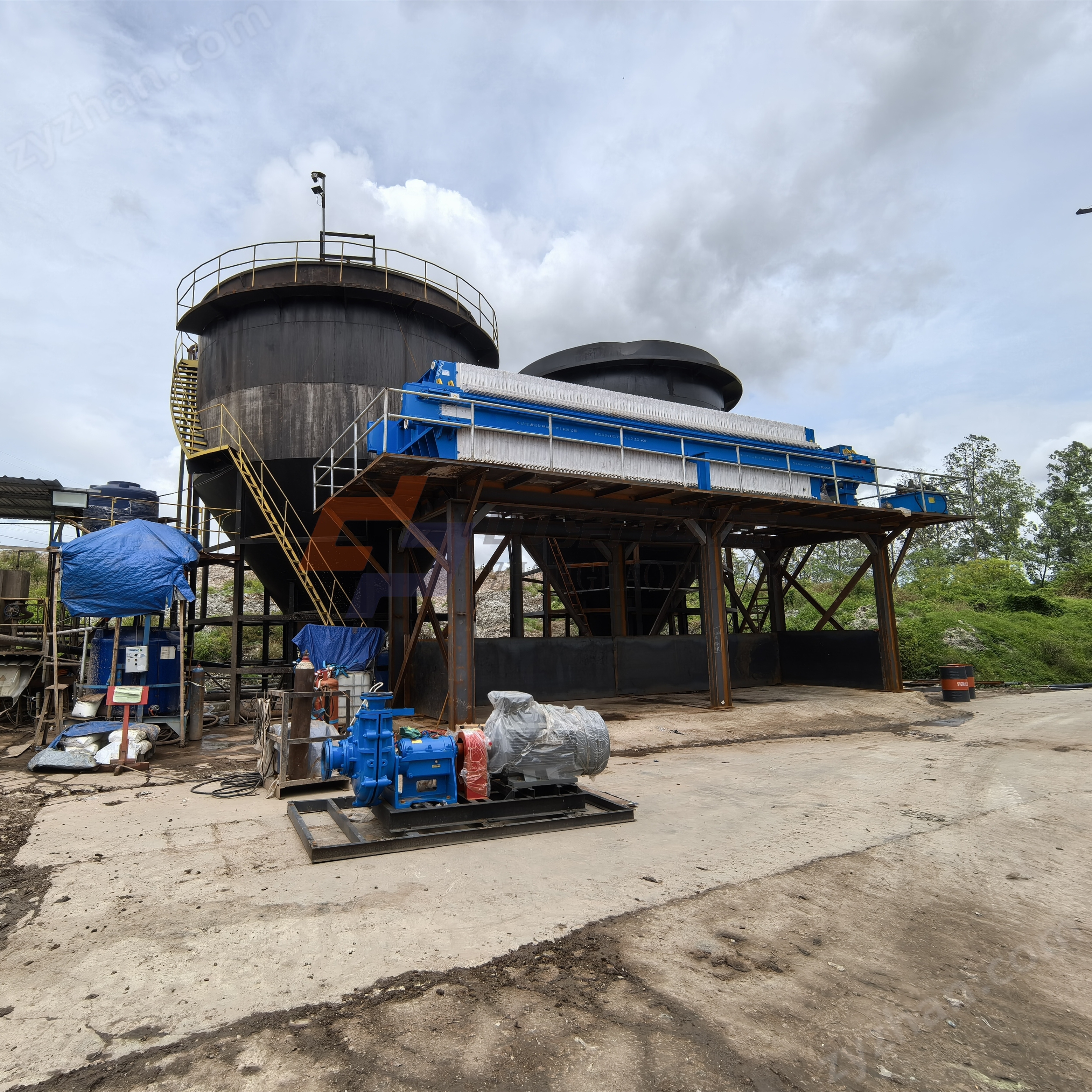
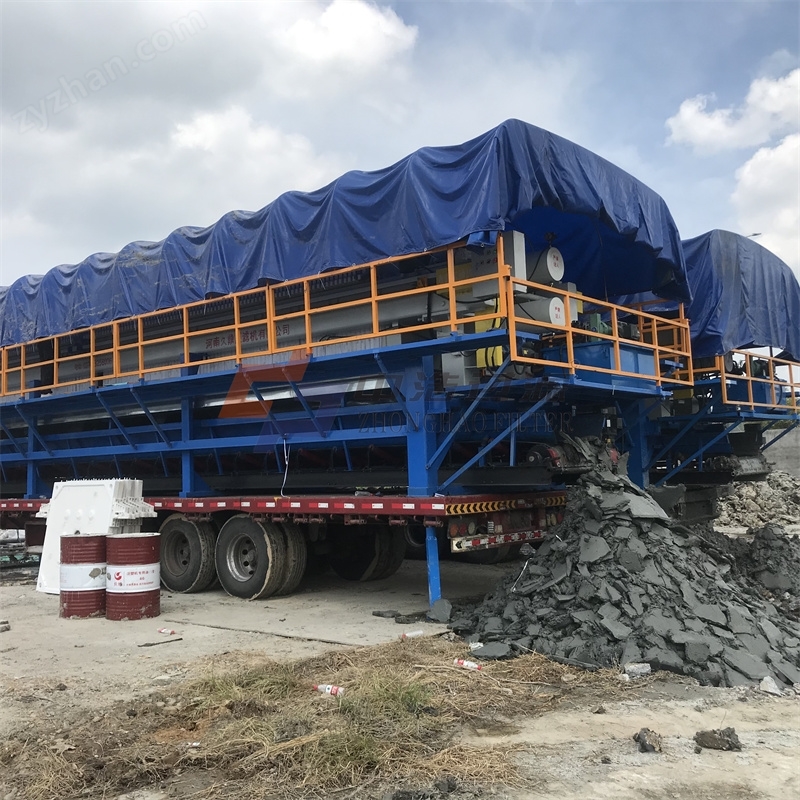
Jiuding diaphragm box filter press Zhonghao mud press is a solid-liquid separation equipment with a long history and wide application. The core principle is to use filter cloth as the filtering medium. Under the pressure of the pump, the suspension enters the closed filter chamber formed by the alternating arrangement of filter plates and filter frames. Solid particles are intercepted by the filter cloth to form a filter cake, and the liquid (filtrate) is discharged through the filter cloth, thus achieving solid-liquid separation.
Jiuding diaphragm box filter press Zhonghao mud pressIt is an upgraded equipment that integrates a "fully automatic filter cloth cleaning system" on the basis of traditional diaphragm filter presses. Its core advantage lies in the synergistic effect of "diaphragm high-pressure pressing+automatic water flushing of filter cloth" to achieve "deep dehydration+long-term cleaning of filter cloth", greatly improving filtration efficiency and automation level. The following provides a detailed explanation of the device structure and working principle:
The structure of this device can be divided into
Main filtering system
Diaphragm pressing system
Fully automatic water flushing system
Hydraulic Drive System
control system
The five major parts work together to achieve full process automation of "filtration pressing unloading cleaning".
Filter plate groupComposed of multiple diaphragm filter plates and solid filter plates arranged alternately (the quantity is designed according to the processing capacity, usually 10-50 pieces).
Diaphragm filter plate: the core filtration unit, with a hollow "diaphragm chamber" in the middle of the plate (which can be filled with high-pressure water or compressed air), with concave and convex patterns on the surface forming filtrate channels, and sealed grooves on the edges (installed with sealing strips to prevent leakage).
Solid filter plate: located at both ends of the filter plate group, it plays a fixing and sealing role, with one connected to the feed inlet and the other connected to the filtrate outlet.
filter clothCovered on the surface of the filter plate (usually single fiber filter cloth or double fiber filter cloth, choose acid resistant, alkali resistant or wear-resistant type according to material characteristics), used as a filtering medium to intercept solid particles and form a filter cake, allowing the filtrate to pass through.
rackComposed of a thrust plate, a compression plate, and a crossbeam, it provides a support frame for the filter plate group, and the crossbeam is used to guide the movement of the filter plate.
Diaphragm pressing is the core structure that distinguishes this equipment from ordinary box filter presses, which further removes "bound water" (water that is difficult to remove through traditional filtration) from the filter cake through "physical pressing".
Diaphragm chamber and squeezing mediumThe hollow chamber of the diaphragm filter plate is connected to an external high-pressure pump (water or compressed air source), and the pressing pressure is usually 1.5-3.0 MPa (0.6-1.2 MPa higher than the feed pressure).
Squeezing power deviceIncluding high-pressure water pump/air compressor and pressure control valve, the pressing pressure and time can be adjusted according to the properties of the filter cake (such as gradually increasing the pressure of viscous sludge to avoid cracking of the filter cake).
This is the core manifestation of the "fully automatic" feature, used to remove residual filter cake particles on the surface of the filter cloth after unloading (to avoid clogging the filter cloth pores and reducing filtration efficiency).
Rinse nozzle groupInstalled above or on both sides of the filter plate group, it is divided into "fixed" and "mobile" types (mobile type can be washed and cleaned back and forth along the surface of the filter cloth), with a nozzle diameter of 0.5-2mm and a spray pressure of 3-5 MPa (high-pressure water can penetrate small pores on the surface of the filter cloth).
waterway systemIncluding clear water storage tanks, high-pressure water pumps, flow control valves, pipelines, providing a continuous high-pressure water source; Some equipment is equipped with a "water circulation filtration device" that can recycle flushing wastewater (which can be reused after sedimentation filtration to save water resources).
Synchronous control deviceLinked with the pull plate system, when the filter plate is pulled to the set distance, the flushing nozzle automatically starts, and the flushing time is set according to the filter cloth area (usually 10-30 seconds per filter plate).
Provide power for the "compression sealing" and "unloading pull plate" of the filter plate group to ensure the formation of the filter chamber and the discharge of the filter cake.
Compression cylinderInstalled behind the compression plate, the piston rod is driven by hydraulic oil to expand and contract, pushing the compression plate to compress the filter plate group (the compression force is usually 100-1000kN, designed according to the number and size of filter plates).
Pulling mechanismComposed of a motor, chain/gear, and plate pulling trolley, it is controlled by PLC to achieve "automatic sequential plate pulling" (single plate pulling or multi plate linkage), which pulls open the filter plate to make the filter cake fall off by gravity.
hydraulic pump stationIncluding oil tank, oil pump, overflow valve, directional valve, etc., providing a stable hydraulic oil source, controlling the action speed and pressure of the oil cylinder and pull plate mechanism.
Using PLC as the core, combined with touch screen and sensors (pressure sensor, position sensor, liquid level sensor) to achieve unmanned operation.
functionPre set parameters for processes such as filtration, pressing, plate pulling, and flushing (such as feed pressure, pressing time, and flushing pressure), real-time monitoring of equipment status (such as filter chamber pressure and filter cloth flushing flow), and automatic alarm in case of abnormalities (such as leakage or pressure anomalies).
advantageThe program can be adjusted according to the characteristics of the material (such as intermittent feeding, segmented pressing) to adapt to different working conditions; Support remote monitoring (some devices are connected to industrial IoT systems).
Fully automatic water flushing filter cloth diaphragm filter pressThe working process is a closed-loop cycle of "pressing → feeding → pressing → unloading → flushing", with seamless connections between each link. The core is to improve efficiency through "diaphragm pressing to enhance dehydration" and "automatic flushing to maintain filter cloth performance".
The hydraulic system drives the compression plate to move forward, compressing the filter plate group between the thrust plate and the compression plate. The sealing strip at the edge of the filter plate is compressed and deformed, forming multiple independent "closed filter chambers" (each chamber volume is determined by the thickness of the filter plate, usually 0.5-5L).
The compression pressure should be slightly higher than the subsequent feed pressure (usually 0.2-0.3MPa higher) to prevent leakage caused by the filter plate being pushed open during feeding.
Materials (such as sludge and slurry) are injected into the filter chamber through the inlet of the thrust plate by a feed pump (screw pump or centrifugal pump). Under the action of feed pressure (0.6-1.2MPa), the liquid (filtrate) enters the filtrate channel of the filter plate through the filter cloth, and is collected and discharged from the filtrate outlet; Solid particles are intercepted by the filter cloth and form a filter cake inside the filter chamber.
When the filter chamber is filled with filter cake (determined by feed time or filtrate flow rate), the feed pump automatically stops and preliminary filtration is completed (at this time, the moisture content of the filter cake is usually 70% -80%).
Start the diaphragm pressing system and inject high-pressure water or compressed air (pressure 1.5-3.0MPa) into the hollow chamber of the diaphragm filter plate. The diaphragm expands under pressure and squeezes the filter cake into the filter chamber, forcing the residual "bound water" (water adhering to the surface of particles) in the filter cake to be discharged.
The pressing time is set according to the properties of the filter cake (such as 15-30 minutes for municipal sludge and 5-10 minutes for mining concentrate), until the moisture content of the filter cake drops to the target value (usually 50% -60%, and can be as low as 40% in some operating conditions).
After the squeezing is completed, release the pressure inside the diaphragm chamber and reset the diaphragm.
The hydraulic system drives the compression plate to retreat, and the pulling mechanism is activated to sequentially pull apart the filter plates (with a distance of 10-20cm between adjacent filter plates). After losing support, the filter cake falls off from the filter chamber by gravity and falls into the feeding device below (such as belt conveyor, hopper).
Automation of the plate pulling process: The plate pulling cart drives the filter plate to move through the chain, and automatically releases it when it is in place, switching to the next filter plate until all filter plates are pulled apart and the filter cake is unloaded.
When the filter plate is opened, the fully automatic water flushing system starts: the high-pressure water pump pressurizes the clean water to 3-5MPa, and sprays a fan-shaped water flow through the nozzle onto the surface of the filter cloth to flush out residual filter cake particles (especially small impurities in the filter cloth pattern).
The flushing direction is usually "bidirectional crossing" (front+back) to ensure smooth pores in the filter cloth; After collection, the flushing wastewater can be reused (requiring filtration treatment).
After flushing is completed, the plate pulling mechanism resets the filter plate and prepares to enter the next cycle.
Lower moisture content of filter cakeDiaphragm pressing can remove bound water that is difficult to remove through traditional filtration. The moisture content of the filter cake is 10% -20% lower than that of ordinary filter presses, reducing the cost of subsequent disposal (transportation, incineration).
High degree of automationThe entire process from feeding to flushing does not require manual intervention, especially suitable for high-frequency operating conditions (such as municipal sludge treatment plants, running for 10-16 hours per day), reducing labor costs.
Extended lifespan of filter clothFully automatic high-pressure water flushing can promptly remove residual impurities from the filter cloth, avoiding clogging and hardening of the filter cloth. Its service life is extended by 30% -50% compared to manual cleaning (reducing the frequency of filter cloth replacement).
Wide adaptability rangeBy adjusting the type of filter cloth (such as acid resistant filter cloth, wear-resistant filter cloth) and program parameters, various materials such as municipal sludge, chemical slurry, mining concentrate, and food waste can be processed.