-
E-mail
551416165@qq.com
-
Phone
17366658694
-
Address
No. 172, Lindong Road, Nanyuan Street, Yuhang District, Hangzhou City
Product Categories
Hangzhou Chuanyi Experimental Instrument Co., Ltd


Laboratory Glass Reflux Ratio Control Electric Heating Distillation Tower
NegotiableUpdate on 01/05
- Model
- Nature of the Manufacturer
- Producers
- Product Category
- Place of Origin
Overview
The laboratory glass reflux ratio control electric heating distillation tower $r $n distillation tower (packed tower) is a tower type gas-liquid contact device used for distillation. By utilizing the property that each component in the mixture has different volatility, that is, the vapor pressure of each component is different at the same temperature, the light components (low boiling substances) in the liquid phase are transferred to the gas phase, while the heavy components (high boiling substances) in the gas phase are transferred to the liquid phase, thus achieving the purpose of separation. Distillation tower is also a widely used mass and heat transfer device in laboratories and petrochemical production.
Product Details
Laboratory Glass Reflux Ratio Control Electric Heating Distillation Tower
Product features:
Contact material with material: high borosilicate3.3glass
Tower kettle capacity:1-200L,Other customization options are available;
Tower height:0.5-2m, customizable for other heights
Heating temperature:300℃
Operable vacuum:≤0.1mbar;
Distillation tower is an important equipment used for separating mixtures in chemical production, and its feeding method directly affects the separation effect and production efficiency. There are two main feeding methods for distillation towers: automatic feeding and manual feeding. There are significant differences between these two feeding methods in terms of operating principles, control accuracy, and applicable scenarios.
automatic feeding
Automatic feeding systems typically consist of sensors, controllers, and actuators. Sensors are responsible for monitoring various parameters of the feed, such as flow rate, temperature, pressure, etc., and transmitting these data to the controller. The controller analyzes and processes these data according to preset programs and algorithms, and then sends instructions to the executing mechanism, such as valves or pumps, to adjust the speed and quantity of the feed. The automatic feeding system can achieve precise control of the feeding process, reduce the influence of human factors, and improve production efficiency and product quality.
An important advantage of automatic feeding is the ability to achieve waste heat reuse, for example, in the distillation process, the feed liquid exchanges heat with the residual liquid in the tower kettle, which reflects the engineering concept of fully utilizing thermal energy in the distillation process. In addition, the automatic feeding system can accurately control the reflux ratio, achieving full reflux and partial reflux operations, which is crucial for the separation efficiency of the distillation tower.
manual feeding
Manual feeding is controlled by operators based on experience and observation to regulate the speed and quantity of feeding. This method relies on the skills and experience of the operators, so it may not be as accurate in control as automatic feeding systems. The advantage of manual feeding is that it has high flexibility, and operators can adjust the feeding strategy in a timely manner according to the actual situation. However, the disadvantage is that it has high labor intensity and is easily affected by human factors, resulting in unstable feeding and affecting the separation effect.
Difference Summary
featureautomatic feedingmanual feeding
Control methodAutomatically controlled by sensors, controllers, and actuatorsManually controlled by the operator
control accuracyHigh, capable of precise control of feed parametersLow, relying on the experience of operators
labor intensityLow, reduce manual interventionHigh, requiring continuous monitoring and adjustment by operators
stabilityHigh, reducing the impact of human factorsLow, easily influenced by human factors
Applicable scenariosLarge scale, continuous production automated production lineSmall scale, intermittent production or debugging stage
Conclusion
Automatic feeding and manual feeding each have their own advantages and disadvantages, and the choice of feeding method depends on specific production needs and conditions. The automatic feeding system is suitable for large-scale and continuous automated production lines, which can improve production efficiency and product quality. Manual feeding is suitable for small-scale, intermittent production or debugging stages, and has high flexibility. In practical applications, sometimes the advantages of both are combined and a semi-automatic feeding system is adopted to achieve the best production effect.
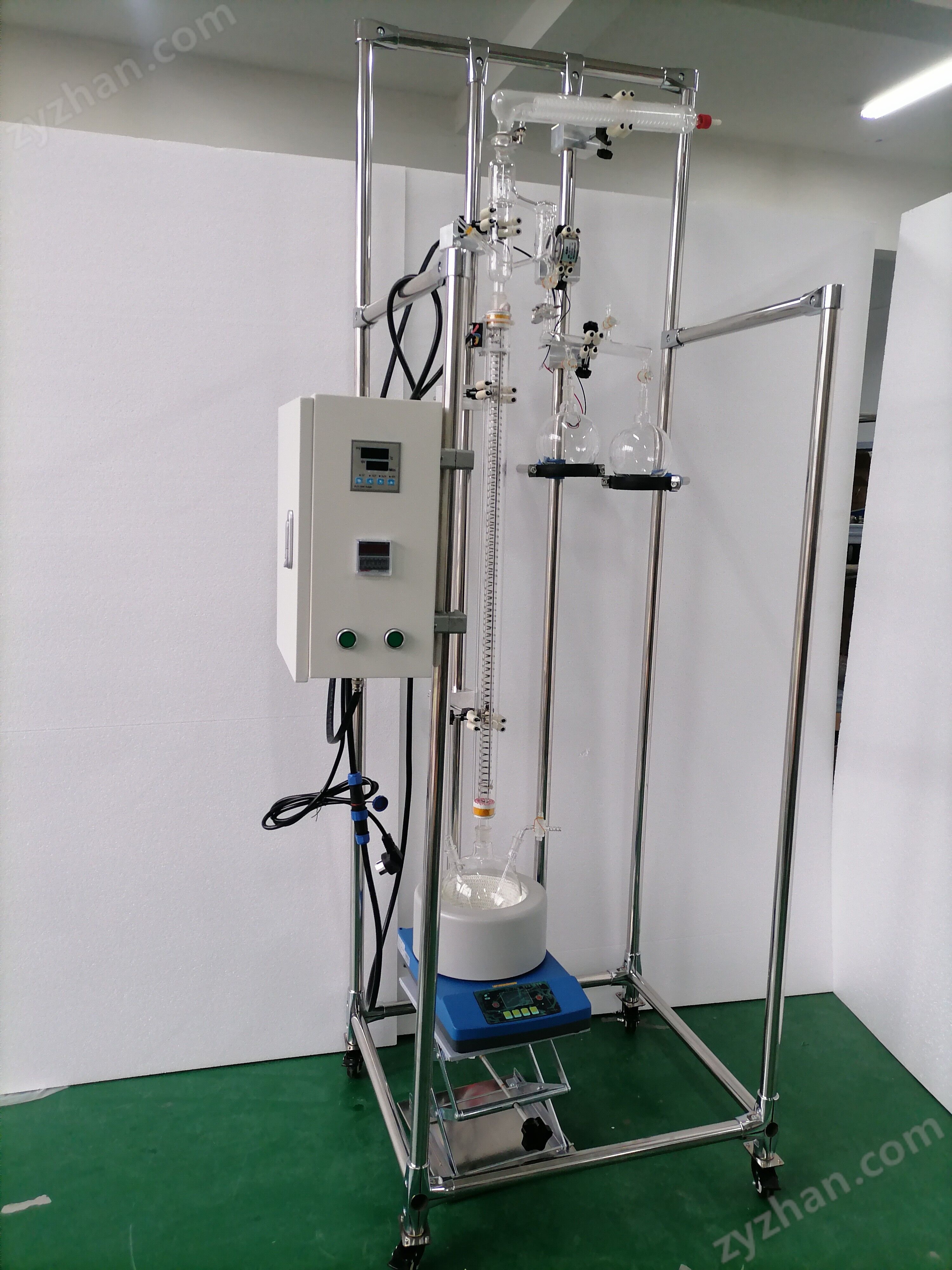
Laboratory Glass Reflux Ratio Control Electric Heating Distillation Tower
Technical Specifications:
Technical parameters of glass distillation tower |
AYJ-2 |
AYJ-5 |
AYJ-10 |
AYJ-20 |
AYJ-50 |
AYJ-100 |
Main equipment material |
glass |
glass |
glass |
glass |
glass |
glass |
Tower kettle capacity(L) |
2 |
5 |
10 |
20 |
50 |
100 |
Tower diameter/Mm (inner diameter) |
25mm |
25mm |
32mm |
32mm |
40mm |
40mm |
Collection tank capacity(L) |
1 |
2L each, 3L each |
5 |
10 |
20L each, 30L each |
50 |
Number of collection tanks/A |
2 |
2 |
2 |
2 |
2 |
2 |
Effective height of distillation tower packing(m) |
1 |
1 |
2 |
2 |
2 |
2 |
Is the distillation column segmented |
No |
No |
yes |
yes |
yes |
yes |
Distillation column heat tracing method |
heating wire |
heating wire |
heating wire |
heating wire |
heating wire |
heating wire |
Total height of distillation tower main equipment(mm) |
≈2770 |
≈2800 |
≈3350 |
≈3500 |
≈4200 |
≈4500 |
Tower kettle heating(Heating form can be selected according to the actual application of the customer) |
Electric heating sleeve |
Electric heating sleeve |
Electric heating sleeve |
Electric heating sleeve |
heat transfer oil |
heat transfer oil |
Working temperature of tower kettle(℃) |
room temperature+10℃-300℃ |
room temperature+10℃-300℃ |
room temperature+10℃-300℃ |
room temperature+10℃-300℃ |
room temperature+10℃-300℃ |
room temperature+10℃-300℃ |
Empty load limit pressure of distillation tower(Standard opening) |
0.1mbar |
0.1mbar |
0.1mbar |
0.1mbar |
0.1mbar |
0.1mbar |
Temperature measurement port at the top of the distillation tower(Outer diameter) |
∅12mm |
∅12mm |
∅12mm |
∅12mm |
∅12mm |
∅12mm |
condenser form |
vertical form |
vertical form |
horizontal format |
horizontal format |
horizontal format |
horizontal format |
Condenser heat exchange area(m²) |
0.2 |
0.2 |
0.5 |
0.5 |
0.8 |
0.8 |
Continuous sampling valve |
yes |
yes |
yes |
yes |
yes |
yes |
Temperature Display |
yes |
yes |
yes |
yes |
yes |
yes |
Reflux ratio control |
yes |
yes |
yes |
yes |
yes |
yes |
power supply |
220V 50/60HZ1P |
220V50/60HZ 1P |
220V 50/60HZ 1P |
220V50/60HZ 1P |
220V 50/60HZ 1P |
220V50/60HZ1P |
Heating matching |
Electric heating sleeve |
Electric heating sleeve |
Electric heating sleeve |
Electric heating sleeve |
High temperature cycler |
High temperature cycler |
vacuum pump |
Rotating blade/Or water pump |
Rotating blade/Or water pump |
Rotating blade/Or water pump |
Rotating blade/Or water pump |
Rotating blade/Or water pump |
Rotating blade/Or water pump |
optional |
Pressure detection port, pump front cold trap, distillation tower wall insulation wrapped with cotton insulation, packing type specifications |
|||||
Similar Product Recommend