-
E-mail
1622018819@qq.com
-
Phone
+8613729962354,+8615369622507
-
Address
No. 181 Dongcheng West Road, Guancheng District, Guangdong Province/511, Building B, Huaqiang Office Building, Xiaobao North Street, Songzhuang Town, Tongzhou District, Beijing
Product Categories
Dongguan Youte Purification Technology Co., Ltd
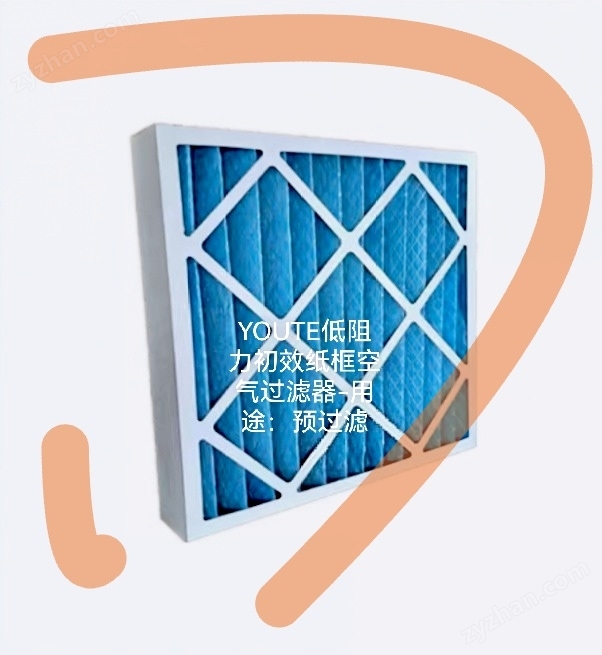
Low-resistance primary paper frame air filter
NegotiableUpdate on 04/21
- Model
- Nature of the Manufacturer
- Producers
- Product Category
- Place of Origin
Overview
Low-resistance pre-filter paper frame air filter is a disposable filter suitable for primary filtration in air conditioning and ventilation systems
Product Details
Low-resistance pre-filter paper frame air filter product structure and materials
1. Outer frame material
Made of moisture-proof and water-resistant virgin wood fiber paperboard, possessing high strength characteristics, not easily deformed, cracked, or twisted under normal operating conditions -1-7
The filter media is fixed diagonally at the front and back of the paper frame to ensure a tight bond between the filter media and the outer frame, preventing any airflow leakage -5-7
Common thickness specifications: 20mm (1"), 46mm (2"), 96mm (4"), etc. -2
2. Filter media material
Mainly uses polyester synthetic fiber or non-woven fabric as the filter material -4-9
The filter media undergoes a needle-punching process to form a gradient structure, possessing high dust collection capacity and a long service life -5
Moisture resistance up to 99%, adaptable to high humidity environments -4-5
A metal mesh is bonded to the air outlet surface to prevent vibration and ensure consistent folding spacing -5
3. Structural Design
The filter media is folded and housed within high-strength die-cut cardboard, resulting in a filtration area 2-5 times that of a flat filter.
The folded structure effectively increases the frontal area, ensuring smooth and uniform airflow.
III. Features and Advantages of Low-Resistance Pre-Effect Paper Frame Air Filters
Features and Specific Advantages
Filtration Performance: Filters dust particles larger than 5μm, achieving a gravimetric efficiency of 90%-93%.
Operating Resistance: Initial resistance as low as 18-70Pa (depending on specifications and airflow), saving system energy.
Dust Holding Capacity: Dust holding capacity. .. Large capacity, long service life, reduced replacement frequency -1-2
Strength and robust outer frame, moisture-proof and not easily deformed, ensuring long-term stable operation -1-6
Economical disposable design, no cleaning or maintenance required, low overall operating cost -4-7
Good compatibility and versatility, no need to change the original air conditioning unit design, can be directly replaced -1
Efficiency rating description:
G3 rating: Average efficiency (colorimetric method) 30%-35%
G4 rating: Higher average efficiency (colorimetric method), conforms to EN779 standard -4-6
IV. Technical Performance Parameters
1. Standard Specifications and Performance Parameters - 2-6-8
Actual Dimensions (mm) Thickness Filter Area (m²) Rated Airflow (m³/h) Initial Resistance (Pa) Efficiency Class
595×595×4646mm (2") 1.75 3400 60-70 G3/G4
595×290×4646mm (2") 0.85 1500-1700 45-68 G3/G4
594×594×9696mm (4") 2.66 3400 68 G4
595×595×2020mm (1") 0.88 2380 70 G3/G4
2. Operating Conditions
Recommended Final Resistance: ≤225Pa-2
Moisture Resistance: ≤90%-2
Maximum Operating Temperature: 80°C-4
Recommended Air Velocity: 350FPM (approx. 1.78m/s)-5
V. Application Scenarios
1. Building Ventilation
Primary filtration for air conditioning and centralized ventilation systems-2-8
Pre-filtration for ventilation systems in public places such as office buildings, shopping malls, and airports-6
Filtration for subway ventilation systems-10
2. Industrial and Cleanroom Applications
Pre-filtration for large air compressors-2-8
Dedicated constant temperature and humidity air conditioning for PBX and computer rooms-1-3
Pre-filtration for cleanroom return air systems and FFU inlets-6-10
Pre-filtration before HEPA/ULPA high-efficiency filters to extend the life of downstream high-efficiency filters-1-6
3. Special Applications
Pre-filtration for painting systems and painting workshops-6
Coarse filtration for factory exhaust gas and processing dust collection


