-
E-mail
szchina1718@163.com
-
Phone
13632925349
-
Address
608A, Jimao Building, No. 111 Shaping North Road, Nanwan Street, Longgang District, Shenzhen
Product Categories
Shenzhen Weierkang Technology Co., Ltd
PPS 4.0 invasive, IBP tester
NegotiableUpdate on 01/05
- Model
- Nature of the Manufacturer
- Producers
- Product Category
- Place of Origin
Overview
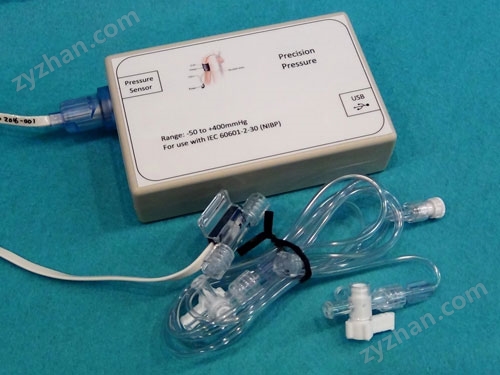
PPS 4.0 is composed of PC software, USB module, and pressure sensor
Product Details
PPS 4.0 is composed of PC software, USB module, and pressure sensor. It is used for real-time monitoring of pressure waveforms, with a speed significantly higher than the usual speed in pressure monitoring equipment, while maintaining high accuracy.
This system is designed specifically for IEC 80601-2-30, which includes various tests under normal and fault conditions, where it is necessary to check the peak pressure waveform and the duration above and below the threshold to determine compliance. This system has the following characteristics:
IBP sensor, easily compatible with NIBP tubing
High precision (+/-0.5mmHg or 0.2% of reading)
Fast response time (<100ms)
The ability to accurately capture peak pressure
The measurement range is -50 to+400mmHg (or according to user requirements)

In addition, the PC based measurement system provides graphical records and time logs where pressure exceeds certain thresholds, such as the 15, 300, and 330 mmHg values specified in the standard. The software will automatically indicate whether the pressure and duration exceed the allowable limits (for example, exceeding 15mmHg for more than 180 seconds without interruption). These charts can be easily copied into word processing applications, making it easy to create test reports and visualize or interpret non-conforming test results.
As the sensor is a regular IBP sensor, the system can also be used for other purposes, such as measuring pressure in the blood circuit. In the case of measuring occlusion pressure (such as in IEC 60601-2-24), a special range of up to 200kPa (approximately 1300mmHg) can be provided. For laboratories testing NIBP and simultaneously, a dual range version can be used, which can maintain appropriate accuracy for both ranges.
Please note that the sensor is an external IBP sensor and does not undergo temperature compensation. Therefore, it cannot provide an accuracy of 0.1% throughout the entire range as required by the IBP standard IEC 60601-2-34.
PPS 4.0 is an innovative PC based USB module designed to capture rapidly changing dynamic value devices related to medical electrical testing and provide a chart of pressure changes over time for detailed analysis. Automated NIBP equipment that meets the single fault requirements of IEC 60601-2-30/IEC for testing and trial use
80601-2-30, the software automatically records the time of events as needed to determine compliance.
The system uses standard IBP sensors, which have been found to easily connect to various pressure systems in medical devices.
This sensor can handle both wet and dry conditions.
This sensor can handle both wet and dry conditions.
Condition 1
The combination of IBP sensors with precision electronic devices and nonlinear curve fitting provides a convenient sensor with fast response time, high accuracy, and software interface. Customers can choose a pressure range up to ± 300kPa2
Composed of a standard IBP pressure sensor, USB module, and software for displaying current pressure, peak pressure, zeroing function, graphics, and event logs: the sensor is a standard bridge sensor suitable for invasive blood pressure IBP measurement (5 µ V/V/mmHg). The USB module contains special circuits that ensure high-precision measurements from such sensors and are combined with nonlinear compensation in PC software. The system adopts a standard IBP sensor interface, which can easily connect to pressure systems in various wet and dry conditions in medical equipment. Sensors combine precision electronics and nonlinear curve fitting, with fast response time, high precision, and software interface.
PPS 4.0 Innovation, IBP Tester Selection Table:
Composed of a standard IBP pressure sensor, USB module, and software for displaying current pressure, peak pressure, zeroing function, graphics, and event logs: the sensor is a standard bridge sensor suitable for invasive blood pressure IBP measurement (5 µ V/V/mmHg). The USB module contains special circuits that ensure high-precision measurements from such sensors and are combined with nonlinear compensation in PC software. The system adopts a standard IBP sensor interface, which can easily connect to pressure systems in various wet and dry conditions in medical equipment. Sensors combine precision electronics and nonlinear curve fitting, with fast response time, high precision, and software interface.
PPS 4.0 Innovation, IBP Tester Selection Table:
range | standard | feature |
-50 to +220kPa | IEC 60601-2-24() | • Directly connected to, suitable for liquids• Software records peak pressureThe assumed range should not exceed the limit of 200kPa(Restrictions according to ISO standards)• Response time 80ms• Medium precision (± 0.5kPa, ± 0.2% full-scale) |
-50 to+400mmHg | IEC 80601-2-30(NIBPs) | IBP sensors are easy to connect to the air circuit• Record peak pressure• Scope consideration limits to 330mmHgHigh precision (± 0.5mmHg ± 0.2% full-scale)• Response time 80msThe software automatically records the threshold timeThe standard requires that it be recorded in the event log and notified whether or notMay have exceeded the limits in the standard |
Dual range (-50~+400mmHg and -50~+200kPa) | Both can be satisfied | • Same as above. Include range switching to enable bothApplications within a single unit• Compatible with software version 4.0.0. x |
The product meets the standards:
GB 9706.227-2021 Electrical Equipment Part 2-27: Specific Requirements for Basic Safety and Basic Performance of Electrocardiogram Monitoring Equipment
YY 0783-2010 Electrical Equipment Part 2-34: Special Requirements for Safety and Basic Performance of Invasive Blood Pressure Monitoring Equipment
YY 0781-2010 Blood Pressure Sensor
Connection method:

This sensor is a standard bridge sensor used for IBP measurement (5 μ V/V/mmHg). USB
The module contains special circuits to ensure high-precision measurements can be obtained from such sensors, combined with nonlinear compensation in PC software.
Like all pressure sensors, the zero point (output when zero pressure is applied) will drift over time.
Therefore, the device is equipped with a "zero" button, which can eliminate the offset. This reset button can also be used to eliminate head offset (if used with a liquid circuit). The zero offset of dry and inflatable sensors when powered on without applying pressure should not exceed ± 3mmHg (± 0.5kPa).
The sensor itself has a very high frequency response and samples at 1kHz3
Remove the power supply
Noise, and then integrate the signal within 40ms. This means that the system may need up to 80ms to fully respond to pressure changes.
This sensor is temperature sensitive with a coefficient of approximately 0.025%/° C.
accuracy
accuracy
The specifications are suitable for normal laboratory environments at 20-30 ° C. The usage range outside of this may exceed the specifications under full range pressure (for example, at 400mmHg, the accuracy may be ± 1mmHg at 35 ° C instead of ± 0.5mmHg).
Similar Product Recommend