-
Phone
18660668986
-
Address
Oulong Technology Park, No.1 Jinma Road, Hanting District, Weifang City, Shandong Province
Product Categories
Shandong Fengtu IoT Technology Co., Ltd

Rice heavy metal detector
NegotiableUpdate on 03/27
- Model
- Nature of the Manufacturer
- Producers
- Product Category
- Place of Origin
Overview
Product Overview FT-ZJS01 Rice Heavy Metal Detector is a new type of heavy metal detection equipment independently developed by our company. With its extremely low cost and high sensitivity, it can replace traditional atomic absorption methods and is widely used in on-site emergency monitoring (such as water environment monitoring)
Product Details
product overview
FT-ZJS01 Rice Heavy Metal Detector is a "new" heavy metal detection equipment independently developed by our company, characterized by its extremely low cost and high sensitivity,
Can replace traditional atomic absorption methods and be widely used in on-site emergency monitoring (such as water pollution, heavy metal pollution in food, etc.), water quality, soil
Testing in the fields of cosmetics, food, pharmaceuticals, etc.
The instrument adopts anodic stripping voltammetry (ASV). This method was first invented in the 1820s and won the Nobel Prize in Chemistry for its inventor Jaroslav Heyrovsky in 1959. At present, traditional atomic absorption methods have been widely used in medicine, biology, and environmental analysis in Europe and America, replacing them;
Authoritative agencies such as the US EPA have listed it as a standard testing method. In the fields of food safety testing and water quality testing in China, this testing method has also been listed as a national standard
One of the standard methods, such as GB 5009.12-2010 "Determination of Lead in Foods" and GB/T 5009.123-2003 "Determination of Chromium in Foods", GB/T 13896- 1992
Determination of Lead in Water Quality, etc.
1.2 Detection principle
The analysis principle of the portable heavy metal detector is anodic stripping voltammetry (ASV). The process of anodic stripping voltammetry is as follows:
① Enrichment: Apply a reducing potential to the working electrode. When the electrode potential exceeds the precipitation potential, the analyzed metal ions (Mn+) in the solution are reduced to metal and deposited on the surface of the working electrode, as shown below:
Mn+ + ne- M
The longer the electric potential is applied, the more metal is reduced and deposited on the electrode surface (known as the "deposition" or "accumulation" process). This process accumulates metal on the surface of the electrode.② Dissolution: When enough metal is deposited on the surface of the working electrode and the potential is increased at a constant rate, the metal will dissolve (oxidize) on the electrode.
For a given electrolyte solution and electrode, each metal has a specific voltage at which oxidation reactions occur:
M Mn+ + ne-
This process releases electrons to form an electric current. Measure the current and plot it against the applied potential, which is called a "voltammogram". The current value on the oxidation or dissolution potential is considered as the peak value of the curve. To calculate the sample concentration, it is necessary to measure the peak height or area and compare it with a standard solution under the same conditions.1.3 Accuracy
For most cases, the instrument has sufficient sensitivity, accuracy, and precision to meet the data quality objectives. When used in the wild, limited by the sample pre-treatment equipment, only preliminary extraction of the sample is carried out, therefore, the obtained detection data needs to consider deviation values.
The conditions that may affect the accuracy and precision of on-site analysis include:
• Uniformity of sampling
Sampling operation error
• Pipette error
Unpredictable errors
• Sampling and analysis of cup contamination
• Extraction efficiency of samples
Chapter 2 Instrument Composition
Glass carbon electrode and gold electrode areworking electrodeThe loading label indicatesWThe hole position; The silver chloride electrode isreference electrodeThe insertion label hasRThe hole position; Platinum disk electrode iscounter electrodeThe insertion label hasCThe hole position.
Adopting anodic stripping voltammetry, it has high detection accuracy and sensitivity. With its extremely low cost and high sensitivity, it can replace traditional atomic absorption methods and is widely used in the detection of cosmetics, health products, food, food, pharmaceuticals, environmental water quality and other fields.
Testing items: heavy metals such as cadmium, lead, mercury, arsenic, chromium, cadmium, aluminum, nickel, manganese, copper, zinc, iron, cobalt, etc
Scope of application: food, tea, fruits and vegetables, aquatic products, seafood, meat products, puffed food, Century egg, condiments and other food and water.
Technical parameters:
1. Detection range: 0-60 mg/L (ppm)
2. Detection limit min: 0.1 ppb
3. Accuracy error: ± 10%
4. Detection limit: 0.1PPb
5. Repetitive error: 10%
6. Testing time:<10 minutes (within 1 hour from sample processing to instrument detection)
7. Measurement environment: 5-50 ℃, 95% relative humidity
Product features:
1. This instrument adopts anodic stripping voltammetry, with high detection accuracy and sensitivity
2. Not affected by the chromaticity of the water sample during testing
3. Using mercury free electrodes, safe and environmentally friendly
4. Multiple elements can be detected simultaneously or individually
5. Testing methods: standard comparison method, standard addition method, standard curve method
6. Scanning modes: linear scanning, conventional pulse scanning, differential pulse scanning
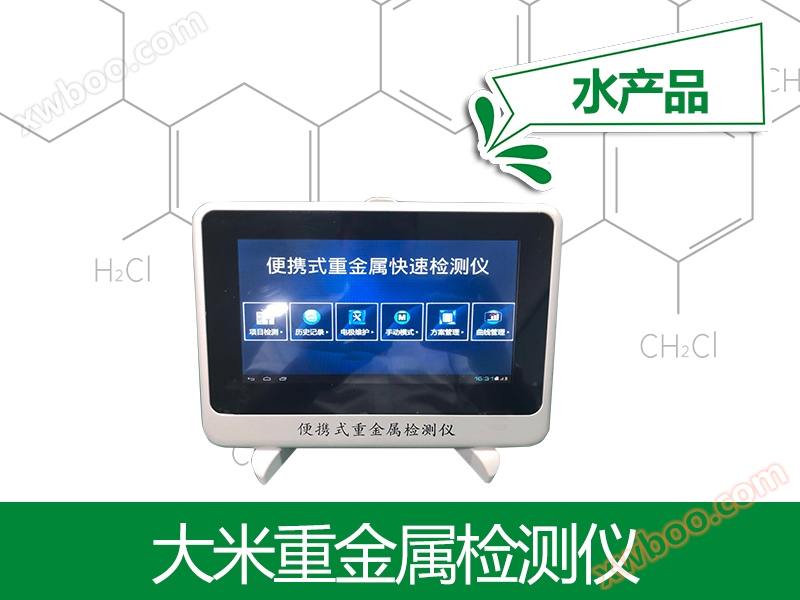
7. Display: 7-inch capacitive touch screen, Android operating system, Chinese operating interface
8. Power supply: DC12V rechargeable lithium battery, standby time>4h
9. Storage capacity of over 2000 sets of data, USB 2.0 data interface
This article's website:


