-
E-mail
551416165@qq.com
-
Phone
17366658694
-
Address
No. 172, Lindong Road, Nanyuan Street, Yuhang District, Hangzhou City
Product Categories
Hangzhou Chuanyi Experimental Instrument Co., Ltd


Triple sulfur dioxide detector, far-infrared ceramic heating sleeve
NegotiableUpdate on 01/05
- Model
- Nature of the Manufacturer
- Producers
- Product Category
- Place of Origin
Overview
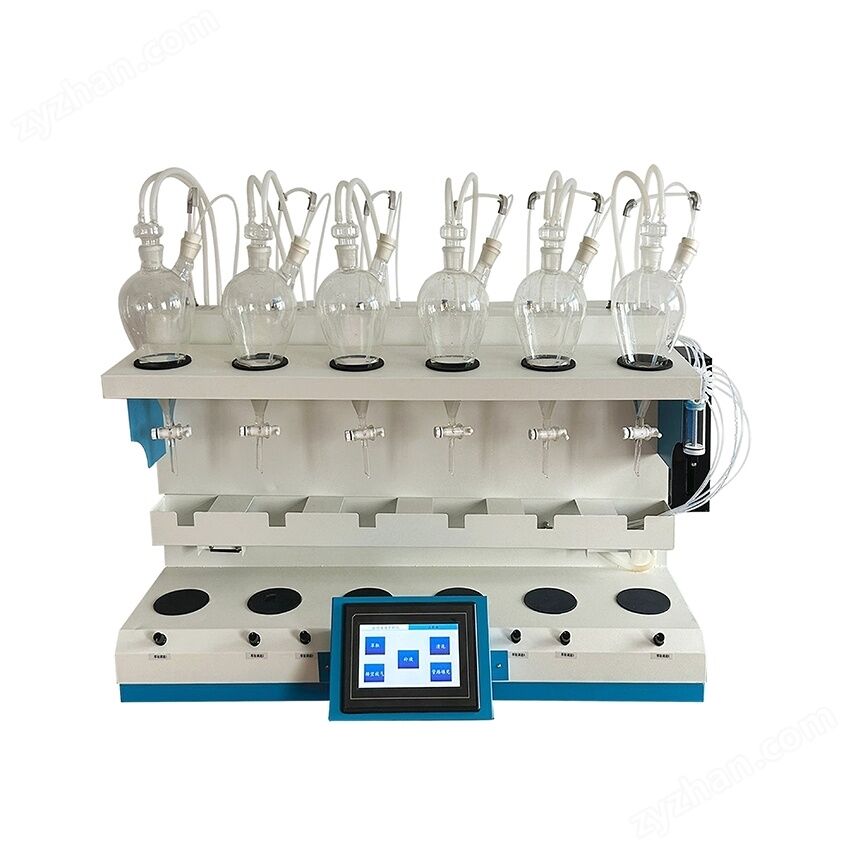
Triple sulfur dioxide detector, far-infrared ceramic heating sleeve, Chuanyi Instrument series fully automatic distiller, also known as sulfur dioxide distiller, is mainly suitable for various traditional Chinese medicine production enterprises, traditional Chinese medicine research institutes, and food production enterprises related to sulfur fumigation. It can be widely used for the detection of sulfur dioxide residue, formaldehyde, alcohol content, and other distillation operations in the field of food and medicinal material detection.
Product Details
Triple sulfur dioxide detector, far-infrared ceramic heating sleeve
Main features
1. Choose a sealed infrared ceramic heating sleeve, which has good heat collection, high heating efficiency, and can prevent equipment damage caused by liquid leakage.
2. Full touch screen control, human-computer interaction interface, easy to operate and control.
3. Heating devicesingle holeTemperature control, adjustable heating power.
4. Heating uptimeFunction, beep reminder, automatic stop heating.
5. External cooling water circulation machine (optional built-in), no need for external tap water cooling
6. Configure a precision nitrogen flow control system. And it can be equipped with a nitrogen generator.(Optional)
The calibration specification of sulfur dioxide analyzer is a key step to ensure the accuracy and reliability of measurement results. The following is a detailed calibration specification based on search results:
1. Preparation before calibration
Instrument inspection: Ensure that the appearance of the instrument is undamaged and that the functional modules (such as touch screen, voice broadcast system, and pipeline connections) are functioning properly.
Environmental control: The calibration environment should meet the requirements of temperature (recommended 20-25 ℃) and humidity (40-60% RH), while avoiding strong electromagnetic interference.
Standard substances and equipment: Use traceable standard sulfur dioxide solution or gas, and the calibration range should cover the nominal 0-50mg SO ₂ range of the instrument. Recommend using a nitrogen generator or steel cylinder to optimize calibration conditions.
2. Core calibration steps
Zero point calibration and baseline correction: Start the instrument in a sulfur dioxide free environment and ensure that the initial reading is zero by using the built-in zero adjustment function or manually adjusting the potentiometer. The intelligent voice prompt system can assist operators in completing the zeroing process.
Multi point linear calibration: Inject standard solutions of different concentrations (such as 10mg, 25mg, 50mg SO ₂) separately, and record the instrument response values. Calibration should cover the actual detection range (such as the typical content range of samples such as preserved wine and grape wine), and verify whether the linear error of the instrument is ≤ 4%. According to the requirements of GB5009.34-2022, use sodium sulfite solution for recovery rate testing to ensure that it is ≥ 85%. The automatic distillation compensation function can reduce human error and improve the reliability of recovery rate.
3. Confirmation and recording after calibration
Data comparison: After calibration is completed, the measured values need to be compared with the standard values. If the error exceeds the allowable range (such as repeatability RSD4%), pipeline blockage or sensor sensitivity issues need to be investigated. The self checking system can automatically prompt abnormal states.
Record keeping: Record the data and results during the calibration process, and save relevant files and records [3].
4. Calibration frequency
Zero point calibration: It is recommended to perform zero point calibration every time the instrument is turned on to eliminate possible zero drift that may occur during prolonged shutdown or use. Calibration instrument
Range calibration: Generally, range calibration is performed every 1-3 months. If the instrument is frequently used or requires high accuracy of the test results, the calibration cycle can be appropriately shortened.
Linear calibration: Linear calibration is generally performed once a year, and it is also necessary to perform linear calibration when key components of the instrument are replaced or when there is a significant deviation in the measurement results.
5. Maintenance methods
Regular cleaning: Use a clean soft cloth to wipe the outer shell of the instrument regularly to remove dust and stains. For stubborn stains on the surface of the instrument, a mild cleaner dipped in a soft cloth can be used to gently wipe, but it is important to avoid liquid entering the interior of the instrument.
Internal cleaning: According to the instrument's user manual, regularly open the instrument's casing or detachable parts, and use a clean brush or compressed air to remove dust and debris from the interior. For optical components such as light sources, lenses, etc., specialized optical cleaning cloths and cleaning agents can be used for wiping to ensure smooth optical paths and accurate transmission of optical signals.
Through the above calibration standards, the accuracy and reliability of the sulfur dioxide analyzer can be ensured, providing strong support for the environmental management and safety production of enterprises

Triple sulfur dioxide detector, far-infrared ceramic heating sleeve
Technical Specifications:
model:CYSO2-3
display mode:LCD touch screen
Heating method:Far infrared ceramic heating (no open flame heating, low power consumption, high efficiency)
Nitrogen blowing control:The host is equipped with a nitrogen main interface, and the nitrogen flow rate of a single hole can be controlled separately through a flow meter
temperature control:Built in micro boiling heating control system, temperature control range can reach200℃
Number of distillation units:3group(Optional 4 or 6 sets)
Distillation flask specifications:Standard configuration:1000ml flask
Receiving bottle specifications:Standard configuration:100ml*3Erlenmeyer flask
rated voltage:220V/50HZ
Leakage protection device:have
Anti dry burning design:have
cooling method:OptionalExternal cooling water circulation machine,Optional built-in compressor for cooling
Similar Product Recommend