-
E-mail
gzw3545@163.com
-
Phone
13908453545
-
Address
Factory Building No.1, Zeng's Enterprise, Dongfanghong Middle Road, High tech Development Zone, Yuelu District, Changsha City
Changsha Yixing Pharmaceutical Machinery Co., Ltd
Analysis of servo drive system for ampoule filling and sealing machine
Date: 2025-07-20Read: 46
Ampoule filling and sealing machineThe servo drive system is the core of high-precision operation of the equipment. Through closed-loop control technology, it achieves precise coordination between filling volume, conveying speed, and flame sealing, enabling the equipment to maintain a filling accuracy of ± 0.5% and a sealing qualification rate of 99.9% even at a high-speed operation of 300-600 units/minute.
The system consists of three core modules. The servo motor adopts permanent magnet synchronous type, with a power range of 0.75-2.2kW, a speed control accuracy of ± 1r/min, a response frequency of ≥ 1kHz, and can quickly match the conveying needs of different specifications of ampoules (1-20ml). The driver adopts vector control algorithm and dynamically adjusts the output current by collecting real-time encoder feedback signals (resolution 17 bits, i.e. 131072 pulses/rev), so that the motor has no crawling phenomenon at low speed (50r/min) and no risk of stepping out at high speed (3000r/min).
The transmission actuator embodies precision linkage design. The servo shaft of the filling pump is connected to the cam distributor through a planetary reducer (reduction ratio 5:1), which converts the motor's rotational motion into the linear reciprocating motion of the piston. Combined with an electromagnetic flow valve, it achieves stepless adjustment of the filling volume (with a small increment of 0.01ml). The conveying servo shaft adopts synchronous belt drive, and maintains speed ratio synchronization with the filling shaft through electronic gearbox function (error ≤ 0.02mm), ensuring that the positioning deviation of the ampoule at the filling station is ≤± 0.1mm. The flame sealing servo shaft controls the opening of the gas valve and the swing angle of the flame gun, and automatically adjusts the flame intensity according to the ampoule specifications (adjustment accuracy ± 5mbar).
The system control logic adopts a multi axis collaborative architecture. The PLC main controller is connected to each servo axis through the EtherCAT bus, with a communication cycle of ≤ 1ms, achieving millisecond level synchronization of filling, conveying, and sealing actions. When unqualified ampoules are detected, the servo system can complete the emergency stop reject reset action within 20ms, without affecting the subsequent production rhythm. The equipped touch screen can display real-time operating parameters of each axis (such as current, speed, position deviation), support the storage of 100 sets of process formulas, and automatically match servo parameters by calling the corresponding parameters when changing the type.
The advantages of servo drive systems are highlighted in special working conditions. For liquid medicines that are prone to foaming (such as traditional Chinese medicine injections), the system can reduce the impact during ampoule transportation through an S-shaped acceleration deceleration curve (adjustable acceleration of 0.5-2m/s ²); Faced with high viscosity materials (such as oil), the filling servo shaft will automatically extend the holding time (adjustable from 0.1-1s) to ensure the injection of medication. After 8 hours of continuous production, the system temperature drift is ≤ 0.5%, and stable control accuracy can still be maintained, meeting the strict requirements of GMP for equipment repeatability.
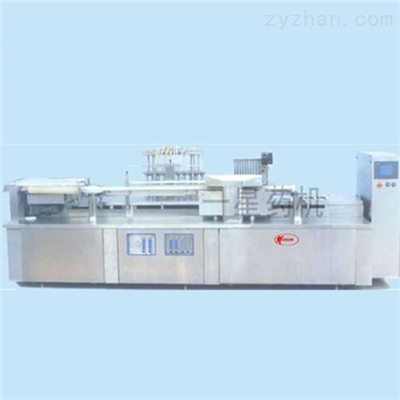
In terms of maintenance,Ampoule filling and sealing machineThe servo system has a complete self diagnostic function, which can monitor abnormalities such as overcurrent, overload, encoder faults in real time, and automatically record fault codes and operating parameters when an alarm is triggered. Daily maintenance requires regular cleaning of the cooling air duct (once a month) and checking of the grounding resistance of the encoder cable shielding layer (≤ 1 Ω) to ensure that there is no electromagnetic interference when multiple motors are running simultaneously. Through the transformation of this system, the overall equipment efficiency (OEE) of a certain antibiotic production line has increased from 68% to 89%, significantly reducing the scrap rate caused by mechanical transmission errors.