-
E-mail
925633677@qq.com
-
Phone
15051989720
-
Address
Sanhekou Industrial Park, Zhenglu Town, Changzhou
Changzhou Xianzhu Drying Equipment Co., Ltd
Briefly describe the scientific usage method of laboratory boiling dryer
Date: 2025-10-23Read: 6
The laboratory boiling dryer, with its efficient and uniform drying characteristics, has become a powerful assistant for the dehydration treatment of small batches of powder and granular materials. It blows clean hot air from bottom to top through the material layer, causing particles to boil under the action of airflow, greatly enhancing heat exchange efficiency, shortening drying time, and avoiding material agglomeration or overheating. However, improper operation not only affects the drying effect, but may also cause dust explosions, material loss, or equipment damage. Mastering the scientific usage method of laboratory boiling dryer is the key to its safety.
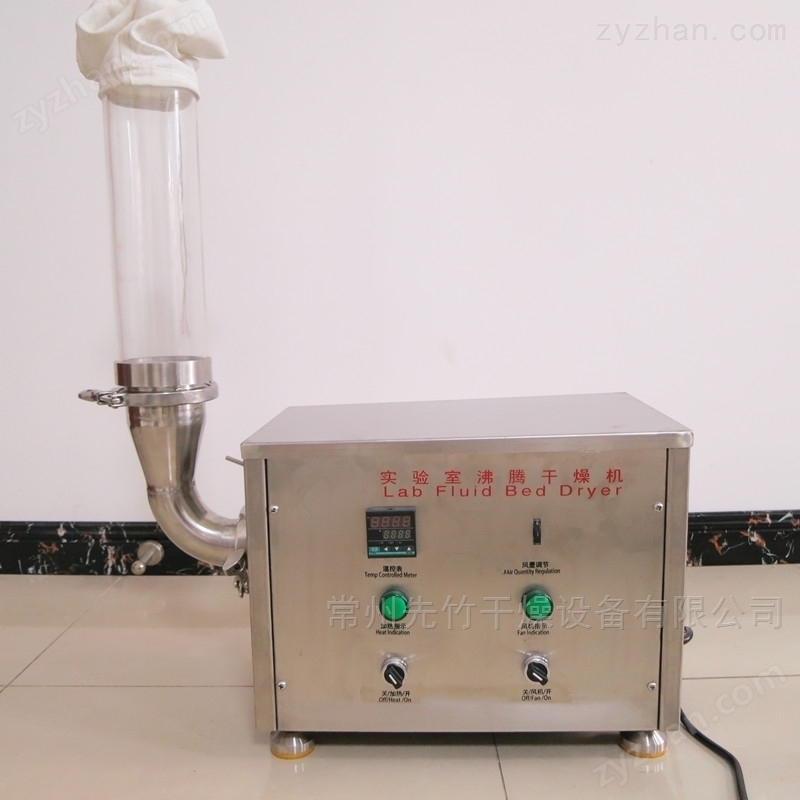
1、 Material preparation: laying the foundation for drying
The material to be dried should be pre crushed to a suitable particle size (usually 0.1-2mm) to ensure uniform particle size and avoid large particles encapsulating moisture or fine powder being carried away by the airflow. The loading amount shall not exceed 2/3 of the capacity of the drying chamber, providing sufficient space for material boiling to prevent clogging of the filter bag or splashing.
2、 System check: Ensure safe operation
Before use, check if the fan, heater, and control system are functioning properly. Confirm that the bag filter is securely installed and undamaged to prevent dust leakage. Check if the air source pressure (if equipped with pneumatic valve) and power supply voltage meet the requirements. Ensure good grounding of the equipment and effective anti-static design.
3、 Parameter setting: precise control of "dance steps"
Set key parameters based on material characteristics:
Inlet air temperature: usually 40-80 ℃. Heat sensitive materials should be dried slowly at low temperatures to avoid coking;
Air volume adjustment: Adjust the fan frequency to ensure that the material is uniformly boiling without blowing through or settling;
Drying time: Based on the initial moisture content of the material, the endpoint can be determined by combining sampling and testing.
4、 Startup and operation monitoring
Start the fan first and wait for the airflow to stabilize before turning on the heating system to avoid dry burning and damaging the heating tube. Observe the boiling state of the material and confirm uniform fluidization through the window. Monitor changes in inlet/outlet air temperature and pressure, and adjust parameters in a timely manner. It is strictly prohibited to open the top cover or touch high-temperature components during operation.
5、 Shutdown and Unloading
After drying, turn off the heating first and continue blowing the cooling material to a safe temperature (usually<40 ℃) to prevent the hot material from contacting the air and self igniting. After the fan stops, gently shake the cloth bag to collect residual powder. Open the sampling port or bottom valve and transfer the dry material to a sealed container.