-
E-mail
3148720484@qq.com
-
Phone
18122108955
-
Address
101, No. 3 Jiangjunzi, Jiangxi Village, Dalong Street Office, Panyu District, Guangzhou City
Guangzhou Yuexin Experimental Equipment Co., Ltd
Spray Test of Container Energy Storage System: Waterproof Performance Guide
Date: 2025-12-19Read: 52
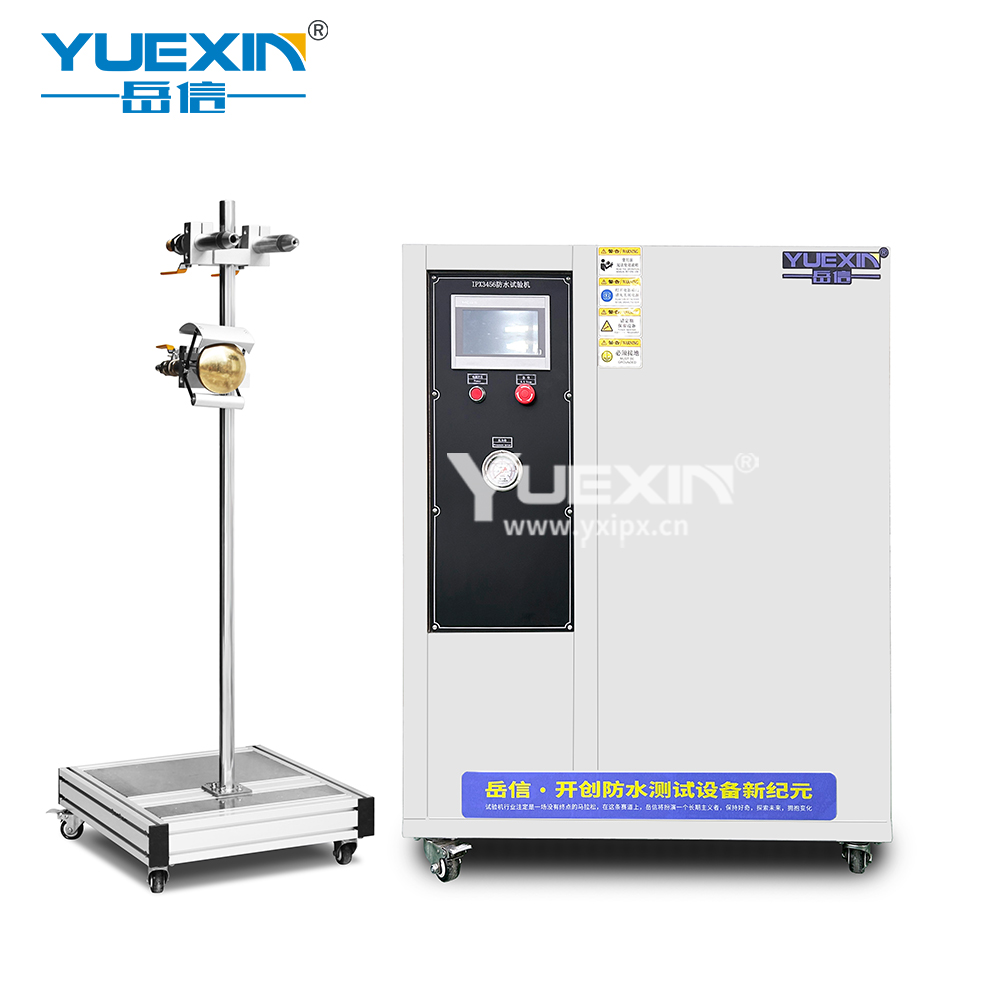
Spray testing equipment plays a key role in the performance testing of container energy storage systems. It accurately evaluates the waterproof sealing performance of the system by simulating precipitation environments in different scenarios, which is an important detection link to ensure the safe outdoor operation of energy storage equipment. Below, we will delve into its technical principles and detailed testing process.
1IPX4 (splash proof) test: Dealing with daily splash challenges
1. Nozzle and fluid parameters: accurateindeedReproduce natural splashing scenes
The IPX4 test uses an SR75.5mm spherical nozzle with 121 evenly distributed small holes with a diameter of 0.5mm on the nozzle surface. During testing, the water flow rate should be accurately maintained at 10 ± 0.5L/min, with an error strictly controlled within ≤ 5%, and the water pressure should be kept stable within the range of 50-150kPa. This set of parameter settings can highly reproduce common splashing scenarios such as daily rainwater tapping and manual watering, ensuring the authenticity of the test.
2. Coverage and time control: Full surface inspection
To ensure that the entire surface of the energy storage cabinet is evenly splashed, the test will use an electric rotating platform to drive the energy storage cabinetThe speed can be infinitely adjusted from 0.5 to 1 r/min for 360 ° rotation. The testing time is calculated based on the actual surface area of the box, with a testing time of 1 minute per square meter; If the surface area of the box is less than 10 square meters, it shall be calculated as 10 square meters, which means the shortest testing time shall not be less than 5 minutes to avoid detection loopholes caused by incomplete coverage.
3. Assessment focus: Focus on sealing parts
The assessment target for this section is the weak sealing area of the box, including the joints, locking positions, ventilation cover plates, and cable entry ports. By verifying whether these parts can block the infiltration of splashing water, the stable and safe operation of energy storage equipment in daily splashing environments can be ensured.
IIIPX5 (low-pressure water spraying) test: withstand the impact of rainstorm
1. Nozzle configuration: Enhance the impact force of water flow
The IPX5 test uses a stainless steel cylindrical nozzle with an inner diameter of 6.3mm, and the outlet is specially designed with a conical water flow structure. This design can significantly enhance the impact of water flow, accurately fit the impact effect of rainwater in rainstorm weather, and put forward higher requirements for the waterproof performance of the energy storage cabinet.
2. Key parameters: Strictly control the impact strength
During the testing process, the water flow rate remained constant at12.5 ± 0.625L/min, with stable water pressure maintained between 200-300kPa. At the same time, the distance between the nozzle and the container surface is strictly limited to 2.5-3m, and through accurate control of parameters, the water flow impact strength is ensured to meet relevant industry standards.
3. Spray method and key coverage: Full coveragenoodlesaccurateindeeddetection
The spraying process adopts a gantry mounted nozzle, with the nozzle positioned along theX. The Y-axis moves uniformly at an adjustable speed of 5-10mm/s, spraying onto the four sides and top surface of the box. Among them, the continuous spraying time on each side shall not be less than 3 minutes, and an additional 1 minute of spraying time shall be added to the top surface due to its susceptibility to water accumulation and large rain area. The focus shall be on covering the top welds and sealing strips to comprehensively verify the waterproof ability of the equipment in low-pressure spraying environments.
The above is the principle and detailed testing process of the spray test equipment for container energy storage systems.