-
E-mail
info@labcan.cn
-
Phone
18016316889
-
Address
No. 988 Jingtang Road, Jiading District, Shanghai
Kerun Experimental Equipment (Shanghai) Co., Ltd
The effect of parasympathetic vasodilation in extraoral and intraoral tissues on blood flow and temperature
Date: 2025-12-26Read: 9
2025year6Month, Department of Dentistry and Oral Biology, Department of Physiology, Hokkaido University of Health SciencesSyed Taufiqul IslamThe research team, in《The Journal of Physiological Sciences》A study was published in a journal. The aim of this study is to investigate the differences in temperature regulation between extraoral tissues (lower lip) and intraoral tissues (tongue) during the activation of the lingual nerve, and to analyze the effects of non cholinergic parasympathetic vasodilation, cervical sympathetic activation, and their interactions mediated by trigeminal reflexes on blood flow and local temperature in both tissues.
summary
Oral and facial temperature can affect oral and facial function and is related to autonomic nervous system mediated hemodynamics. Although there are differences in the autonomous vascular movement response characteristics of different tissues in the oral and facial regions, the differences in autonomous regulation of oral and facial temperature are still unclear. This study investigated the blood flow in the extraoral tissue (lower lip) and intraoral tissue (tongue) of rats anesthetized with Uratan(BF)And temperature(Tm)Differences. Trigeminal nerve mediated reflex induced non cholinergic parasympathetic vasodilation canobviousIncrease the blood flow and temperature of two types of tissues, and the amplification of the tongue is greater than that of the lower lip; Activation of the cervical sympathetic nervous system canobviousLowering the blood flow and temperature of both tissues, and parasympathetic reflex vasodilation can restore this decrease, with a greater effect on the tongue than on the lower lip. The research results indicate that parasympathetic vasodilation is involved in maintaining blood flow and temperature, and its impact on intraoral tissues may be greater than that on extraoral tissues.
experimentInstruments andmaterial
1.experimental materials
•Experimental animals:45Only adult malesWistarRats,9-15Age, weight310-480g
•Anesthesia and muscle relaxants: Isoflurane, Uratan, Pancuronium Bromide
•Neural specimen: Tongue nerve(LN)Cervical sympathetic nerve trunk(CST)
•Gas:50%Air and50%Oxygen mixed gas
2. Experimental apparatus
•Omegawave OZ-1Laser speckle blood flowimagingceremonyMonitor blood flow changes in the lower lip and tongue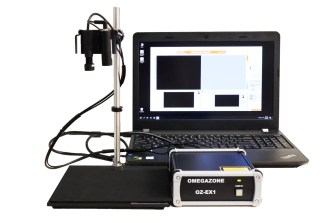
Omegawave OZ-1Laser speckle blood flowimagingceremony
•Non-contact thermometer、pressure sensor、ventilator、Infrared analyzer、Electrical stimulator、heating pad
Experimental Procedure
1. Animal preparation
•Translate into EnglishAfter inducing anesthesia in rats, subcutaneous injection of Uratan was administered to maintain anesthesia, and the room temperature was maintained at during the experiment25±1℃
•Femoral vein catheterization is used for drug injection, and femoral artery catheterization is connected to pressure sensors for monitoringSABPAnd heart rate(HR)
•After tracheal intubation in rats, intravenous injection of pantoprazole was administered to paralyze them, and artificial ventilation was performed through a ventilator to maintain the end expiratory carbon dioxide concentration at40 - 45 mmHg
•Before surgery, bilateral transection of the cervical vagus nerve and the cervical sympathetic nerve trunk is performed to ensure that only non vagus parasympathetic nerve effects are detected during tongue nerve stimulation
2. parameter measurement
•Blood flow measurement: usingOmegawave OZ-1Laser speckle blood flowimagingceremony, in order to780nmSemiconductor laser irradiates the surface of the oral and facial cavity,CCDThe camera collects raw speckle images and analyzes the regions of interest through accompanying software(ROI)Relative changes in blood flow (in any unit)a.u.)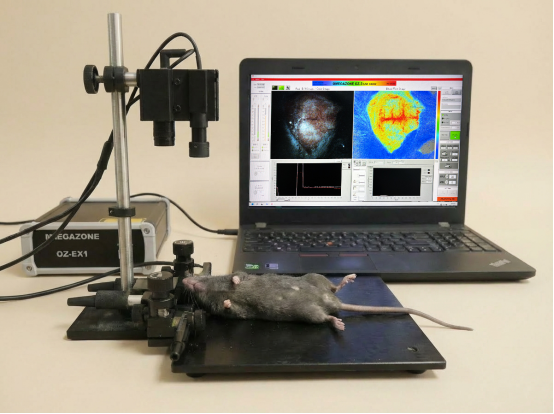 Omegawave OZ-1Laser speckle blood flowimagingceremony
•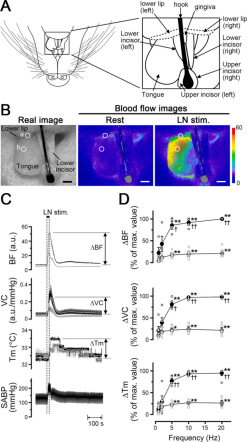
The relationship between hemodynamics and local temperature during trigeminal nerve input stimulation in rat oral and facial tissues
ASchematic diagram of blood flow and temperature measurement sites in the mandibular area (including lower lip and tongue) of supine rats.
BLower lip and ventral tongue in basal state (resting) and left lingual nerve stimulation(LN stim.)Typical examples of real blood flow images and speckle images below.
C: FromATheBThe area of interest indicated by the white circle in the figure(ROI)Increased blood flow in the extracted lower lip (gray trajectory) and tongue (black trajectory)(BF, any unit;a.u.)Vascular conductivity(VC, any unit/Millimeter mercury column;A.u. / mmHg)Local temperature(Tm,°C), as well as systemic arterial blood pressure induced by tongue nerve stimulation (horizontal bar with dashed line)(SABP,MmHg)Change. The white trajectory represents the average vascular conductivity and local temperature of the measurement site.D:100 µAIntensity, different frequencies(1-20 Hz)Tongue nerve stimulation induces ∆ in the lower lip (gray symbol) and tongue (black symbol)BF∆VCAnd ∆TmMean ± standard error of(SEM)(Each group)n=6).
•Temperature measurement: Use a non-contact thermometer to measure the surface temperature of the lower lip and tongue, with a detector diameter2.5mm
•Cardiovascular parameter calculation: based onSABPSignal calculationHRSystolic blood pressure, diastolic blood pressure, and meanSABP; vascular conductivity(A.u. / mmHg)=Blood flow(a.u.)/SABP(MmHg)
3. Neural electrical stimulation
•Tongue nerve stimulation: unilateral stimulation of the peripheral part of the tongue nerve under a binocular microscope, with stimulation parameters of intensity100μAPulse duration2ms, frequency1-20Hz, duration of stimulation20s, used alone or in combination with cervical sympathetic nerve trunk stimulation
•Cervical sympathetic nerve trunk stimulation: unilateral stimulation of the peripheral cut-off end of the cervical sympathetic nerve trunk, with stimulation parameters of intensity100μAPulse duration2ms, frequency0.5-5Hz, duration of stimulation2min
4. pharmacological intervention
•Medication to0.1ml/minThe flow rate of intravenous infusion10minAfter administration, at least7minDetect the response triggered by neural electrical stimulation to ensure blood flow andSABPReaching a stable state
•Observe the effects of hexamethonium bromide (autonomic cholinergic blocker) and atropine sulfate (muscarinic cholinergic blocker) on blood flow, vascular conductivity, and local temperature changes induced by tongue nerve stimulation, respectively
•Using physiological saline as a control, verify that it has no effect on cardiovascular parameters and local temperatureobviousinfluence
empirical conclusion
1. Tongue nerve electrical stimulation can frequency dependently increase blood flow, vascular conductivity, and local temperature in the lower lip and tongue5HzThe10HzThe20HzWhen stimulated, the amplification of the tongue is significantly greater than that of the lower lip, and this effect is mainly mediated by parasympathetic vasodilation, which is a non cholinergic mechanism
2. Hexamethylammonium bromide canobviousInhibiting the increase in blood flow and temperature in the lower lip caused by stimulation of the lingual nerve also significantly weakens this effect on the tongue, but does not affect the increase in vascular conductivity of the tongue; Atropine sulfate has no effect on the above changes of bothobviousinfluence
3. Cervical sympathetic nerve stimulation can frequency dependently reduce blood flow, vascular conductivity, and local temperature in the lower lip and tongue,5HzWhen stimulated, the decrease in blood flow and vascular conductivity of the tongue is greater than that of the lower lip, while the decrease in temperature is smaller than that of the lower lip
4. Tongue nerve stimulation canobviousReverse the decrease in blood flow, vascular conductivity, and local temperature caused by stimulation of the cervical sympathetic nerve trunk, and the reversal effect on the tongue is greater than that on the lower lip
5. Vasodilation of the parasympathetic nervous system is involved in maintaining oral and facial blood flow and temperature. Its regulatory effect on intraoral tissues (tongue) is stronger than that on intraoral tissues (lower lip), and it can compensate for inadequate perfusion and temperature drop mediated by the cervical sympathetic nervous system