-
E-mail
851012694@qq.com
-
Phone
13916683657
-
Address
No. 9 Kesheng Road, Zhongshan Science and Technology Park, Jiangbei New District, Nanjing City
Nanjing Haizhizhou Heating and Cooling Equipment Co., Ltd
Introduction to the principle of central air conditioning and the composition of water system
Date: 2025-10-12Read: 5
1、 What is a water system?
The water system is a type of system in the air conditioning system that uses water as a refrigerant for heat transfer and regulation. Compared to fluorine systems, water systems are larger in scale and are typically used in large construction sites such as shopping malls, office buildings, hotels, etc. When the simultaneous opening rate reaches over 90%, the water system can demonstrate good energy-saving effects. Currently, American brands dominate the water system market and primarily target the commercial market.
The water system transfers all indoor loads to the hot and cold water units. The fan coil units in each room are closely connected to the hot and cold water units through pipelines, relying on the hot and cold water provided by the units to achieve cooling and heating functions. During summer cooling, the hot and cold water unit prepares low-temperature chilled water, which is transported through pipelines to the fan coil units in each room for heat exchange with indoor air, absorbing indoor heat and reducing indoor temperature; During winter heating, the hot and cold water unit prepares high-temperature hot water, which is also transported through pipelines to the fan coil unit to release heat indoors and increase the indoor temperature.
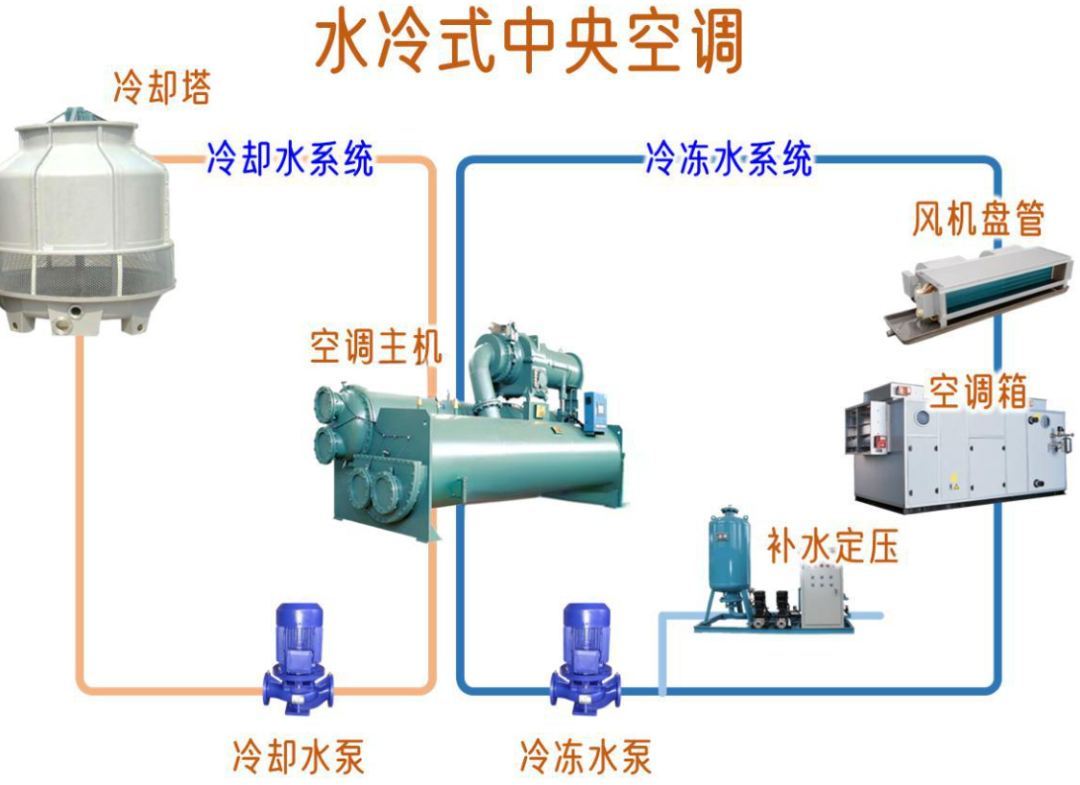
Typical composition of air conditioning units
A typical air conditioning unit is mainly composed of a chilled water circulation system, a cooling water circulation system, and a main unit, which work together to ensure the normal operation of the air conditioning system.
Chilled water circulation system
This section consists of a refrigeration pump, indoor fan, and chilled water pipeline. The low-temperature chilled water flowing out of the main evaporator is pressurized by the chilled pump and sent into the chilled water pipeline (outlet) before entering the room. Indoors, low-temperature chilled water exchanges heat with air, taking away the heat in the room. After completing the heat exchange, the temperature of the chilled water rises and finally returns to the main evaporator (return water). The function of an indoor fan is to blow air through the chilled water pipeline, accelerating the heat exchange between the air and the chilled water, thereby effectively reducing the air temperature and achieving rapid indoor cooling.
Cooling water circulation section
This section consists of cooling pumps, cooling water pipelines, cooling water towers, etc. In the process of indoor heat exchange in the chilled water circulation system, a large amount of indoor heat energy is taken away. These thermal energies are transferred to the cooling water through the refrigerant inside the host, causing an increase in the temperature of the cooling water. The cooling pump sends the heated cooling water into the cooling tower (outlet), where it undergoes sufficient heat exchange with the atmosphere. After the temperature drops, it is then sent back to the main condenser (return water), and this cycle is repeated to ensure the continuous and stable operation of the main engine.
host
The main unit is the core of the air conditioning water system, consisting of a compressor, evaporator, condenser, and refrigerant (refrigerant). The function of a compressor is to compress the refrigerant, causing its temperature and pressure to increase; The high-temperature and high-pressure refrigerant enters the condenser, exchanges heat with the cooling water, transfers heat to the cooling water, lowers its own temperature, and liquefies; After passing through the throttling device, the liquid refrigerant enters the evaporator, where it absorbs the heat of the chilled water and vaporizes, causing the temperature of the chilled water to decrease; The vaporized refrigerant is sucked into the compressor again, starting a new cycle. Through this series of processes, the host realizes the transfer and transmission of heat, providing the required cooling and heating capacity for the air conditioning system.
2、 The composition of water system and the role of key components
bleed valve
The function of the air release valve is to concentrate the air in the water circulation at a local location and automatically discharge it. In air conditioning systems, the presence of air can affect the normal operation of the system, leading to problems such as poor water flow, increased noise, and reduced heat transfer efficiency. The air release valve is generally installed at the highest point and local highest point of the closed water system, in order to timely and effectively discharge the air in the system and ensure the stable operation of the water system.
check valve
Check valves are mainly used to prevent medium backflow. In the air conditioning water system, the water pump is a key device that provides water flow power. When the water pump stops running, in order to prevent water from flowing back to the pump, causing problems such as pump reversal and equipment damage, a check valve needs to be installed in the outlet section of the water pump. Check valves can ensure that water flow can only follow the set direction, ensuring the safety and reliability of the system.
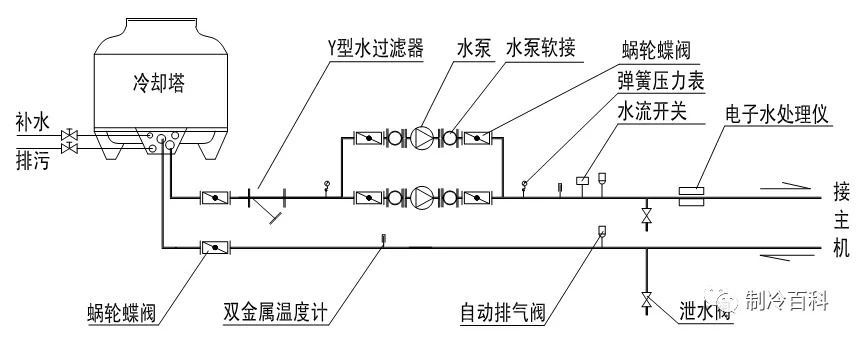
filter
During the installation of the air conditioning system, there may be some dirt such as mud and sand remaining in the water pipes; Meanwhile, during long-term operation, the water system will continuously produce some rust and other pollutants. If these impurities enter the heat transfer tubes of air conditioning equipment, it can lead to a decrease in heat transfer efficiency and even cause local blockages in the system, affecting its normal operation. Therefore, it is required to install water quality treatment devices such as filters at the water inlet of important equipment such as chillers and heat sources. Filters can effectively filter impurities in water, ensuring clean water entering the equipment and extending its service life.
Temperature controlled electric two-way valve or three-way valve
The temperature controlled electric two-way valve or three-way valve can control the temperature according to the load. In summer, when the room temperature is below the set value, the electric valve will automatically adjust or close to regulate the amount of water entering the fan coil unit, achieving the purpose of controlling the indoor temperature. In addition, the electric valve is interlocked with the fan power supply of the fan coil unit. When the fan coil unit stops using, the electric valve closes and stops supplying water, avoiding unnecessary energy waste.
expansion tank
Expansion tanks play two important roles in water systems. One is to collect the increased water volume due to the expansion of water heating volume, in order to prevent the system from being damaged due to excessive pressure. When the temperature of water in the water system increases, the volume of water will expand, and the expansion tank can accommodate this expanded water to ensure stable system pressure. The second is to have a constant pressure function. The connection point of the expansion tank is a constant pressure point, therefore, connecting the expansion tank to different positions within the system can change the pressure distribution within the water system. This is crucial for analyzing the pressure distribution of water systems in high-rise buildings, ensuring that the system can operate normally on all floors.
Water system instruments
In order to facilitate the debugging and operation management of the air conditioning system, it is required to install some necessary instruments in the water system. At the inlet and outlet of the main equipment, pressure measuring devices are generally required to understand the pressure distribution in the water system and the resistance of the equipment. By monitoring the pressure difference between the inlet and outlet of the equipment, it is possible to determine whether the equipment is operating normally and detect equipment failures in a timely manner. At the same time, temperature measuring devices should be installed at locations where water temperature changes, such as the inlet and outlet of cold and heat source equipment. The temperature measuring device can monitor changes in water temperature in real time, providing accurate data support for the operation and regulation of the system, ensuring that the system can operate at its optimal state.
water system valve
Valves installed in water systems generally have two functions. One is to play a regulating role, by adjusting the opening of the valve, the water volume in the pipeline can be controlled to meet the needs of different working conditions. For example, when the load changes in some areas, the water supply in that area can be adjusted by adjusting the valve to achieve energy-saving operation. The second is to have a shut-off function, such as using valves to shut off the corresponding pipelines during the transition of cold and heat sources in different seasons, or during equipment maintenance, to avoid mixing of different media or affecting maintenance work, ensuring the safe operation of the system and the smooth progress of maintenance.