-
E-mail
shouwang6368@126.com
-
Phone
18051034886
-
Address
No. 19, Tuanshan East Road, Lishui Economic Development Zone, Nanjing City
Nanjing Shouwang Machinery Equipment Co., Ltd
The golden rule for installing powder feeding machines, building the first line of defense for dust-free production
Date: 2025-09-29Read: 4
Powder feeding machineIt is a key equipment for achieving automated and sealed processing of powder materials. The installation quality is directly related to the stability, safety, cleanliness, and service life of subsequent production. A successful installation is not only about 'installing the equipment', but also the beginning of systematic engineering.
Here isPowder feeding machineKey details and technical points during the installation process:
1、 Preparation before installation: plan before action
On site investigation and layout planning
Confirm that the installation location has sufficient space and reserve channels for operation, maintenance, and overhaul (recommended front and rear ≥ 800mm, upper ≥ 1000mm).
Plan the lifting path for ton bags (operating radius of cranes or forklifts) to ensure safe and convenient lifting.
Clearly define the connection method and elevation between the feed and discharge ports and upstream and downstream equipment (such as silos and conveyors).
Infrastructure inspection
The ground is flat and sturdy, capable of bearing the full load weight of the equipment (including 2 tons of ton bags and the equipment's own weight).
Reserved power supply (usually 380V/220V, 50Hz), compressed air (0.4~0.7MPa, clean and dry) interface.
Confirm the position of the pipeline interface in the dust removal system to ensure smooth connection with the central dust collector or the built-in dust collector.
Open box inspection
Check the appearance of the equipment for any transportation damage.
Check if the accessory list (hooks, sealing rings, filter cartridges, control boxes, etc.) is complete.
2、 Installation core details: Four dimensional precise control
1. "Stable" - Equipment is securely installed
Horizontal calibration: Use a level to adjust the equipment base to ensure overall levelness (error ≤ 2mm/m), and prevent bag loading and chain wear.
Foot fixation: The equipment is firmly fixed to the ground through expansion bolts to prevent displacement or vibration during operation.
Strengthening support: For large or high-frequency equipment, it is recommended to install auxiliary support frames to enhance structural stability.
2. "Sealed" - The sealing system is tightly sealed and seamless
Clamp bag flange sealing: Check whether the sealing ring (usually silicone or fluororubber) is intact and free of distortion, and apply a small amount of silicone grease during installation to enhance sealing.
Pipeline connection sealing: Install sealing gaskets at all flange connections, tighten bolts diagonally and evenly to prevent powder leakage.
Dust removal interface sealing: Ensure that the dust removal pipeline is tightly connected, without any leakage points, and maintain a slight negative pressure in the system.
3. "Accurate" - precise and error free docking
Discharge port docking: Ensure that the discharge port of the feeder is aligned with the center of downstream equipment (such as spiral feed ports and hoppers) to avoid material spillage.
Height matching: Reasonably set the equipment height to allow materials to flow smoothly into lower level equipment, avoiding backflow or blockage.
Pneumatic/electrical interface: Connect the trachea according to the markings to avoid misconnection; Cable conduit protection, connected to control cabinet, reliable grounding.
4. "Cleanliness" - Cleanliness and Pollution Prevention
Internal cleaning: After installation, clean the welding slag, dust, and oil stains inside the equipment, especially the hopper, disc, and filter chamber.
Installation in a dust-free environment: When installing in a clean room, use dust-free tools to avoid introducing pollutants.
Material channel isolation: After installation, temporarily seal the inlet/outlet with blind plates or plastic film to prevent construction dust from entering.
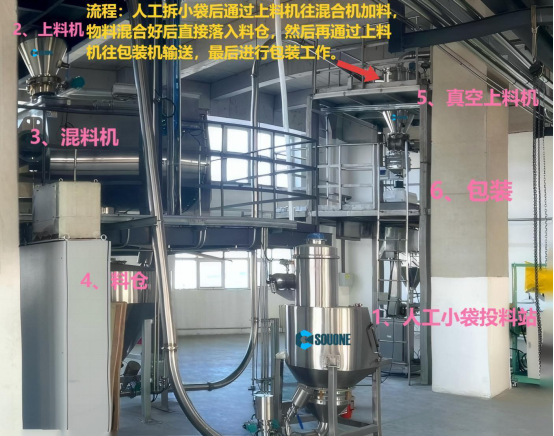
3、 Post installation commissioning and verification
No load trial operation
Perform a jog test to ensure smooth movements such as bag clamping, tapping, and lifting.
Check if the direction and speed of the cylinder action are normal.
Start the dust removal system and test the pulse blowback function.
load testing
Simulate the lifting, clamping, and opening process using empty ton bags.
Inject a small amount of material to test the smoothness of unloading and observe for any blockages or powder leaks.
Online control testing
Coordinate with downstream conveying system and central control system to test whether the start stop interlock and signal feedback are normal.
Verify the functions of formula calling, batch recording, etc. (such as with PLC control).
leak detection
Use foaming agents or dust detectors to check all interfaces to ensure no leaks.