-
E-mail
fengjunjie@noozle.com.cn
-
Phone
13918684639
-
Address
Building 4, 3255 Shengang Road, Songjiang District, Shanghai
Nuoze Fluid Technology (Shanghai) Co., Ltd
Comparative study of top-down and bottom-up methods in the preparation of micro nano suspensions
Date: 2025-09-15Read: 2
Comparative study of top-down and bottom-up methods in the preparation of micro nano suspensions
1、 Introduction
This article belongs to the special topic of micro jet homogenizer application, with a total of 6500 words. It will take about 20 minutes to read.
summary
This article systematically comparesTop down (micro jet homogenization method) and bottom up (ultrasonic precipitation method)The process characteristics and stability of preparing ibuprofen micro nano suspensions using two different techniques were evaluated, and the performance differences of various stabilizers (including SLS, PVP, Pluronic series, Tween 80, and different models of HPMC) were evaluated. Research has shown that the two methods perform similarly in terms of initial particle size and short-term stability, with HPMC stabilizers being more effective in reducing particle size and maintaining stability; The particle size of the microjet method is closely related to the solubility of the drug in the stabilizer, while the precipitation method relies more on the HLB value of the stabilizer. Solubility has been proven to be a key factor affecting the Ostwald ripening phenomenon and particle growth during storage. This study provides a theoretical basis for the rational selection of stabilizers under different process pathways.
keywords
Microfluidic homogenization; Precipitation; Nano suspension; Stabilizer; Solubility; Hydrophilic and oleophilic balance
2、 Overall framework
3、 Introduction
In recent years, the rapid development of high-throughput screening and combinatorial chemistry technologies has given rise to a large number of candidate drugs with high lipid solubility and low water solubility, and their low oral bioavailability has become the main bottleneck in formulation development. Nanosuspensions significantly increase the dissolution rate by increasing the specific surface area of drugs, providing an effective strategy for improving the delivery efficiency of poorly soluble drugs. This study used ibuprofen as a model drug and systematically compared the advantages and disadvantages of two methods for preparing nanosuspensions: top-down (microjet homogenization method) and bottom-up (ultrasonic precipitation method). The focus was on investigating the effects of different stabilizers on particle characteristics, stability, and Ostwald ripening phenomenon, in order to provide theoretical basis and practical guidance for the optimization of nanoformulation processes and rational design of stabilizers.
4、 Basic process
| feature | Bottom Up Approach | Top Down Method |
|---|---|---|
| method name | Ultrasonic precipitation method | Micro jet homogenization method |
| Basic Principles | Transforming drugs from a molecular stateprecipitateInto nanoparticles | Transform macroscopic large particlesCrushing and grindingInto nanoparticles |
| key steps | 1. The drug is dissolved in an organic solvent (acetone) 2. Inject organic phase into ice water phase containing stabilizer 3. Apply probe ultrasound treatment throughout the process 4. Vacuum removal of residual organic solvents |
1. The raw material is dispersed in an aqueous phase containing a stabilizer to form a crude suspension 2. High speed pre homogenization crushing of large agglomerates 3. High pressure circulation treatment of microjet instrument 4. Gradually increase the pressure to prevent blockage, and control the temperature of the circulating water bath |
| core elements | Solvent/anti solvent, ultrasound (promotes mixing and nanoization), stabilizer (inhibits crystal growth) | High mechanical energy (high pressure, high-speed collision), stabilizer (inhibits re aggregation), temperature control (avoids overheating) |
| Product formation mode | Drugs start from scratchbuildnanoparticle | Drug large particles aredecomposeFor nanoparticles |
5、 Data representation
| Characterization indicators | detection method | Key Details and Objectives |
|---|---|---|
| 1. Particle size distribution | Dynamic Light Scattering (DLS) | •Sample pretreatmentDilute with a 30% glycerol solution saturated with ibuprofen to prevent dissolution and change in particle size •Viscosity correctionMeasure the actual viscosity of the diluted sample and input it into the instrument to ensure accurate calculation •purposeObtain the average particle size and distribution width (X50, X99) of the particle population, and evaluate the nanomaterialization effect |
| 2. Zeta potential | Zeta Plus analyzer | •Sample pretreatmentThe same dilution method as particle size measurement ensures consistency •purposeMeasure the effective surface charge of particles and evaluate suspensionsElectrostatic stabilityA high absolute value (>| 30mV |) indicates that the system is more stable |
| 3. Solubility and drug loading capacity | HPLC analysis | •Sample pretreatmentHigh speed centrifugation separates undissolved drugs, and 0.1 μ m filter membrane filters the supernatant •analytical methodQuantification using USP NF 2006 standard HPLC •purpose: -solubilityDetermination of apparent solubility of drugs in different stabilizer solutions, analysis andOstwald ripeningThe association -drug loadingIndirectly evaluate the solid content of the system through initial dosage and solubility data |
6、 Results and Discussion
Ultrasonic precipitation method (bottom-up method)
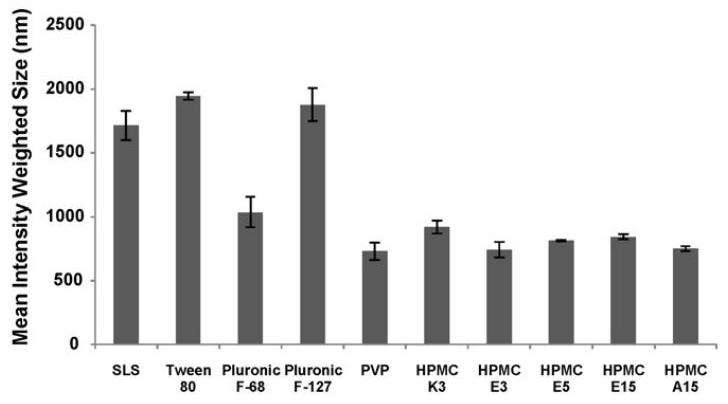
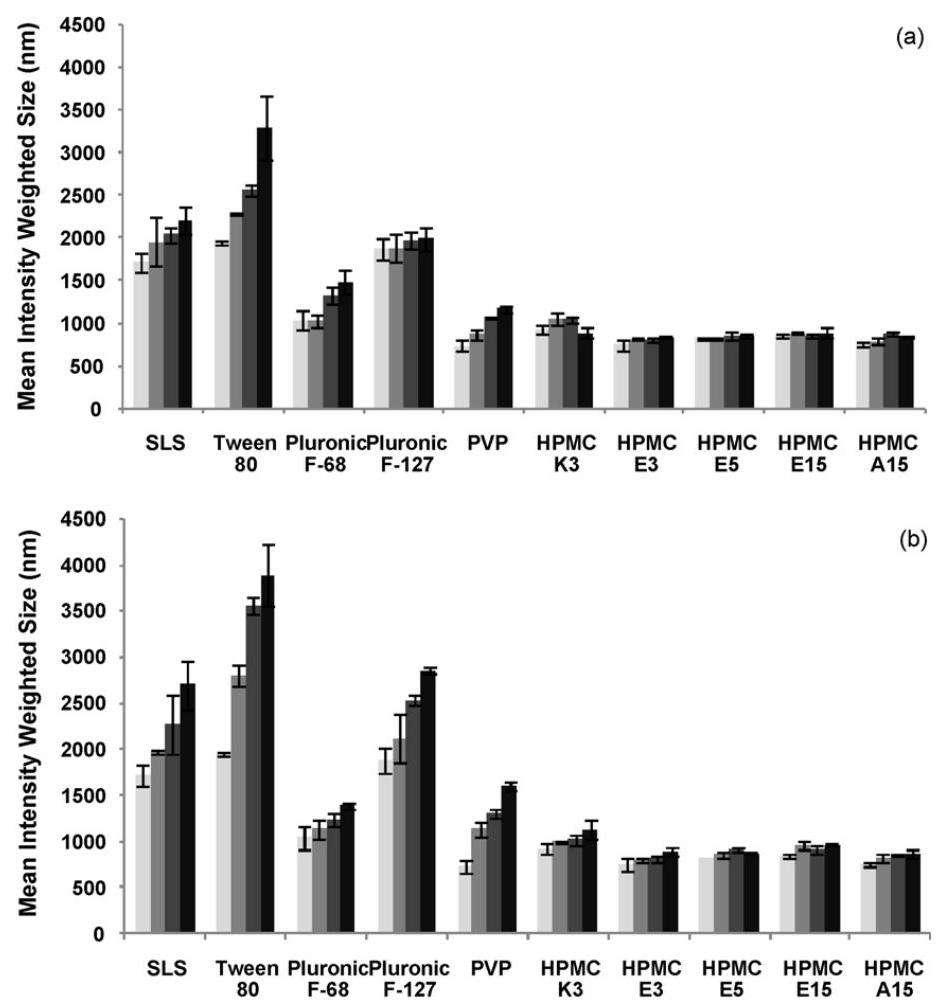
The ibuprofen suspension prepared by ultrasonic precipitation method mainly forms needle shaped particles, so it needs to be characterized by intensity weighted particle size distribution. The results showed that, except for a few HPMC samples, the average particle size of most stabilizer prepared particles was greater than 1 μ m (strictly speaking, it exceeded the nanometer range).
Among them, HPMC K3 performed the best, achieving a minimum average particle size of 702 ± 106 nm, while poloxamer F-68 had the worst effect, with an average particle size of 1282 ± 51 nm.
Distribution analysis shows that only HPMC stabilizers can stabilize a significant proportion (25%) of particles below 500 nm. The X50 values of all stabilizers are less than 1 μ m, and the X99 values are less than 5 μ m. This indicates that although this method can prepare micro scale suspensions, achieving true nano scale stability is still challenging. HPMC stabilizers exhibit excellent nano scale effects and stability capabilities.

Micro jet homogenization method (top-down method)
The ibuprofen suspension prepared by microjet homogenization method forms irregular particles, and its overall nano effect is better than that of ultrasonic precipitation method, with a smaller average particle size. Hydroxypropyl methylcellulose (HPMC) stabilizers showed the best performance, successfully reducing the particle size to below 1 μ m, and all HPMC formulations had X25 values less than 500nm. It is worth noting that suspensions prepared with sodium dodecyl sulfate (SLS), Tween 80, and Pluronic F-127 exhibited abnormal particle size increase, which is closely related to the high solubility of the drug in these stabilizer solutions, suggesting the possibility of Ostwald ripening. The results indicate that although the microjet method can effectively achieve nanomaterialization, the selection of stabilizers still needs to consider their impact on drug solubility to avoid particle growth, and HPMC exhibits excellent and stable performance in both methods.
Zeta potential
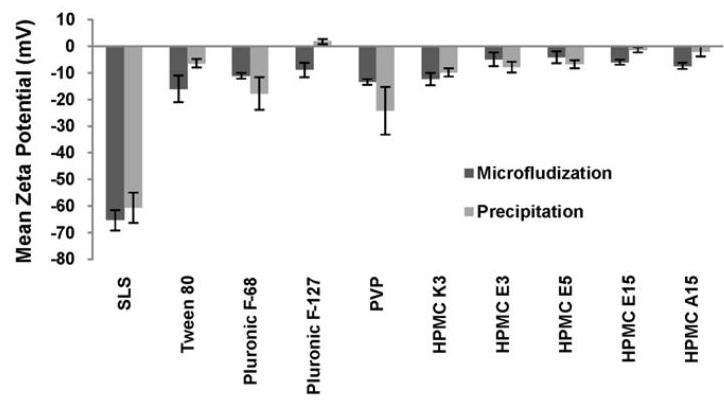
The two methods of preparing ibuprofen suspensions have similar Zeta potential characteristics, indicating that the surface charge characteristics of particles are mainly influenced by the type of stabilizer rather than the preparation process. Sodium dodecyl sulfate (SLS), as an ionic stabilizer, causes strong negative charges (-60.70 to -65.00mV) on the surface of particles, mainly through electrostatic stabilization mechanism; Non ionic stabilizers such as polyvinylpyrrolidone (PVP), poloxamer, Tween 80, and hydroxypropyl methylcellulose (HPMC) work through spatial stabilization mechanisms, with a narrow Zeta potential range (-25mV to+2mV). It is worth noting that HPMC stabilizers can effectively mask the negative charge of ibuprofen particles themselves (Zeta potential close to zero), proving that they form the most complete and compact adsorption layer, which is directly related to their best performance in stability studies.
Stabilizer effect
Hydroxypropyl methylcellulose (HPMC) exhibits excellent stability in both preparation methods. The methoxy hydrophobic groups in its molecules achieve strong adsorption through hydrophobic interactions with the surface of ibuprofen particles, while the hydrophilic segments extend into the aqueous phase to provide spatial stability. Research has found that the selection criteria for stabilizers vary depending on the preparation method: in the ultrasonic precipitation method, the stabilizer effect is positively correlated with its hydrophilic lipophilic balance (HLB) value (low HLB value is more favorable), while in the micro jet homogenization method, the stabilizer effect is closely related to the solubility of the drug in it (the lower the solubility, the better the effect). There is no clear correlation between surface energy, contact angle and stability effect, but the Zeta potential results indicate that HPMC can form the most complete surface coating, which is directly related to its stability performance. This study provides important basis for the rational selection of stabilizers under different preparation methods.
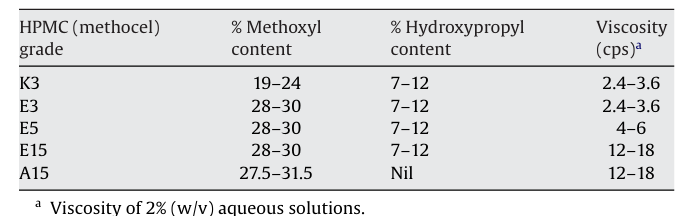
In order to determine the influence of stabilizer properties on the formation of ibuprofen micro/nano suspensions, various stabilizer properties were considered, such as their effects on interfacial tension, contact angle, ibuprofen solubility, surface energy, and hydrophilic lipophilic balance (HLB). Attempting to correlate the surface energy of drugs with the surface energy of various stabilizers to assist in the selection of nanosuspension stabilizers. However, no correlation was observed between surface energy and the ability to form nanosuspensions. Therefore, among these properties, only the HLB values of various stabilizers and their effects on the solubility of ibuprofen were further considered for comparison with the obtained particle size data.
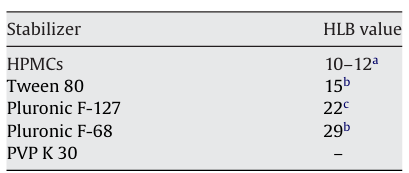 The table lists the HLB values of various non-ionic stabilizers used in the study. Cannot compare SLS because the HLB system does not determine the functionality of ionic surfactants. HLB is a measure of the hydrophilicity and lipophilicity of stabilizer molecules. The lower the HLB value, the stronger the lipophilicity of the stabilizer, and vice versa. Lipophilic (hydrophobic) molecules should exhibit a higher probability of interacting with hydrophobic ibuprofen particles, thereby achieving smaller particle sizes. In the case of using a bottom-up method to prepare the suspension, a positive correlation was obtained between particle size and non-ionic stabilizer HLB (Figure 4a). However, this correlation was not obtained for suspensions prepared using microjet homogenization method (Figure 4b)

The difference in the behavior of stabilizers under different processing conditions can be explained by some aspects of precipitation technology that are similar to the properties of lotion formation (HLB system is mainly developed for this purpose), because particles are formed from solution through phase incompatibility. However, HLB values are unlikely to play a dominant role in nanosuspensions prepared by microjet homogenization method. The particle size obtained by microjet homogenization method seems to be related to the solubility of ibuprofen in various stabilizer solutions (25 ° C) (Figures 5 and 6). The stabilizers (PVP K-30, Pluronic F-68, and HPMCs) that have the least impact on the inherent water solubility of ibuprofen (0.049 mg/ml) result in lower average particle size compared to stabilizers that significantly increase ibuprofen solubility (SLS, Tween 80, and Pluronic F-127).


storage stability
Storage stability studies have shown that hydroxypropyl methylcellulose (HPMC) based formulations can maintain particle size stability for 7 days under both 4 ° C and 25 ° C conditions, while suspensions prepared with other stabilizers exhibit varying degrees of particle size growth. Sodium dodecyl sulfate (SLS), Tween 80, and poloxamer F-127 significantly increase the solubility of ibuprofen, and their particle size growth is mainly due to the Ostwald ripening mechanism; However, polyvinylpyrrolidone (PVP K-30) and poloxamer F-68 aggregate due to incomplete surface coverage. Research has found that high temperature (25 ° C) significantly accelerates unstable processes, while HPMC exhibits both low solubilization effect and excellent spatial stability, thus demonstrating the best storage stability. This result demonstrates that inhibiting Ostwald ripening and achieving complete surface coverage are key factors in ensuring the stability of the nanosuspension.



VI. Conclusion
Both top-down and bottom-up processes provide similar initial formulations with comparable short-term stability.
The HLB value of stabilizers can assist in the selection of stabilizers for the bottom-up (ultrasonic precipitation) process, as this process is mainly a variant of emulsification technology.
In the top-down (micro jet homogenization) process, the solubility of the drug in the stabilizer solution plays a dominant role.
There is a relationship between the solubility of drugs in stabilizer solutions and the observed particle size stability during storage for formulations made by two processing methods. This means that Ostwald ripening plays an important role in the stability of nanosuspensions. Therefore, when preparing nanosuspensions, only stabilizers with minimal/negligible impact on drug solubility should be used.
The spatial stabilization effect of HPMC is sufficient to stabilize ibuprofen micro/nano suspensions for 7 days, thus providing sufficient preparation time for further processing of formulations.
The data indicates that HPMC molecules interact well with the surface of ibuprofen, resulting in optimal surface coverage. This may be the main reason for its excellent performance in stability research. However, further research is needed to investigate the specific interaction between HPMC and ibuprofen to confirm this hypothesis.
References
[1] Verma S , Gokhale R , Burgess D J . A comparative study of top-down and bottom-up approaches for the preparation of micro/nanosuspensions[J]. Int J Pharm, 2009, 380(1-2):216-222.DOI:10.1016/j.ijpharm.2009.07.005.
Integrated solution for micro jet homogenization treatment