-
E-mail
mike@sgnprocess.com
-
Phone
13681679740
-
Address
No. 900 Zhudai Road, Zhuqiao Town, Jiading District, Shanghai
Shanghai Sijun Machinery Equipment Co., Ltd
The structural principle of nanoscale disperser
Date: 2025-07-16Read: 8
The structural principle of nanoscale dispersers is mainly based on two core technologies: high-speed mechanical shearing and ultrasonic cavitation, corresponding to different core structures and mechanisms of action:
1、 Mechanical cutting type disperser
1. Core structure
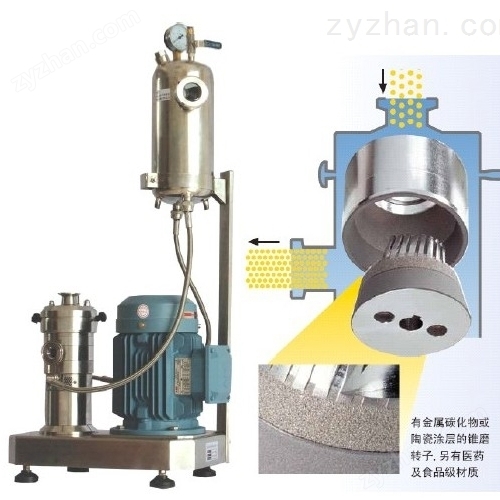
Composed of a high-speed rotor stator system, the rotor is typically equipped with three-stage serrated dispersing discs or grinding heads, and the stator is designed with an adjustable gap groove structure. By driving the rotor through a motor (with a maximum speed of 14000rpm), a strong shear force is generated within a narrow gap of 0.2-0.3mm (with a shear rate of 200000 S ⁻¹). The material undergoes a triple action of shear, centrifugal compression, and liquid layer friction between the rotor and stator, achieving a step-by-step crushing of particles from coarse to fine.
2. Mechanism of action
Shear fragmentation: The high-speed rotating dispersing disk generates turbulent zones, which directly destroy particle aggregates through mechanical force;
Step by step refinement: In the three-stage dispersion tray, the first stage crushes large particles, the second stage refines to the micrometer level, and the third stage completes nanoscale dispersion;
Energy transfer: By precise gap control, the energy transfer efficiency is maximized to ensure sufficient contact between particles and the medium.
2、 Ultrasonic disperser
1. Core structure
The core is an ultrasonic transducer that can generate high-frequency vibration waves of 28-132kHz. Some devices integrate microfluidic channels, combined with ultrasonic generators and temperature control modules.
2. Mechanism of action
Cavitation effect: High frequency vibration forms microbubbles in liquid, and the collapse of bubbles instantly generates local high pressure (up to 1000atm) and microjet, which strongly peels off nano aggregates;
Sound flow mixing: Ultrasonic waves push the fluid to form vortices, enhancing the uniformity of particle and medium mixing;
Microfluidic collaboration: Within microchannels, cavitation bubbles collide with particles at high frequencies to achieve efficient nanoemulsification.
3、 Composite design innovation
Some devices integrate two types of technologies:
1. Mechanical ultrasonic composite: such as graphene disperser, which peels off the graphite layer by high-speed shearing, and then refines it into a single layer of graphene through ultrasonic cavitation;
2. Vibration dispersion assistance: The three-dimensional high-frequency vibration device drives the grinding ball to impact the particles, combined with dispersant coating to prevent re aggregation.
4、 Key structural optimization
1. Material selection: The stator is made of 316L stainless steel or ceramic material, which is corrosion-resistant and meets GMP standards;
2. Gap adjustment: The distance between the stator and the rotor can be precisely adjusted to meet the dispersion requirements of materials with different viscosities;
3. Sealing design: Double end mechanical seal prevents leakage and supports online cleaning and sterilization.
This type of structural design achieves efficient de aggregation and stable dispersion of nanoparticles by focusing on energy density and action accuracy, and is widely used in fields such as new materials and biomedicine.